
Ever feel like you’re playing chess while everyone else is playing checkers? Welcome to the world of modern competitive play. Here, intuition alone gets you nowhere fast.
These digital assistants, like PokerTracker and Hold’em Manager, are more than scorekeepers. They’re your personal data butlers. They record every move and share opponents’ secrets through real-time HUD displays.
I’ve seen more players think these tools are cheating than I’ve seen bad beats on a Sunday night. The truth is, they’re intellectual equalizers. They turn raw hand histories into actionable intelligence.
This isn’t about memorizing cards—it’s about understanding patterns. The software builds databases that let you study tendencies. You can spot leaks and increase your win rate.
Whether you’re a multi-tabling maniac or a casual player, understanding this technology is key. It’s like discovering fire while everyone else is rubbing sticks together.
Choosing the Best Tool
Choosing your best poker HUD is like picking between a scalpel and a laser beam. Both cut, but one is precise, the other might blind you. I’ve spent hours looking at PokerTracker and Hold’em Manager, and it’s not just Coke vs. Pepsi. It’s like choosing between two smart but quirky professors who promise to make you smarter.
Both platforms offer free trials because they know you’ll pay after seeing your opponents’ stats. This is a big advantage for a small price, about three microstakes buy-ins.
Before installing, play at least 1,000 hands first. Using a HUD too early is like giving kindergarten flamethrowers. It’s messy and not good.
The poker world has changed a lot with tracker acceptance. Some sites, like GGPoker, don’t allow trackers. But PokerStars and 888poker welcome them.
Test both platforms during their trials. The one that doesn’t hurt your brain after hours of playing is the best. The best poker HUD makes complex data easy to understand, not requiring a cryptography degree.
| Feature | PokerTracker 4 | Hold’em Manager 3 | Ideal For |
|---|---|---|---|
| Initial Cost | $99 | $99 | Serious players |
| Free Trial | 30 days | 30 days | New users |
| Learning Curve | Moderate | Steep | Tech-savvy players |
| Customization | Extensive | Extensive | Advanced users |
| Site Compatibility | Wide range | Wide range | Multi-site players |
These tools do more than just record your hands. They build your poker brain. For more details, check our comprehensive tracker comparison guide.
Your choice between PokerTracker and Hold’em Manager depends on what you prefer. Both will make you better. Both are worth the cost if used right. The only wrong choice is not using them when you’re ready.
Key Features (HUD, Hand History, Analysis)
Welcome to the poker laboratory where numbers speak louder than chatbox bravado. Your tracking stats online poker software turns raw data into psychological profiles. It’s like having a CIA team watching your poker table.
HUD Poker Meaning
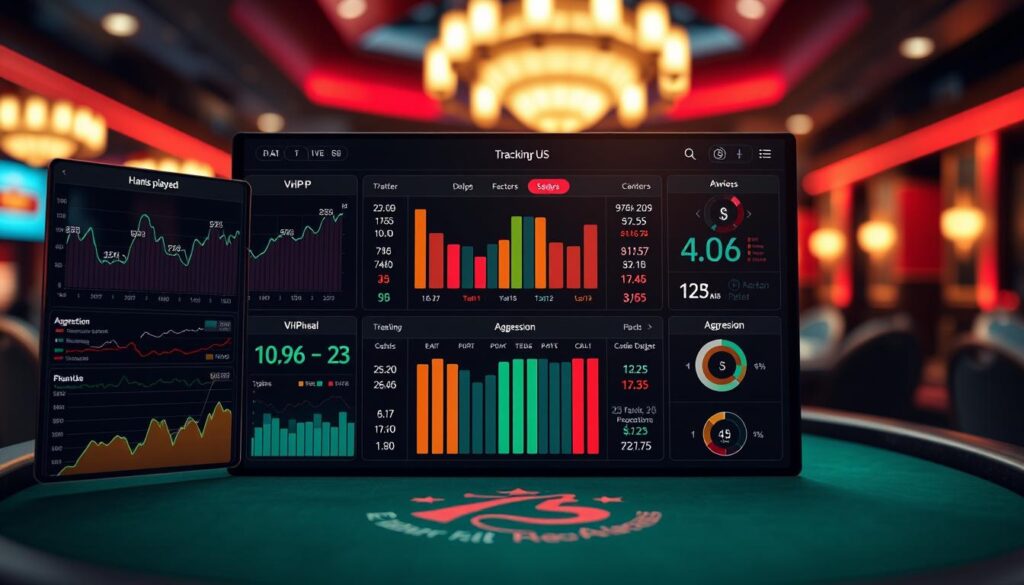
A HUD (Heads-Up Display) is your real-time intelligence dashboard. It shows player statistics right on your poker table. These numbers come from past hand data, giving you quick insights without needing to be a detective.
When you mix these stats with actual gameplay, magic happens. But remember, small samples can be misleading. Trust patterns over outliers.
VPIP % (voluntarily put money in pot)
VPIP shows how often someone enters the pot. A 90% VPIP is like buying every infomercial product. A 10% VPIP might fold pocket aces preflop “just to be safe.”
PFR % (Preflop Raise)
PFR reveals aggressive tendencies. High PFR players are aggressive, always raising. The gap between VPIP and PFR shows passive calling behavior. A big gap means they call too much.
3b (three-bet) %
Three-bet statistics show who’s aggressive and who’s bluffing. A 3% three-bettor only raises with strong hands. Higher frequencies mean they’re bluffing or desperate.
F3 (Folds to 3-bets) %
This stat shows who folds under pressure. High F3% players fold easily when faced with re-raises. They’re perfect targets for aggressive three-betting.
AG (Aggression Factor)
AG measures bet/raise frequency versus checking/calling. A 0.5 AG player is very passive. A 6.0 AG player is extremely aggressive, making opponents nervous.
WTSD % (Went to Showdown postflop)
WTSD reveals showdown tendencies. High percentages mean players need to see cards like reality TV fans need drama. Low percentages suggest weak-tight players who fold easily.
CB (Continuation-bets as the preflop raiser)
CB stats measure post-flop aggression. High CB% players bet aggressively post-flop. Low percentages mean they’re cautious, only betting when they connect.
2B (Second barrel as preflop raiser)
The second barrel shows who keeps the pressure on. High 2B% players maintain aggression across multiple streets. They’re relentless like salespeople.
FCB (Folds to C-bets) %
This stat identifies who folds to initial pressure. High FCB% players fold easily to continuation bets. They’re easy targets for aggression.
F2 (Folds to Second barrel)
F2 measures resilience against sustained pressure. Players with high F2% percentages fold to second barrels easily. They can’t handle aggression on multiple streets.
Mastering these tracking stats online poker metrics turns your game into strategic warfare. Tools like PokerTracker 4 make analysis easy for everyone.
Remember, stats are tendencies, not truths. Use them as guides, not gospels. The best players combine data with observation. Sometimes, the numbers don’t tell the whole story.
Translating Stats Into Strategy
Your poker tracking software is like a treasure map. But, you need to learn how to read it. Raw numbers are useless without a strategy. The real magic is turning those stats into winning moves.
Start with your non-showdown winnings. If they’re all over the place, you might be c-betting too much. I once folded top pair to a min-raise out of habit. The solution? Play more hands in position and stop c-betting too much.
Choosing the right table is easier with data analysis. Big wins often come from bad players. Use database filters to analyze your game.
First, check your early position stats. If they’re similar to your overall play, you’re losing money. Look at three-bet pots from the blinds. Are you winning or losing? Compare your win-rates to successful players to find strategy gaps.
Here’s how to turn stats into winning moves:
- Redline repair: Reduce c-bets in multi-way pots by 20-30% against passive opponents
- >Position mastery: Increase hands played in late position by 15-25%
- Table selection: Use win-rate filters to identify profitable player types
- Blind defense: Analyze three-bet success rates from different positions
The best poker tracking software shows you patterns. Study your win-rate against different opponents. Analyze your performance in various stack depths. Review hands with tough river decisions.
Remember, stats without strategy are just numbers. Your software gives you the evidence. You need to be the detective who solves the case. The difference between winning and losing often comes down to understanding your numbers.
Start with small changes based on your worst stats. Track these changes over 10,000 hands. Keep making adjustments. That’s how you dominate with data.
Common Pitfalls
Even the best poker tracking software can be a problem if used too much. I’ve seen many players rely too heavily on small data sets, only to lose big. They ignore the bigger picture for a quick win.
Playing too many tables at once can make your HUD useless. Folding to every c-bet while playing twelve tables? Your win rate will drop fast. The best software can’t help if you’re not paying attention.
Using stats the wrong way is another big mistake. Thinking an opponent folds too much to c-bets? They might not on certain boards. Trying to bluff players who call too much is like teaching a goldfish calculus. It’s pointless and sad. You need to understand the context of your stats, not just the numbers.
The worst mistake is marking hands as mistakes but never checking them. It’s like buying a gym membership just to use the locker room. Your software should help you learn, not just record your errors. Always use your live reads and don’t just rely on stats.
Leave a Reply