

Let me confess something: I’ve pushed chips across smoky felt and clicked bets on digital tables. The difference goes far beyond physical versus virtual.
Online play changes the game of deception. Gone are the nervous ticks and sideways glances that reveal everything in live games.
Instead, we enter a mathematical chess match. Your avatar’s poker face never cracks. Timing tells replace physical tells. Patterns override intuition.
We’ll explore how even artificial intelligence struggles with this concept. ChatGPT’s hilarious poker failures show fundamental misunderstandings about deception.
The digital environment demands a new approach. Your moves must become more algorithm than gut feeling. Welcome to bluffing in the digital age.
When to Bluff
Timing your bluff is like telling a joke at a funeral – get it wrong, and you’re the one who looks ridiculous. The digital poker arena demands precision timing that would make a Swiss watchmaker jealous. Unlike live games where you can read tells, online play requires a more mathematical approach to your digital bluff strategy.
So when exactly should you pull the trigger? The answer lies in three key factors that separate profitable bluffs from donation bets.

First, consider board texture. Does the flop connect with your opponent’s likely range? If the board shows 9-10-J and you raised pre-flop, your story makes sense. You could have Q-K or even a set. But bluff a dry 2-7-3 rainbow board? You might as well announce “I’m bluffing!” in the chat.
Second, analyze your opponent’s range weakness. Did they check-call the flop and turn? They’re likely weak. Did they min-raise from the button? They might be testing you. The best bluffs attack uncertainty and weakness simultaneously.
Third, pot odds matter more than ego. If you’re betting ⅔ pot on the river, you’re giving your opponent 2.5:1 odds to call. They need to be right only 28% of the time. Make the math work against them.
Continuation Betting: The Workhorse Bluff
The continuation bet remains the bread and butter of online bluffing. You raised pre-flop – now follow through! As noted in expert micro-stakes strategy, c-bets work well against single opponents on disconnected boards.
But don’t become predictable. Mix up your c-bet sizing based on board texture. Smaller bets on dry boards, larger bets on wet boards. Keep your opponents guessing.
Semi-Bluffing: The Beautiful Compromise
Semi-bluffs represent the perfect marriage of aggression and insurance. You bet with both fold equity and hand equity. Flush draws, straight draws, even backdoor draws can become powerful semi-bluff opportunities.
The beauty? Even if called, you might improve. It’s like having a backup plan while trying to steal the pot.
| Bluff Type | Success Rate | Risk Level | When to Use |
|---|---|---|---|
| Continuation Bet | 55-65% | Low | Heads-up on flop |
| Semi-Bluff | 45-60% | Medium | With 8+ outs |
| Pure Bluff | 25-40% | High | River against tight players |
| Overbet Bluff | 30-50% | Very High | Polarized ranges only |
Remember what “Applications of No-Limit Hold’em” teaches us: theoretically sound poker means bluffing in spots where your story makes sense. Your betting pattern should tell a consistent narrative from pre-flop to river.
The analytical frameworks from “Expert Heads Up No Limit Hold’em” emphasize opponent-specific adjustments. Against calling stations, bluff less. Against nitty players, bluff more. It’s not rocket science – it’s pattern recognition.
Ultimately, successful bluff timing comes down to reading situations, not people. The digital felt reveals different tells than live games. Bet patterns, timing tells, and frequency stats become your new tells.
Master these elements, and you’ll transform from bluffing clown to strategic maestro. The difference between comedy and tragedy? About three seconds of thought before clicking “bet.”
Table Image in Online Play
Forget about your poker face – in digital poker, you’re just a collection of data points. Your table image isn’t about intimidating stares or fancy watches. It’s about the story your betting patterns tell.
Online, you’re not a person – you’re a statistic. Opponents categorize you as fish, shark, or something in between based on cold, hard numbers. The art lies in consciously crafting this perception.
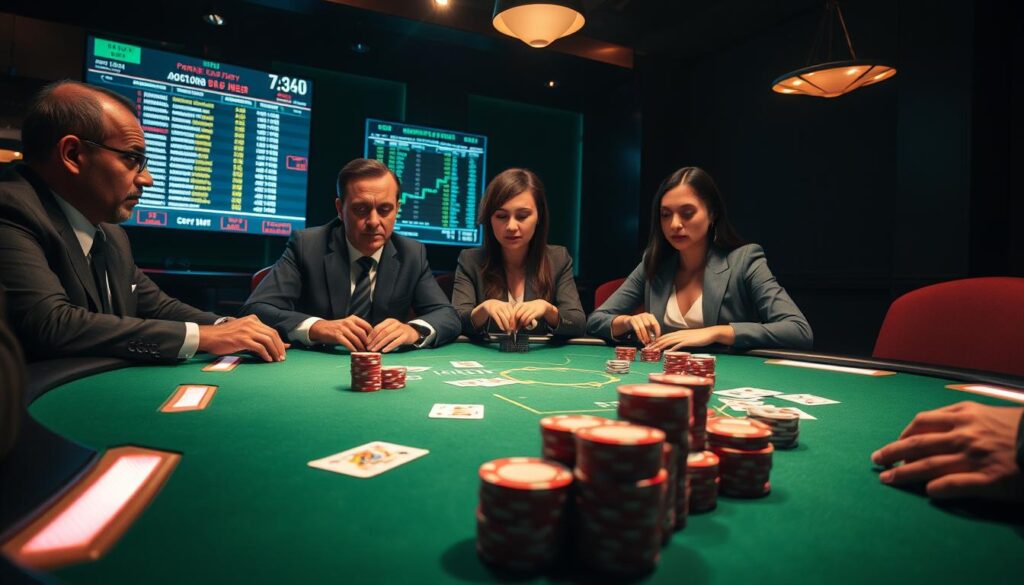
How do you balance appearing predictable enough to get action on strong hands while maintaining enough mystery to make bluffs work? It’s like being an author writing multiple novels simultaneously.
Your betting sizes become your vocabulary. Consistent patterns create expectations. Suddenly changing your bet sizing tells a different story. It’s psychological warfare through mathematics.
Hand selection transparency (or lack thereof) shapes your narrative. Playing too many hands? You’re the loose cannon. Too tight? You’re the nit everyone avoids. The sweet spot lies in calculated unpredictability.
Timing patterns matter more than you think. Instant calls suggest strength or weakness? Rapid folds indicate discipline or fear? These micro-decisions paint your portrait.
The real challenge comes with multi-tabling. You’re not managing one table image – you’re juggling multiple parallel identities. Each table sees a different version of you.
| Player Type | Betting Pattern | Table Image | Bluff Success Rate |
|---|---|---|---|
| Tight Aggressive | Consistent raises | Strong & predictable | High when deviating |
| Loose Passive | Frequent calls | Weak & unpredictable | Low overall |
| Balanced Player | Mixed sizing | Mysterious | Consistently medium |
As Barry Greenstein notes in “Ace on the River,” the psychology extends beyond statistics. Your digital persona needs depth. It needs a backstory opponents can believe in.
Tommy Angelo’s “Elements of Poker” reminds us that profitability lives beyond pure math. Your table image creates opportunities mathematics alone cannot calculate.
The best online poker bluffing strategies work because they’re built on consistent narratives. Your bets tell stories. Your folds create mysteries. Your raises build legends.
Master this, and you’re not just playing cards – you’re directing a theatrical production where every opponent is both audience and critic.
Board Texture Analysis
Forget squinting at opponents across the table – in online poker, your most valuable read comes from the five community cards staring back at you. Your digital bluff strategy lives or dies by how well you interpret what the board is screaming about everyone’s possible hands.
The flop is like the opening scene of a play. A coordinated board (like 8♥9♥10♦) screams drama – everyone could have something. This is where your digital bluff strategy needs nuance. Tight players might fold medium pairs here, while loose players will chase any draw. You’re not reading faces; you’re reading possibilities.
The turn card is the plot twist that separates the heroes from the fools. Did a fourth heart hit when three were already there? Congratulations – your bluff just became exponentially harder against anyone with a brain. But when that turn card is a beautiful, glorious brick (say, a 2♦ on a K♥Q♣7♠ board), it’s like finding an unlocked door in a heist movie.
This is where advanced turn texture analysis separates the pros from the amateurs. That brick card didn’t help anyone’s obvious draws, making it the perfect moment to represent the hand that actually improved – the made hand that was already strong.
River cards are the final verdict. They either complete the story your betting has been telling or expose it as fiction. A third club on the river when you’ve been betting aggressively? You might actually have the flush now. Or you might be bluffing into someone who just made their hand.
Your digital bluff strategy requires understanding what these cards mean in context. A coordinated board means more possible strong hands exist. A disconnected board means fewer natural holdings make sense. It’s chess, not checkers – every card changes the entire equation.
Ask yourself these questions on every street:
- What draws just got there?
- What hands would have bet the way my opponent did?
- Does this card help my story more than theirs?
The beauty of online play is that you can apply this digital bluff strategy systematically across multiple tables. While live players rely on gut feelings, you’re building mathematical models in real-time. It’s the difference between reading tea leaves and reading satellite imagery.
Remember: in digital poker, the board doesn’t lie. It might not tell the whole truth, but it never bluffs. Your job is to listen to what it’s saying and craft your story. That’s the essence of sophisticated digital bluff strategy – becoming both the author and critic of the narrative unfolding on the felt.
Balancing Bluffs and Value Bets
Finding the right mix between truth and lies in online poker bluffing is more than just guessing. It’s about using math to create a perfect balance. This balance makes your opponents unsure whether to fold or call.
Your bluffing should match the odds of the pot you’re betting on. This creates a beautiful balance that keeps everyone guessing.
The key ratio is about 2:1, with value bets to bluffs on many river spots. But, the size of the stack changes these numbers. Short stacks need simple plays, while deep stacks allow for more tricks.
At times, you need to break from GTO balance to outsmart your opponents. If they always call, bet value. If they fold too much, bluff more.
Being good at online poker bluffing means making your moves seem random but logical. Your value bets win because your bluffs earn respect. It’s a constant dance – adjust your moves based on your opponents’ mistakes, but keep your own rhythm.
Leave a Reply