

Have you ever wondered about your real chances of winning a hand? Modern digital tools provide clear answers. These applications analyze known cards and simulate thousands of possible outcomes.
They compute the exact probability of winning, tying, or losing. This moves the game away from guesswork. It introduces a layer of calculated risk assessment.
For any player, understanding this math is a game-changer. It transforms decisions from hunches into data-driven choices. This knowledge directly impacts long-term success at the table.
Our guide will walk you through everything. You will learn how to use these powerful tools effectively. We will also show you how to interpret the results you get.
Key terms like equity and pot odds will be explained in simple language. These concepts are central to solid strategy. Mastering them is essential for serious players.
While this technology offers powerful insights, it is a learning aid. It is designed to complement your skill and experience. The ultimate goal is to build your own strategic intuition.
We will cover step-by-step instructions and advanced applications. Get ready to deepen your understanding of the game’s mathematical core.
What Are Poker Odds Calculators?
At their essence, these tools translate unknown variables into clear percentage-based insights. They are specialized software applications or online platforms. Their primary function is to perform complex probability math instantly.
Manual computation of every possible card combination is impractical. This technology handles that immense workload in milliseconds. It provides a snapshot of your current standing in a hand.
Fundamentally, an odds calculator acts as an equity simulator. It determines the share of the pot your specific holding is projected to win. This is based on all known cards and the range of possible future community cards.
Advanced algorithms power these simulations. A common method is the Monte Carlo simulation. This technique runs through millions of random, possible board runouts.
Each simulated scenario is tallied as a win, loss, or tie for the entered hands. The final output is presented as simple percentages.
The basic inputs required are straightforward:
- Your hole cards (and optionally, suspected opponent holdings).
- The current community cards on the board.
- Any known dead cards that are out of play.
With this data, the software generates its analysis. You receive three key figures: win percentage, tie percentage, and total equity. This data forms the core of a strategic assessment.
These applications are versatile. You can use them for pre-flop analysis to compare starting hand strength. They are equally valuable on the flop, turn, or river to reassess your position.
While most popular for Texas Hold’em, these tools adapt to other variants. Versions exist for Omaha, Stud, and more. They adjust their calculations to match different rules and hand-ranking structures.
A major benefit is the removal of emotional bias. The results are purely mathematical. This objectivity helps you focus on long-term expected value, not short-term outcomes.
For learners, these programs serve as a crucial educational bridge. By repeatedly seeing the probabilities, you begin to internalize them. Over time, you can estimate equity and pot odds intuitively during live play.
For any serious competitor aiming to refine their approach, this technology is indispensable. It transforms vague guesses into precise, data-driven decisions. Mastering its insights is a key step toward consistent profitability.
How Poker Odds Calculators Work: The Math Behind the Tool
Behind the simple percentage output is a sophisticated engine that simulates every conceivable way a hand can finish. Its primary job is to map the vast landscape of possible future cards. This process transforms a situation of uncertainty into a clear statistical picture.
You start by telling the application what you know. This includes your hole cards, any visible community cards, and suspected opponent holdings. The software instantly identifies the remaining deck composition.
It then faces the task of evaluating what can happen next. Two main computational methods handle this heavy lifting. The choice between them balances speed with perfect accuracy.
- Exhaustive Enumeration: This method is used for simpler scenarios. It calculates every single possible board combination from the remaining deck. The result is a 100% mathematically exact answer, leaving no room for estimation.
- Monte Carlo Simulation: For complex multi-way pots, this is the preferred technique. The program randomly deals the unknown cards thousands or millions of times. Each random deal is one possible future scenario, or “runout.”

The Monte Carlo method provides a highly reliable approximation. The law of large numbers ensures that with enough trials, the results converge on the true probability. This is ideal when calculating every combination would take too long.
Implicit in these simulations is the concept of “outs.” These are the cards left in the deck that can improve a holding to the best hand. The software doesn’t just count them; it tests their effectiveness against all other possible cards your opponent might hold.
For every simulated board, the engine performs a crucial task. It compares the final five-card hands for all players involved. The assignment is based strictly on standard hand-ranking rules for the variant you’re playing.
Each scenario is tallied as a win, loss, or tie for your specified hand. After running through all possibilities—either exhaustively or via sampling—the tool aggregates the data.
The final output is straightforward. Win Percentage equals (Wins / Total Trials). Tie Percentage equals (Ties / Total Trials). Your total equity in the pot is Win% + (Tie% / 2).
Input accuracy is paramount for precise results. If you know an opponent’s exact cards, input them. If you don’t, advanced tools allow you to input a range of hands they might have. This provides a more realistic, weighted average of your chances.
Some applications let you add “dead cards.” These are cards you know are out of play, like exposed or folded cards. Factoring these in refines the remaining deck composition. This further sharpens the accuracy of the probability math.
You can trust the reliability of these applications. They are not making guesses. Their outputs are grounded in solid combinatorial mathematics and proven statistical sampling techniques.
This rigorous approach removes emotional bias from your decision-making. It provides a objective snapshot of your strategic value at any point in a hand. Understanding this process helps you interpret the results with greater confidence.
How to Use a Poker Odds Calculator: A Step-by-Step Guide
The power of these applications is unlocked through correct setup, beginning with defining who is at the virtual table. The process is interactive and intuitive. Following a clear sequence ensures you get accurate, actionable data every time.
This walkthrough covers the essential steps for any standard online tool. You will learn to input data correctly and interpret the feedback. Let’s start from the beginning.
Step 1: Input Player Hands
Begin with a blank virtual table. Most programs let you add between two and nine participants. Select the number that matches your real or hypothetical scenario.
Next, assign hole cards to each player. Click on a visual deck interface to select two specific cards for every seat. Be precise here, as this forms the foundation for all subsequent calculations.
You can input your own holding and, if known, an opponent’s exact cards. For a more general analysis, you might assign a likely range of hands to other players. This first step defines the starting point of the simulation.
Step 2: Set the Community Cards
Now, inform the tool about the shared board. Click to input the flop, which consists of three cards. The software will instantly update the winning chances for every hand entered.
As the hand progresses, add the turn (one card) and then the river (one card). The program recalculates probabilities after each new piece of information. This mirrors how your strategic assessment should evolve during actual play.
Step 3: Add Dead Cards and Adjust
For maximum accuracy, use the optional dead card feature. These are cards you know are out of play, like from folded hands or a dealer burn.
Adding them refines the composition of the remaining deck. This leads to more precise probability math. The interactive nature of the tool is a key benefit.
You can click on any card at any time to remove or replace it. This allows for powerful “what-if” scenario testing. See how your equity changes if the river card were different, for instance.
Step 4: Review and Analyze the Results
Once all data is entered, review the instantly generated analysis. Results are typically shown in a clear table or graphic format.
You will see three key percentages for each active hand: win, tie, and total equity. These numbers represent your projected share of the pot. This data is the core insight for your next decision.
Use this information to assess the strength of your holding. Compare it against the pot odds being offered. This combination is the bedrock of profitable strategy.
For best practices, use the tool to review hands from your past sessions. Input the exact cards to understand the equity you had in key moments. This turns experience into concrete learning.
Avoid common input errors, like assigning the same physical card to two different players. Good applications will flag this, but staying careful prevents confusion.
The more you practice with this technology, the more intuitive it becomes. You will start to internalize equity dynamics and probabilities. This builds the mathematical skills needed for long-term success in the game.
Understanding Win, Tie, and Equity Percentages
Interpreting the numbers from a simulation requires a clear grasp of what each percentage truly represents. The software provides three core figures that define your standing in a hand. Mastering their meaning is essential for making informed choices.
Let’s break down each metric:
- Win Percentage: This shows how often a specific holding is projected to be the outright winner at showdown. It counts all possible future board runouts where your cards finish as the best. For example, a 65% win rate means you are favored in about two out of every three scenarios.
- Tie Percentage: Also called a chop, this figure represents runouts where two or more participants end with hands of equal rank. The pot is split in these cases. A high tie number often signals a potential split-pot scenario, like competing flush draws.
- Hand Equity: This is the most crucial number. It is calculated as Win% + (Tie% / 2). Equity represents your hand’s fair share of the current pot based on its chance to win or tie.
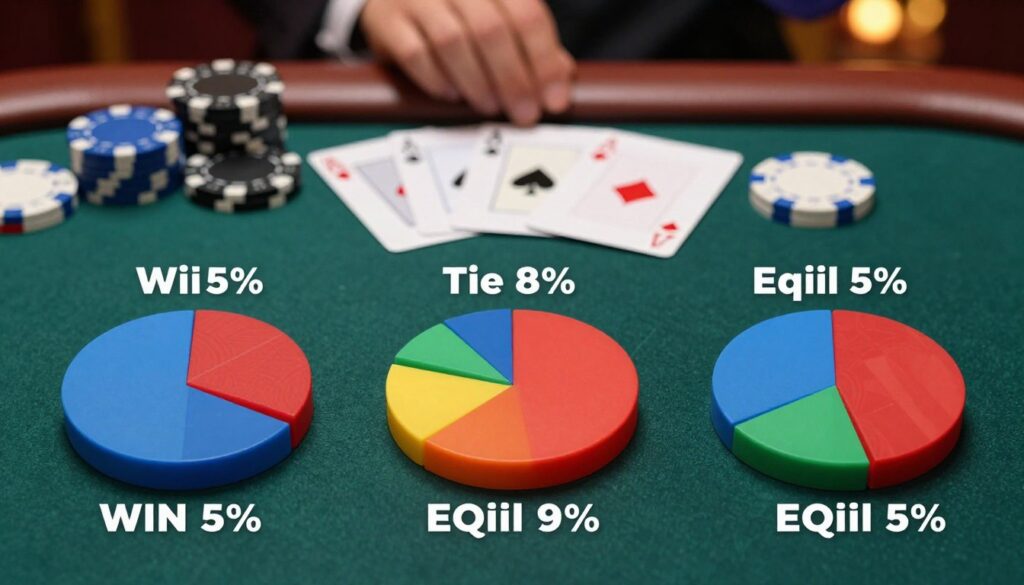
Consider a practical example. If your holding has a 70% win and 5% tie chance, its equity is 70% + (5%/2) = 72.5%. On average, you are entitled to 72.5% of the pot’s value.
These percentages are never static. They change with every new community card revealed. A powerful pre-flop hand can see its equity drop dramatically after an unfavorable flop. Continuous reassessment is key.
How should you use these figures? A high win percentage indicates you are a strong favorite. A significant tie percentage warns of a potential split. Your total equity is the number to compare against the pot odds being offered.
It is vital to remember that equity is an expectation, not a guarantee for a single hand. It describes what should happen over thousands of identical situations. Understanding this concept is central to managing variance.
Not all percentage differences are equal. A 52% versus 48% equity situation is essentially a coin flip. In contrast, an 80% versus 20% edge shows a dominant favorite. Your decisions should reflect the magnitude of the advantage.
Ultimately, mastering these percentages allows you to make mathematically sound calls, folds, and raises. This analytical approach forms the foundation of a profitable, long-term strategy. It moves your game from guesswork to calculated decision-making.
The Strategic Benefits of Using an Odds Calculator
Beyond simple number generation, these applications offer profound benefits for long-term development. They transform raw data into actionable insights that elevate your entire approach. This strategic edge is what separates casual participants from serious competitors.
The most immediate impact is on decision-making. By providing instant equity calculations, the tool removes guesswork. You can make calls, folds, and raises based on cold, hard math rather than gut feeling.
This leads to more consistent and profitable choices at the table. Your moves become grounded in expected value. Over time, this discipline builds a much stronger foundation for your game.
Off the table, the software is a powerhouse for strategy development. You can test how different starting hands perform against various opponent ranges. This builds a data-backed pre-flop plan tailored to your style.
Knowing the exact probabilities also provides a significant confidence boost. It reduces hesitation and second-guessing during play. Decisive and timely actions can themselves become a strategic advantage.
For newcomers, this technology acts as a powerful educational accelerator. It visualizes equity, helping beginners understand why certain holdings are strong or weak. This fast-tracks the learning curve dramatically.
The tool is perfect for deep scenario analysis. Recreate tricky spots from your sessions and input different assumptions. See which line would have been most profitable, turning losses into valuable lessons.
It even offers guidance for bluffing situations. By understanding your hand’s equity and the board texture, you can better identify moments with a high chance of success. This is based on calculating opponent fold equity.
Consistent use helps internalize critical odds. You begin to estimate pot odds and equity mentally during live play. This improved intuition is a direct result of repeated analytical practice.
Importantly, using these applications for post-session review is universally accepted. It is encouraged even on platforms that ban real-time assistance. This makes it a safe and effective way to study.
The strategic benefits compound over time. They transform a recreational player into a thoughtful, analytical competitor focused on long-term value. Embracing this tool is an investment in your fundamental skills.
Applying Calculator Insights: Pot Odds and Hand Equity
Raw percentages from a simulation become actionable strategy when combined with a fundamental concept: pot odds. This section connects the dots between your tool’s output and the real-time math needed at the table.
Mastering this integration is what separates theoretical knowledge from profitable application.
Calculating and Comparing Pot Odds
Pot odds are the ratio between the total money you can win and the amount you must risk to call. They tell you the price the pot is offering.
Here is the simple formula: Pot Odds = (Total Pot Size) : (Amount to Call).
First, find the total pot. This includes all chips in the middle plus your opponent’s latest bet. Then, look at the cost of your call.
For example, the pot is $100. Your opponent bets $50. The total pot is now $150. You must call $50.
Your pot odds are $150 to $50. This simplifies to a 3:1 ratio.
To use this with your equity percentage, convert the ratio. Divide the call amount by the total pot after your call.
Required Equity % = Call Amount / (Total Pot + Call Amount).
In our example: $50 / ($150 + $50) = $50 / $200 = 0.25, or 25%.
This means you need at least a 25% chance to win to break even on that call. Use this quick-reference table for common bet sizes:
| Bet Size (% of Pot) | Equity Needed to Call |
|---|---|
| 25% (1/4 pot) | 16% |
| 50% (1/2 pot) | 25% |
| 75% (3/4 pot) | 30% |
| 100% (pot-sized bet) | 33% |
The Relationship Between Equity and Pot Odds
The core principle for a profitable call is straightforward. Your hand’s equity must exceed the required equity from the pot odds.
Let’s continue the example. The pot odds require 25% equity. You check your poker odds calculator.
It shows your current holding has a 30% chance to win. Your equity is higher than the price.
This indicates a profitable call in the long run. You are getting good value for your risk.
If your equity were only 20%, a fold would be the correct mathematical play. This objective comparison removes guesswork.
Remember, equity is your share of the pot based on all possible future cards. Pot odds are the cost of buying that share.
When the share is worth more than its price, you buy it. This is the foundation of value-based decision-making.
Using Key Odds and Outs Charts
Often, your equity comes from a draw—a hand that needs improvement. The cards that help you are called outs.
Memorizing common draw scenarios speeds up your analysis. You can estimate equity without a tool during play.
Here is a key reference for common draws in Texas Hold’em:
- Flush Draw (4 cards of one suit): 9 outs. ~35% equity on the flop to hit by the river.
- Open-Ended Straight Draw (8 possible cards to complete): 8 outs. ~31% equity on the flop.
- Gutshot Straight Draw (4 possible cards to complete): 4 outs. ~16% equity on the flop.
- Overcards (hoping to pair a high card): 6 outs. ~24% equity on the flop.
A simple “rule of 2 and 4” helps. On the flop, multiply your outs by 4 to estimate your river equity percentage. On the turn, multiply outs by 2.
For a flush draw (9 outs) on the flop: 9 x 4 = approximately 36%. This matches the chart above.
Combine this with pot odds. If you have a flush draw (~36% equity), you can call a bet that requires less than 36% equity.
Advanced players also consider implied odds. This accounts for extra money you might win on future streets if you hit your draw.
Reverse implied odds consider the cost if you hit but still lose. Basic calculators show raw equity without these factors.
Your strategic skill lies in adjusting the basic math with these deeper considerations.
Ultimately, marrying calculator-derived equity with instant pot odds analysis is a fundamental skill. It turns draws into calculated investments and value bets into precise instruments.
Practice this integration off the table to make it automatic during play.
Poker Odds Calculators for Different Game Variants
The utility of probability tools isn’t limited to a single style of play. They adapt to the unique rules of various poker variants.
Specialized applications exist for all major formats. These include Texas Hold’em, Pot-Limit Omaha (PLO), and Omaha Hi-Lo.
Other supported games are Seven-Card Stud and Razz. Each format requires a uniquely configured equity simulator.
The core difference lies in the input requirements. In Texas Hold’em, you enter two hole cards per participant.
For Omaha games, you must input all four hole cards. The software then evaluates the best two-card combination from that set.
This rule makes Omaha analysis more complex. The sheer number of possible two-card combos from four hole cards is significant.
It dramatically affects the final equity calculations. A tool designed for this format handles this internal math correctly.
Stud calculators operate on a different principle. They must account for visible upcards and uniquely known dead cards.
The simulation and input process differs from community card games. You track which cards are live throughout the hand.
While equity and pot odds principles remain constant, the strategic insights change. In Omaha, nut hands and redraws are paramount.
A good tool highlights these scenario-specific advantages. It provides insights relevant to that game’s winning strategy.
It is crucial to use a variant-specific application. A Hold’em calculator used for Omaha will produce incorrect results.
The rules governing hand formation are not the same. This leads to faulty probability math and poor decisions.
Some advanced universal tools allow switching between game types. They automatically adjust the hand evaluation algorithm.
The input requirements update based on your selection. This offers great flexibility for players who enjoy multiple formats.
When using a dedicated PLO equity calculator, input all four hole cards for each player. The application will correctly find the best two-card hand from each set.
It simulates the remaining board runouts under Omaha rules. This provides the most accurate strategic snapshot.
Always choose the analytical software tailored to your game of choice. It delivers the most precise and relevant insights for that format.
This ensures your practice and study translate directly to improved performance at the tables.
Conclusion
To truly elevate your play, integrating data-driven insights into your strategy is non-negotiable. Modern analytical tools demystify the game’s mathematics. They provide clear win, tie, and equity percentages.
Master the simple process: input hands and community cards. Receive instant, accurate probabilistic feedback. This bridges the gap between guesswork and informed action.
The core strategic duo is hand equity and pot odds. Comparing these figures guides profitable calls and bets. Consistent off-table practice builds intuitive skills.
Remember, these applications are powerful supplements. They enhance, but do not replace, experience and psychological reads. Use them to review hands and test new approaches.
Start using a reputable tool today. Transform your understanding and build a foundation for long-term success. Make every decision count.
Leave a Reply