
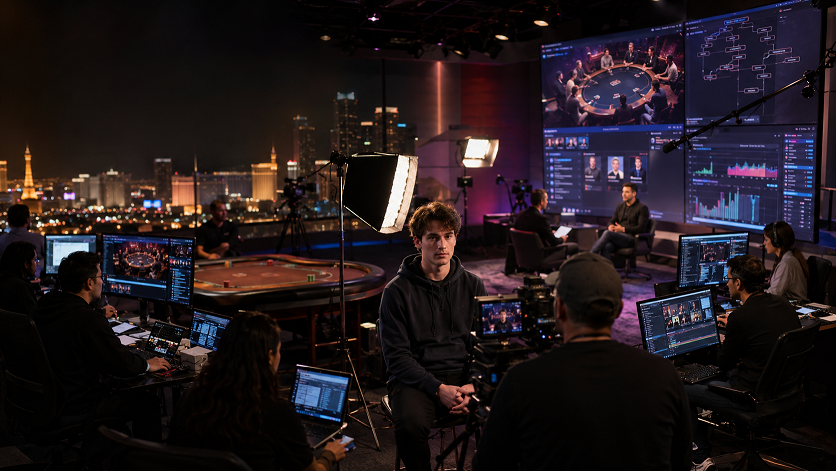
The 2026 World Series of Poker Main Event has reached the point where nine poker players become more than tournament competitors. Between the final table being set on July 14 and play resuming on August 3, broadcasters, poker platforms, social channels, gaming communities, and content creators have almost three weeks to turn each finalist into a recognizable digital personality.
That pause changes how audiences experience poker. The final nine emerged from a field of 9,208 entries at Horseshoe and Paris Las Vegas, creating a prize pool of roughly $85.6 million. Every finalist is guaranteed at least $1 million, and the eventual champion will receive $10 million and the Main Event bracelet.
Those numbers supply the scale, but personalities give the event its digital reach. The group includes a 22-year-old chip leader, established bracelet winners, online poker specialists, business owners, analytical professionals, and recreational players from several countries. Their backgrounds create the character arcs that poker video games, livestreams, documentaries, podcasts, social clips, and interactive broadcasts need to hold attention beyond the cards.
The Final Table Now Has A Built-In Content Window
In recent editions, the WSOP Main Event moved quickly from the final nine to the champion. The 2026 schedule introduces a longer break after the final table was formed, bringing back some of the anticipation once associated with the November Nine format without waiting several months.

The final nine are scheduled to return to Las Vegas from August 3 through August 5. According to the official WSOP final table schedule, ESPN2 will carry the opening session on August 3, followed by ESPN coverage on August 4 and August 5. Edited programming is scheduled to begin August 10.
That gap gives each player time to become a story. Interviews can explain how they learned poker, what they do away from the table, which hands defined their tournament, and how they plan to handle the biggest televised session of their career. Fans can study chip counts, watch previous hands, follow player accounts, and discuss possible outcomes across forums and social platforms.
Poker has always produced memorable personalities, but the modern content cycle processes those personalities differently. A televised player introduction may become a YouTube profile, a reaction clip, a podcast segment, a short-form vertical video, and a discussion thread within hours. A single major hand can be reconstructed through animation, hand-history graphics, commentary, and poker-game simulations.
The final-table delay makes that process part of the event rather than a retrospective exercise. The tournament is paused, but the story remains active.
Nine Players Offer Nine Different Digital Character Arcs
The final table is led by Lucas Jumalon of Spokane, Washington, with 194 million chips. Jumalon is 22 and entered the Main Event with less than $200,000 in recorded live tournament cashes. His lead is large enough to make him the immediate central character, yet his limited experience on poker’s biggest stage keeps the result uncertain.
Rami Hammoud of Montreal sits second with 79 million. Hammoud works as an analytics manager for a Roblox studio and studied actuarial mathematics at Concordia University. That connection between professional analytics, game development, and tournament poker gives digital gaming outlets an unusually direct angle. His profile can appeal to readers interested in how game systems, probability, data interpretation, and poker decision-making overlap.
The remaining finalists supply contrasting stories:
| Finalist | Country | Starting Chips | Digital Content Angle |
|---|---|---|---|
| Lucas Jumalon | United States | 194,000,000 | Young chip leader facing a career-defining stage |
| Rami Hammoud | Canada | 79,000,000 | Roblox studio analytics manager and satellite qualifier |
| Jamie Shaevel | United States | 56,000,000 | Business owner making his 18th Main Event appearance |
| Greg Mueller | Canada | 48,500,000 | Former professional hockey player and three-time bracelet winner |
| Michael Gagliano | United States | 46,500,000 | Online poker specialist with three bracelets |
| Mario Boos | France | 44,000,000 | First-time Main Event entrant pursuing a historic French victory |
| Lauri Saaskilahti | Finland | 37,500,000 | Semi-professional player balancing poker, work, and family |
| Han Feng | United States | 25,000,000 | Texas-based tournament winner with a strong mid-major record |
| Evagoras Evagorou | Cyprus | 22,500,000 | Optician and part-time player visiting the United States for the first time |
The detailed WSOP finalist profiles show how varied the group is. Greg Mueller brings decades of tournament experience and three bracelets. Michael Gagliano built much of his reputation online before winning bracelets in both online and live events. Jamie Shaevel is a Santa Monica business owner playing his 18th Main Event. Evagoras Evagorou is an optician from Cyprus who reached the final table during his first trip to the United States.
A strong poker video game would treat those differences as more than biography text. They resemble the character classes found in competitive games: the inexperienced leader, the analytical outsider, the veteran champion, the online specialist, the persistent amateur, and the short stack attempting a comeback.
Poker Video Games Can Learn From Real Player Identity
Many poker games reproduce the rules of Texas Hold’em successfully but struggle to reproduce the human identity that makes a major tournament compelling. Digital tables can display cards, chips, timers, betting actions, and tournament standings. They often lack the emotional and narrative context surrounding those systems.

The 2026 Main Event offers a model for stronger career modes. A poker game could track a character’s origin, qualification path, previous finishes, preferred formats, rivals, public reputation, and changing expectations. Reaching a final table would then affect more than an in-game currency balance. It could unlock interviews, sponsorship decisions, invitations, training opportunities, media pressure, and new tournament routes.
Real finalists show why those layers matter. Gagliano’s history as an online player is different from Mueller’s background in professional hockey. Hammoud’s analytical work at a Roblox studio creates another identity. Shaevel’s long record of Main Event appearances gives him a persistence storyline that cannot be represented by a single skill rating.
Poker communities already interpret players through these details. Readers comparing reactions on social channels, livestream chats, and Best Casino Forums are often discussing personalities, memorable decisions, broadcasts, and the wider casino culture surrounding an event rather than reviewing a hand in isolation.
Game developers can use that behavior as a design signal. Players may respond more strongly to an evolving career story than to a basic sequence of anonymous tournaments. Real-world poker demonstrates that people remember who made the decision, what was at stake, and how the moment changed that player’s reputation.
Broadcast Graphics Are Moving Closer To Game Interfaces
Modern poker coverage already shares several features with competitive video games. Viewers receive chip counts, hole-card information, pot sizes, player positions, action histories, elimination consequences, and tournament standings through a screen-based interface.
The information must be delivered quickly without overwhelming the audience. That is the same user-experience problem faced by poker video games. A clean interface needs to explain the current state of play, reveal meaningful changes, and maintain visual focus on the people making decisions.
The WSOP’s move to live coverage across ESPN, ESPN2, Eurosport, TNT Sports, and limited international YouTube markets broadens the number of viewers encountering these systems. Someone who rarely plays poker can still follow the chip leader, identify the short stack, and understand that an all-in decision may alter the final table.
This creates a feedback loop between broadcasts and games. Television graphics borrow the clarity and pacing of esports interfaces. Poker games borrow camera angles, commentary styles, player introductions, table lighting, and dramatic pauses from televised events.
Future poker titles could go further by offering broadcast modes built around viewer participation. Audiences might compare decisions after a hand, review alternate lines, follow a selected player’s tournament path, or switch between table and career statistics. Such features should explain strategy without implying that any decision guarantees a financial return.
Social Clips Turn Individual Hands Into Playable Stories
The most reusable unit of poker content is no longer an entire tournament session. It is the individual hand.
A major confrontation can be compressed into a short clip showing the preflop action, community cards, pot development, player reactions, and final result. Longer videos can then examine the same hand through probability graphics, commentary, or recreated scenarios.
That structure is naturally compatible with poker games. A game can turn a real hand into a challenge: play the position, choose an action, and compare the decision with what occurred at the table. The value lies in understanding the situation, not in claiming that the historical result proves one universal strategy.
Jumalon’s huge chip lead creates an immediate library of potential content. Viewers want to know how he accumulated 194 million chips and how that stack changes the pressure on every opponent. PokerGO has already published coverage centered on the hands behind his rise, showing how rapidly a tournament storyline can become a separate digital product.
The National Council on Problem Gambling remains a relevant reference when poker content crosses from entertainment into real-money play. Recreations, simulations, and strategy discussions should distinguish between learning game mechanics and expecting predictable financial results. Poker outcomes involve hidden information, opponent behavior, and variance, even when a player makes a sound decision.
The Final Nine Can Reach Audiences Beyond Traditional Poker Fans
The range of backgrounds at the 2026 final table gives publishers several ways to reach audiences who may not follow tournament poker every week.
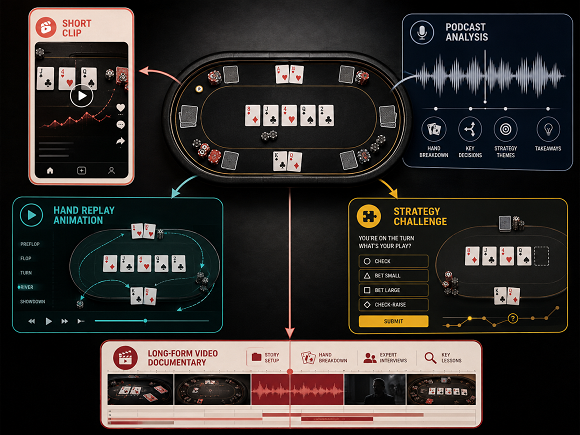
Hammoud’s work in the Roblox ecosystem connects the event with game development and analytics. Gagliano’s interest in video games and experience consulting for online poker sites supports stories about digital platform design. Mueller’s professional hockey history can attract sports audiences. Jumalon’s age and sudden rise fit creator-led platforms built around emerging personalities.
This does not mean every finalist needs to become an influencer. The larger point is that digital distribution allows the tournament to be presented through several lenses at once. One viewer may care about strategic decisions. Another may follow the technology behind online poker. A third may respond to the personal journey of an amateur reaching a guaranteed seven-figure payout.
The 9,208-entry field gives those stories additional weight. The final nine represent roughly one-tenth of 1% of the original field. That scale can be communicated visually through elimination maps, tournament trees, interactive timelines, and progress systems familiar to video game players.
Such presentations can make poker easier to follow without reducing it to casino promotion. They explain how difficult the tournament is, how different players arrived at the same table, and why the final sessions matter.
Why The 2026 Final Table Matters For Poker Game Design
The 2026 WSOP Main Event final table shows that poker content is strongest when rules, personalities, data, and presentation work together.
The cards create uncertainty. The chip counts establish the competitive state. The prize structure raises the stakes. The player profiles give the audience a reason to care which decisions follow. Broadcast and social platforms convert those elements into content that can travel far beyond the casino floor in Las Vegas.
For poker video games, the lesson is clear. Accurate rules and realistic tables are only the foundation. Stronger titles need characters with histories, career consequences, recognizable tournament stages, useful broadcast tools, and stories that develop from one event to the next.
When play resumes on August 3, the final nine will compete for the bracelet and the $10 million first prize. Long before the first card is dealt, they will have spent weeks becoming digital characters in the eyes of the audience. That transformation may be one of the most revealing developments surrounding this year’s Main Event.
Leave a Reply