

Poker isn’t about reading souls – it’s about understanding positions. New players often try to bluff and read others like in improv. But, Nathan “BlackRain79” Williams shows that winning at microstakes is more about strategy than showmanship.
Playing 7♠8♠ from the button is more important than your poker face. It’s like Survivor, where weak hands get eliminated early. Williams’ approach makes starting hand selection simple and effective, like decluttering your cards.
This isn’t about memorizing charts. It’s about knowing why certain hands work in specific situations. To avoid being the Jenga tower of your game, focus on math and muscle memory. This way, you can play smart, even when it’s tempting to slow-play aces.
What Makes a Good Strategy?
Think of poker strategy like assembling IKEA furniture. If you ignore the instructions, you’ll end up with something that looks like success but falls apart. A good poker strategy isn’t about memorizing hand charts. It’s about understanding why stealing blinds is more important than your cousin’s “hot streak” at Friday night games.
Let’s look at two big strategies:
- Botfeld’s “Play Better Cards” Doctrine: This is like only swiping right on 10/10 profiles. It’s about playing tight, with premium hands, and avoiding marginal spots.
- Williams’ Initiative Framework: This strategy is all about aggression. It turns position into power, making opponents fold quickly.
When Nathan’s 3-bet theories meet Amanda’s RFI charts, you get a powerful strategy. The magic is in the mix of these approaches:
| Strategy | Strength | Weakness |
|---|---|---|
| “Premium Hands Only” | Reduces costly mistakes | Misses bluffing opportunities |
| “Constant Aggression” | Maximizes fold equity | Increases variance |
The best strategy is a mix of both. Think of it like a Swiss Army knife. Position is key, acting last is an advantage. Add selective aggression, and you’ll get value like Netflix gets subscribers.
Here are three poker strategy tips for beginners:
- Treat position like real estate – late position is the best
- Balance your ranges like a nutritionist balances macros
- Adjust faster than a thermostat in a heatwave when opponents show patterns
The goal isn’t to play perfect poker. It’s to make fewer mistakes than others. That’s how you turn “learning poker strategy” into a cheat code.
Pre-flop Planning
Forget Iron Thrones – in poker, your seat at the table is key. It decides if you’ll win or lose. Pre-flop strategy is like chess, but with a medieval twist.
Starting Hands Selection
Botfeld’s 15-20% rule is not just a tip. It’s like a rule for your chips. Think of strong hands as filet mignon and weak ones as bad sushi. Our pre-flop strategy guide explains it all:
- Top Shelf: Pocket pairs (TT+), Broadway cards (AK, AQ)
- Happy Hour Special: Suited connectors (89s+) in late position
- Last Call: Offsuit gappers (Q7o) – just say no
Table Position
If poker were high school, UTG would be the hall monitor. The button would be the kid with a fake ID. Williams’ positional ranges show:
| Position | Playable Hands | Win Rate Impact |
|---|---|---|
| UTG | Top 12% | +2.1bb/100 |
| Button | Top 28% | +7.8bb/100 |
Early positions need tight play, like a submarine. Late positions are your chance to play big, like a hedge fund manager at a yard sale.
Understanding Pot Odds
Think pot odds are just for math geeks? Think again—they’re your secret weapon for avoiding bad bets. They help you make smart choices faster than Netflix cancels shows. Let’s make pot odds simple, even for those who hate math.
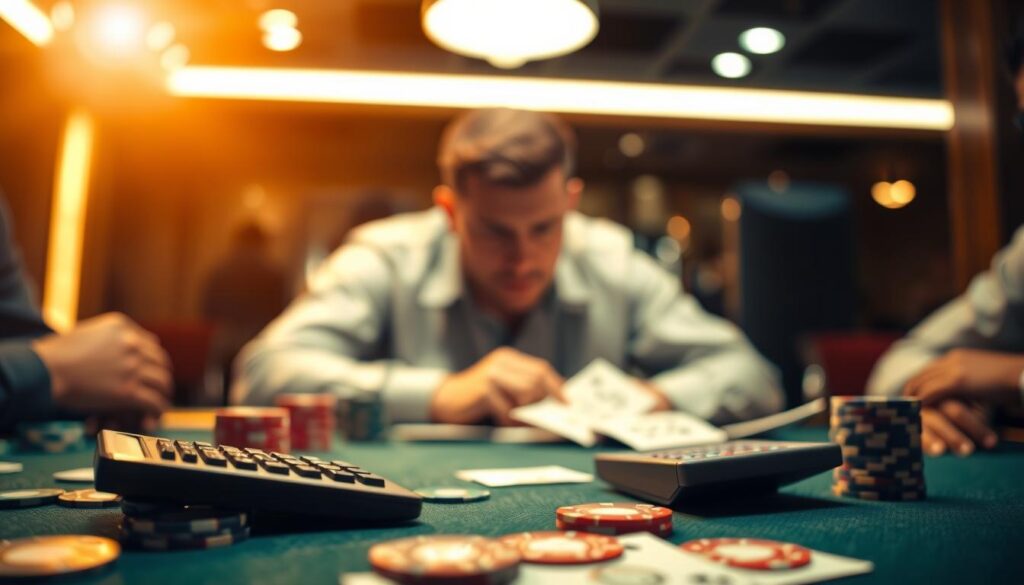
Here’s the truth: pot odds compare what’s in the pot to what it costs you to stay. Imagine facing a $50 pot with a $10 call. Your odds are 5:1, like finding a designer shirt at thrift store prices. The magic happens when you match these odds to your hand’s chance of improvement.
Let’s look at common scenarios:
| Situation | Outs | Equity Needed | Smart Play |
|---|---|---|---|
| Flush Draw | 9 | 35% | Call if pot odds > 4:1 |
| Straight Draw | 8 | 31% | Raise to manipulate odds |
| Overpair | 2 | 8% | Fold unless pot’s juicy |
| Gutshot | 4 | 16% | Check unless bluffing |
Pro tip: Use pot odds with poker hand rankings knowledge. Chasing a gutshot with 16% equity? Only worth it if the pot’s huge. Good Texas Hold’em tips mix math and madness.
Williams’ continuation bet strategies work well here. Bet enough to make opponents’ pot odds bad. This makes their draws costly.
Final thought: Pot odds aren’t about complex math. They’re a reality check against poker’s tempting odds. Use them to let only profitable situations in.
Tight vs. Loose Play: Which Wins for Beginners?
Poker strategies range from strict rules to complete freedom. For beginners, the choice between tight and loose play is huge. It’s like deciding between Batman’s rules and the Joker’s wild ways.
Tight play is like chess, with careful moves and known outcomes. Loose play is like Calvinball, where rules change often. Beginners need to learn the basics before trying to be too flexible.
| Tight Play | Loose Play | |
|---|---|---|
| Hand Range | Top 15% of starting hands | Bottom 40% of starting hands |
| Bluff Frequency | 5-10% of hands | 25-40% of hands |
| Win Rate Stability | +3.5 BB/100 (low variance) | -8 BB/100 (extreme swings) |
| Skill Requirement | Basic math + discipline | Advanced reads + adaptability |
Imagine playing with KJo from early position. Tight players fold most hands. Loose players call with weak hands “for fun.” The flop is J-8-3 rainbow.
- Weapon: Value bet against weaker jacks
- Suicide Note: Bluff magnet for sets/two-pairs
Loose play requires a lot of risk awareness. Can you tell when KJo becomes a bad play? Stick to the basics until you’re ready for more.
Three reasons tight strategies are better for beginners:
- Reduces complex post-flop decisions by 60%
- Minimizes tilt-inducing bad beats
- Builds foundational skills for future aggression
Phil Ivey’s success took 20 years. Start with the basics before trying advanced moves.
Post-Flop Fundamentals
The flop is more than just a card turn. It’s where beginners often fold quickly. We’ll explore how post-flop play makes a difference, using “initiative ownership” and avoiding too many continuation bets.
Your A3o looked great before the flop, but now it’s not so good. This is where common beginner mistakes in poker can become big problems. These mistakes include overvaluing weak aces and not understanding the board texture well.
BlackRain79 has three key rules for surviving:
- C-bet like a sniper, not a shotgunner (Botfeld’s ghost approves)
- Match aggression to board texture – dry boards are museums, not mosh pits
- Use your poker hand chart as a compass, not handcuffs
Continuation bets work 47% of the time on A-high boards, says GTO. But betting too much can be costly. Think of c-bets like Netflix – cancel them if they’re not working immediately.
Let’s look at two important spots using a poker hand chart:
| Board Texture | Your Hand | Smart Play |
|---|---|---|
| K♠7♦2♥ (Dry) | A♥J♣ | C-bet 66% pot |
| Q♥8♥5♣ (Wet) | K♦3♦ | Check-fold |
Dry boards let you show strength well. Wet boards make your bluffs easy targets. It’s not hard – just understand the difference.
Mastering post-flop play isn’t just about memorizing moves. It’s about reading stories in the cards and avoiding common mistakes. Your survival kit includes a hand chart, the discipline to fold often, and knowing when your ace-high is just a high card.
Managing Your Table Image
Your table image isn’t about looks – it’s about psychological games. Think of it as performance art for profit. You play both the chessmaster and the court jester. Botfeld’s tactics show us: every action should be as planned as a Broadway show.
Want to make Grandma Betty fold her aces? Use Amanda’s negotiation tricks. I saw her make three retirees think she bet her dentures by mistake. She was holding the best hand. The secret? Mix Williams’ strategies with a bit of absurdity:
- Tight Mode: Fold so much, people think you’re guarding the Gutenberg Bible
- Loose Cannon: Start acting like Vegas’ bachelorette party, bluffing with confidence
Your best trick? Being a little bit predictable but also a bit wild. Play tight for 12 hands, then go all-in with 7-2 offsuit. The guy with the third whiskey sour will wonder about your choices, not his own.
Building poker confidence means being different. Be the math whiz who talks probability over nachos, then turn into a slot machine at $5/$10 blinds. Every check-raise is not just a bet – it’s shaping how others see you and your poker strategy.
Tracking Early Progress
Tracking poker wins as a beginner is like trying to count fireflies in a hurricane. It’s chaotic and fleeting. Research shows 80% of new players eliminate themselves within six months by ignoring one critical skill: progress analysis. Let’s turn your scribbled session notes into actionable intel sharper than a Vegas card shark’s smirk.
Amanda’s “Min-Cash Math” cuts through the noise: if your average tournament cash equals 2.5 buy-ins, but you’re busting 70% of the time, your “break-even” fantasy needs an intervention. Pair this with Nathan’s BRM formula – (Biggest Loss x 20) = Minimum Bankroll – and suddenly you’ve got a financial seatbelt when variance tries to crash your party.
Three red flags screaming “adjust your strategy”:
- Your 7-day graph resembles a polygraph test of a compulsive liar
- “Bad beats” account for 60%+ of your post-match notes
- You’re rebuying more often than a Netflix binge-watcher
Williams’ variance studies reveal cold truth: even winning players face 50k-hand droughts. My rookie mistake? Thinking a 200bb stack made me Phil Ivey. Spoiler: it didn’t. Track hourly rates, not hero calls. Analyze fold percentages, not gut feelings.
Pro tip: Treat your bankroll like a SpaceX launch – rigorous pre-flight checks, real-time telemetry, and abort systems when metrics go sideways. Because in poker, the only thing worse than going broke is not knowing why.
Adapting as You Learn
Poker evolution isn’t about being the strongest. It’s about being the flittest. Think of your strategy like a GPS. If you follow old instructions, you might end up lost.
Nathan Williams learned this the hard way. He realized his 3-bet range was too obvious. It was like shouting “pocket aces” in Times Square.
Williams changed his game by studying how opponents reacted. He started 3-betting less against tight players. This small change led to a 23% increase in fold equity in just two weeks.
Adapting is like playing jazz, not chess. It’s all about making smart moves based on probability.
Amanda Botfeld used a color-coded RFI chart to improve her game. It was like a toddler’s shape sorter. Her system had three parts:
- Green zones: Hands to raise 100% (your best hands)
- Yellow zones: Situational raises based on table dynamics
- Red zones: Traps masquerading as playable hands
Botfeld’s approach made her game more targeted. She updates her charts every month. This keeps her game fresh, even at the microstakes.
The key is to find a balance. Playing too rigidly makes you predictable. Playing too loosely makes you a table ATM. Your strategy should have four main parts:
- A decision journal (not a diary – no emojis)
- Weekly leak reviews (name and shame your bad calls)
- Opponent tendency tracking (basic profiling without the FBI warrant)
- Strategic experiments (try one new move per 100 hands)
Remember, every change you make teaches opponents how to adjust you. The best poker skills evolve faster than your opponents can counter them. Now, update your mental algorithm – version 1.0 is outdated.
Tools for Practice and Study
Think your poker brain runs on caffeine and hope? Let’s upgrade that mental Rolodex with tactical tools sharper than a Vegas card shark’s nail file. Forget luck – we’re building a Navy SEAL-style training system using Amanda Botfeld’s RFI charts and Nathan Williams’ HUD hacks. Ready to turn GTO theory into instinct?
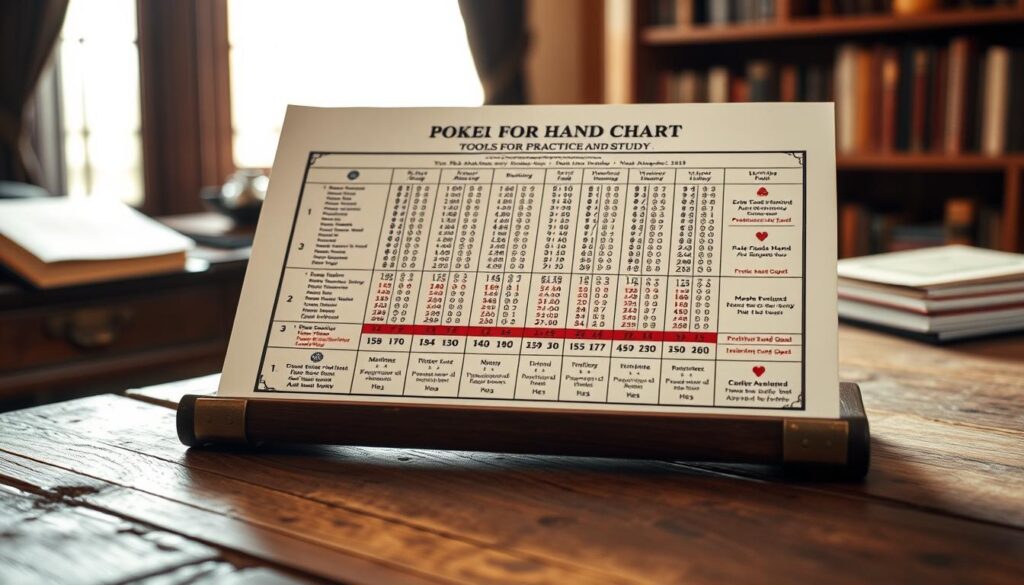
- Botfeld’s 888poker RFI Charts: The poker equivalent of cheat codes. These color-coded matrices transform “Should I raise?” into instant math. Pro tip: Tape them to your monitor until your brain absorbs the patterns like a blackjack dealer’s shoe.
- Williams’ HUD Configurations: Because tracking VPIP/PFR ratios manually is like counting cards with an abacus. Set these up once, and you’ll spot fish faster than a sushi chef.
- 180-Flashcard System: Amanda’s brute-force memorization method that makes muscle memory look lazy. Study these during bathroom breaks – your opponents won’t know what hit them.
| Tool | Time Investment | Skill Boost |
|---|---|---|
| RFI Charts | 15 mins/day | Pre-flop precision |
| HUD Configs | 1-time setup | Player profiling |
| Flashcards | 5 mins/session | Instant recall |
These texas holdem tips work like cognitive steroids. Combine them with daily hand reviews (yes, even your bad beats), and you’ll start seeing equity calculations in your sleep. Remember: Pros don’t wing it – they weaponize data. Your move, cowboy.
Key Takeaways for New Players
Poker’s learning curve is like Neo learning kung fu in The Matrix. It starts with sudden clarity, then hits you with harsh reality. Amanda Williams teaches us to focus on pre-flop strategies. These are like armor against the frustration of bad beats.
Think of starting hand selection like Netflix’s algorithm. It’s about cutting out weak hands, like 7-2 offsuit. This approach helps you avoid getting tilted.
Nathan Botfeld’s winning mindset is all about using position to your advantage. If you’re in the early seat, fold quickly. In late position, take advantage of tighter players. Simple strategies work best, like calculating pot odds fast and playing tight-aggressive.
Your table image isn’t about looking cool like on Instagram. It’s about being strategic. Mix tight-aggressive play with smart post-flop moves. Tools like GTO Wizard and hand history trackers can help you learn without years of practice.
So, get back to playing. The old-school strategists won’t know what hit them.
Leave a Reply