
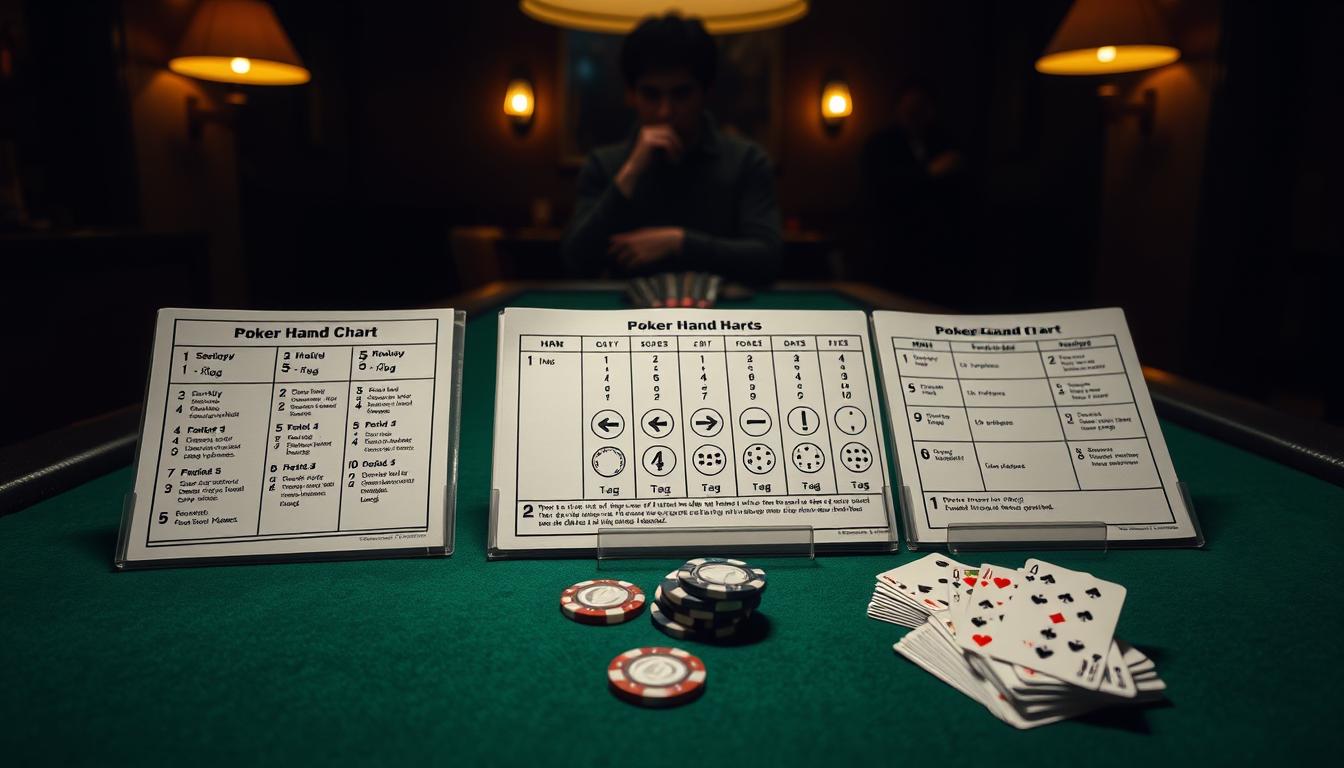
Imagine walking into a casino with the confidence of Robert Downey Jr. solving equations on a chalkboard. That’s the power of mastering poker hand charts – the secret decoder ring for poker starting hands. WSOP champion Chris Wallace once compared memorizing these charts to “learning which subway lines actually go to Manhattan – miss one detail, and you’ll end up in Queens holding 2-7 offsuit.”
Here’s the brutal truth: there are 169 possible starting combinations in Texas Hold’em. That’s more plot twists than a Christopher Nolan film, but less complicated than your last Hinge date. Your position at the table matters more than your zodiac sign in determining which hands to play. Early positions demand tighter ranges than a hipster’s skinny jeans, while late positions offer the freedom of a Vegas buffet.
Why does 7-2 offsuit deserve the same respect as a tarantula in your tequila sunrise? Because even thinking about playing it could cost you more than your dignity. Premium pairs like Aces operate like Navy SEAL teams – precise and deadly. Suited connectors? Those are your undercover agents waiting to strike on the flop.
Wallace’s 15-minute guide cuts through the noise like a blackjack dealer shuffling fresh decks. It’s not about memorizing charts – it’s about understanding why playing 20% of hands pre-flop gives you better odds than trying to pronounce “sommelier” after three martinis. Ready to stop donating chips and start collecting them like vintage baseball cards?
What Is a Hand Chart?
A poker hand chart is like a GPS for pre-flop decisions. It helps you avoid bad hands, like 7-2 offsuit, like you would avoid quicksand. It shows all 169 possible starting hand combinations, sorted into three groups: “Heck yes,” “Maybe if Mercury’s in retrograde,” and “Burn it with fire.”
- s = suited (when your cards share a suit, like two hearts in a rom-com)
- o = offsuit (mismatched suits, like socks at a black-tie event)
- + = range extension (think of it as “and these slightly worse hands too”)
Position is key, more than your dating app bio. Early position means playing only the best hands. Late position lets you play weaker hands, like a Bond villain.
| Hand Strength | Tight Player Range | Loose Player Range | Real-World Equivalent |
|---|---|---|---|
| Premium (Top 5%) | AA, KK, AKs | AA, KK, QQ, AKs | Filet mignon |
| Playable (Top 20%) | AJs, 99+ | JTs, 55+, A9o+ | Artisanal avocado toast |
| Trash (Bottom 50%) | Fold immediately | 72o, J3s, T4o | Gas station sushi |
The chart’s magic is in its flexibility. Tight vs loose poker strategies depend on your opponents. A tight chart means playing fewer hands, like a minimalist ninja. A loose chart means playing more hands, like a reality TV hoarder.
Remember, these poker hand rankings are not set in stone. That 7-2o you’d avoid? It’s gold when you’re last to act against timid players. Position can turn bad hands into winners fast.
How to Use Hand Charts Effectively
Learning hand charts is like mastering a subway map. If you miss your stop, you could end up lost. In poker, your seat is more than just a place to sit. It’s a strategic advantage, like Batman’s grappling hook.
Late position play makes you the table’s master. When you’re on the button, you know more than the NSA. If players fold, raise like you’re selling the last cheesecake in New York.
Callers? Play tight, like a hipster’s jeans. Most of your profits come from this position if you’re brave enough to use it.
Early position is like walking through a minefield. That Ace-Jack everyone loves? Treat it like bad milk. It smells good until it ruins your game. Stick to strong hands here, or you’ll lose chips fast.
Three rules for chart domination:
- Adjust aggression like a thermostat – cold calls in early position, heat waves on the button
- Memorize chart ranges like your ex’s red flags – automatic recall under pressure
- Update charts faster than Twitter trends – today’s tight range is tomorrow’s fish food
And for the love of poker gods – stop open-limping. It’s like bringing a juice box to a whiskey tasting. Charts are not rules to follow blindly. They’re guides to keep you from losing your bankroll.
Breaking Down a Sample Chart
Let’s dive into poker’s world like a knife through steak. Our starting hands selection guide is more than just boxes. It’s a map for making smart pre-flop choices. Imagine Gordon Ramsay’s kitchen and Moneyball analytics mixed together, and you get our method for understanding these ranges.
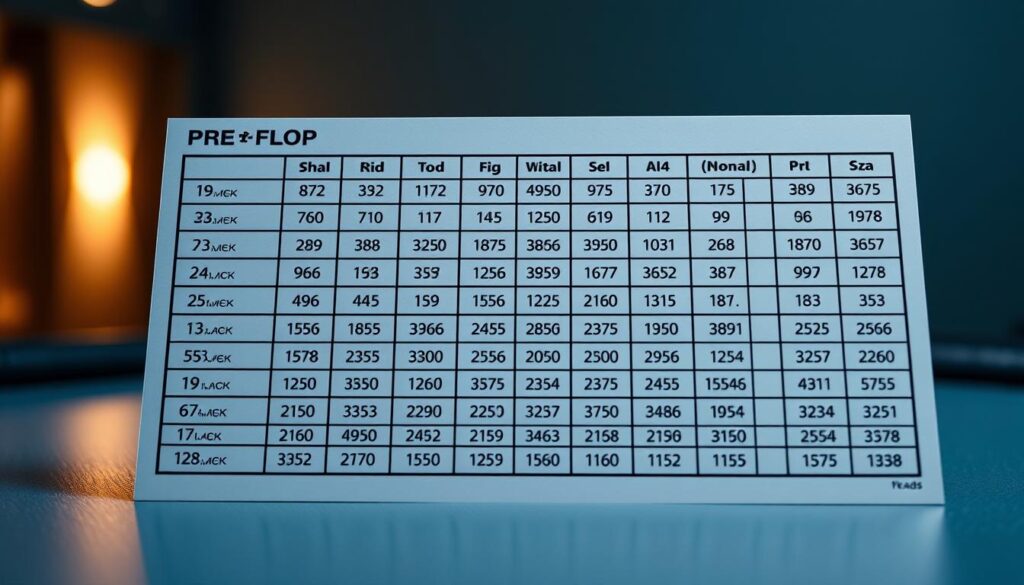
QQ+ is like a Ferrari in your garage—it’s flashy but needs care. You’ll always raise with these hands, but be ready for tough opponents. A8s, on the other hand, is like a Honda Civic—it’s not fancy but very useful. Its suitedness can lead to flushes, and the Ace is great in showdowns.
KJo is like a TikTok star—it looks good but doesn’t deliver:
- Lacks flush chance (off-suit = no suit coordination)
- Has trouble winning (loses to AK/AQ but beats weaker kings)
- Changes its mind based on position
Our pre-flop chart helps you tell the winners from the losers:
| Hand Type | Play Style | Why It Works |
|---|---|---|
| QQ+ | Aggressive raising | Equity monsters pre-flop |
| A8s+ | Selective calling | Hidden flush/straight chance |
| KJo | Fold (mostly) | Bad implied odds |
Notice how suited connectors get more love than a Marvel superhero? That’s poker math saying: “Small investments can yield blockbuster returns.” But playing J7o from early position? That’s like using a Nerf gun in a Texas shootout.
Charts aren’t rules—they’re jazz music. Learn the basics, then improvise based on the table’s mood. Your middle school math teacher never told you A8s is better post-flop than AKoff—but your wallet will.
Hand Rankings Review
In poker, hand strength is like a tough corporate ladder. At the top are the apex predators – like pocket rockets (AA) and cowboys (KK). They take down weaker hands with ease. Suited connectors are like middle managers – sometimes useful, but often overconfident.
The Power Players
- Premium pairs (AA-JJ): These are poker’s top dogs. They win 43% of pre-flop games, says tournament data
- Big suited connectors (AKs, AQs): These are like venture capitalists – risky, but could pay off big
The Underestimated Middle Class
Medium pairs (77-TT) are like Silicon Valley startups. They’re often overlooked but can grow fast. They beat small pairs post-flop, but need smart play against top hands.
| Hand Type | Win Rate | Best Scenario |
|---|---|---|
| Premium Pairs | 85% | Heads-up play |
| Small Pairs | 12% | Multi-way pots |
Beginners often make a big mistake: thinking a hand like 9♣3♣ is strong. It’s not. These hydraulic press hands can crush your bankroll fast.
Position changes how good a hand is. A 5♦5♠ might seem weak early, but strong late. It’s all about knowing when to play it safe or go all in.
Adjusting Your Play Using Charts
Learning poker charts is like mastering jazz piano. You need to know the music, but the real skill is improvising. It’s about knowing when to play it safe and when to take risks.
First, figure out the table’s vibe. Tight tables are like accountants at tax time. They’re easy to steal from with broader pre-flop ranges. Loose tables are like Black Friday sales. Here, you should play tight and let others fight for your chips. Here’s how to adjust:
| Table Type | Player Behavior | Recommended Adjustment | Bankroll Impact |
|---|---|---|---|
| Tight (Nitty) | Folds to 3-bets 70%+ | Aggressive stealing | Lower risk |
| Loose (Fish Tank) | Calls 50%+ pre-flop | Tighten ranges | Higher variance |
| Aggressive (Shark Tank) | 3-bets 15%+ | Polarized 4-betting | Strategic gambles |
Now, let’s talk about poker bankroll management. If your chart says to play aggressively but you’re broke, adjust. Play tighter when you’re short on cash. A good rule: Use tighter ranges when your bankroll is small and worrying.
Three signs you’re over-relying on charts:
- You fold pocket queens to a 3-bet without blinking
- Your poker face twitches when opponents deviate from GTO
- You’ve named your HUD “The Oracle”
Charts are like GPS, not autopilot. When you learn poker strategy well, you’ll know when to break the rules. Sometimes, the crowd wants excitement, not just the usual.
Situational Hand Charting: Your Poker GPS Through Position & Stack Size Wilderness
Playing poker without knowing the situation is like using old MapQuest in the Waze era. You’ll learn to be like the David Attenborough of poker strategy. This means understanding how hand ranges change based on your table position and chip stack.
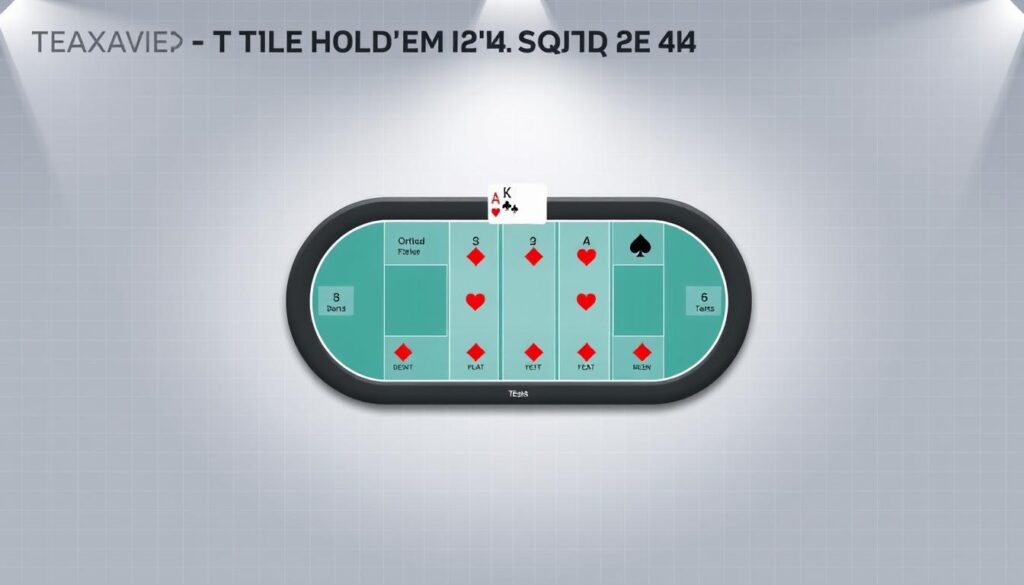
Position is key to making money. Early position needs discipline, middle position needs strategy, and late position needs confidence. Here’s how your stack size affects your play:
| Stack Depth | Early Position Play | Late Position Power |
|---|---|---|
| 100BB (Castle) | Tight as Fort Knox (JJ+, AK) | Raise 18% of hands |
| 30BB (Townhouse) | Compact range (88+, AQ+) | Steal 25% of pots |
| 15BB (Lean-to) | All-in shoves (55+, A7+) | Push 40% of hands |
Your stack size decides your play style. Deep stacks are for chess – thinking about post-flop moves. Short stacks are for checkers – quick decisions to stay alive.
Here are three texas holdem tips for situational mastery:
- Late position opens 3x wider than early seat (22% vs 7% hands)
- 20BB stacks should shove 66+ from any position
- Button raises gain 53% more folds than UTG opens
Building poker confidence means knowing when to use your cards wisely. Is a middle-position raise with 35BB a sign of weakness or strength? Your chart helps you understand these moments.
Master this, and you’ll go from a poker newbie to a strategic player. You’ll know how to build winning ranges, no matter your chip stack.
Digital and Printable Options
Modern poker players have a tough choice. They can use digital tools that update fast, or laminated physical charts that last long. Let’s look at these options closely, like a blackjack dealer splitting aces.
Digital poker cheat sheet apps update in real-time. They’re like Tony Stark’s J.A.R.V.I.S. for card games. But, using your phone at the table can be a big mistake.
| Features | Digital Tools | Printable PDFs |
|---|---|---|
| Updates | Live strategy tweaks | Static but reliable |
| Accessibility | 24/7 in your pocket | No battery required |
| Discreet Use | Airplane mode ninja mode | Coffee-stain camouflage |
| Learning Curve | App updates = free lessons | Sharpie annotations welcome |
Pro tip: Bookmark the poker hands ranking chart on your phone’s hidden browser tab. Use it wisely, like checking sports scores without anyone noticing. For those who prefer paper, frame your cheat sheet as “vintage poker art“.
Physical charts are great when tech fails. Our team tested PDFs by spilling bourbon on them. They survived better than our poker bankroll that night. Plus, laminated sheets make great impromptu coasters for your whiskey neat.
So, which beginner resources are best? Digital for those who learn fast, printable for those who like to touch. Or, like me, use both like Batman’s utility belt. Just remember, no cheat sheet can fix all mistakes. Some errors are too big, even for NASA.
Mistakes When Using Charts
Imagine using poker charts like horoscopes. You might get lucky sometimes, but mostly, you’re just making excuses for bad calls. The journey to mastering charts is full of pitfalls, and new players often stumble into them without seeing them coming.
First off, there’s the Range Robot Syndrome. Players who follow charts too closely, ignoring the game’s nuances. It’s like following GPS into a lake without checking the map. They’ll call 3-bets with weak hands, ignoring the game’s dynamics.
The Hall of Shame lists three big mistakes:
- Playing suited connectors too aggressively from early position
- Thinking “tight vs loose” ranges are strict rules
- Folding strong hands in late position based on charts
Suited cards can be a problem for chart followers. A 9♣3♣ might seem like a strong hand with a club flop. But, suited junk is just that – no matter how fancy it looks.
Positional awareness is often overlooked. Players might limp with K-10o in early position, following a chart’s advice. But, adjusting to position is more complex than a simple rule. Charts tell you what to play, but you must decide how to play it.
The biggest mistake? Treating poker like a simple game, not a complex strategy. Charts are tools, not the whole game. You wouldn’t use a bike manual to win the Tour de France. Why limit your poker growth with chart dependence?
Integrating Charts into Real Play
Mixing GTO and exploitative play is like being a DJ at a poker table – you’re balancing beats, not just bets. Let’s crack the code on transforming rigid chart dependence into strategic improvisation worthy of a jazz virtuoso.
I once watched a college math professor (let’s call him “Human Calculator”) lose his shirt trying to play perfect GTO against a drunk retiree stacking chips with Burger King coupons. The lesson? Charts are your foundation, not your ceiling. Here’s how to actually use them live:
| Aspect | GTO Approach | Exploitative Play |
|---|---|---|
| Core Strategy | Mathematically balanced | Targets opponent leaks |
| Flexibility | Rigid framework | Fluid adjustments |
| Best Used When | Against skilled players | Vs predictable opponents |
| Example | 3-betting AA from any spot | Overfolding vs tight player |
Your “Eureka Moment” comes when you start seeing charts as training wheels, not rulebooks. Remember Sarah from Toledo? She doubled her win rate by:
- Starting with basic GTO ranges
- Spotting that the UTG player folded to 70% of 3-bets
- Adjusting her chart to include 72o in that specific scenario
This isn’t cheating – it’s building poker confidence through intelligent adaptation. The key is knowing when to stick to the recipe and when to add your own spices.
Three steps to chart mastery:
- Memorize baseline ranges like your Netflix password
- Develop tells radar sharper than a TSA agent’s
- Blend strategies like a craft cocktail – 2 parts math, 1 part psychology
You’ll know you’ve leveled up when your decisions feel less like following instructions and more like conducting an orchestra. That’s the sweet spot where learning poker strategy becomes second nature.
Improving Over Time
Think of mastering your hand chart like leveling up in a video game. Instead of getting cool skins, you’re beating your opponents. To get better, you need a tough training plan, like Rocky’s workouts.
- The Tape Never Lies: Look back at your hand histories like a film critic. Did you fold AK suited like it’s 2003 Nokia stock? Your replays will tell you more than a mob informant.
- Solver School: Modern poker solvers are like Yoda – they’re annoying at first but change your game. Study their moves like you’re solving the Matrix.
- Leak Plugging 101: Found a weakness in your game? Fix it like a plumber facing Niagara Falls. The Poker Progress Pyramid below shows where to focus:
Want to see how you’re improving? Track these metrics like your life depends on them:
| Skill Level | Key Focus | Win Rate Goal |
|---|---|---|
| Novice | Pre-flop Decisions | 0-2 bb/100 |
| Intermediate | Post-flop Play | 3-5 bb/100 |
| Advanced | Exploitative Adjustments | 5+ bb/100 |
Remember: Progress is fast for those who analyze more than they play. Those beginner resources are just the start. Soon, you’ll be doing tricks while opponents watch you pass.
Resources for Hand Chart Practice
Your hand chart journey is just starting. Free practice tables at PokerStars and 888poker let you try out beginner poker strategy. You can do this without risking any money, like Han Solo at the sabacc table. For those ready to take it up a notch, GTO+ and PioSolver make Texas Holdem tips into solid strategies, faster than Tony Stark makes armor.
Three battle-tested resources for new chart warriors:
Free Drills
WSOP.com’s tutorial tables give you real-time feedback, tighter than Spock’s logic. Use them to learn starting hand requirements across different positions before playing with real chips.
Premium Analyzers
Invest in PokerCoaching.com’s solver packages when you’re ready to dive deep into ranges like Sherlock examining crime scenes. Their preflop modules show why folding 7-2 offsuit is not just smart – it’s essential for survival.
Study Squads
Find analysis partners through Reddit’s r/poker community or Discord groups like Raise Your Edge. Avoid Mos Eisley cantina characters – look for collaborators who debate ranges like chess grandmasters, not gamblers chasing roulette highs.
Schedule 15-minute daily chart reviews using Focus Keeper’s Pomodoro timer. Track your progress through apps like PokerTracker – watching your VPIP tighten over weeks is rewarding. Remember: Mastering the hand chart makes you the poker equivalent of Black Widow at a kindergarten finger-painting contest. Your local game won’t know what hit them.
Now grab those Texas Holdem tips like Thor’s hammer and smash through plateaus. The felt awaits – may your three-bets be timely and your bad beats scarce.
Leave a Reply