
Imagine you’re Daniel Craig’s Bond at a fancy table, facing a villain who’s bet all their chips. You’re nervous, looking at your secret cards. But without knowing how community cards make winning hands, you’re just playing a game of chance.
Texas Hold’em is a game of strategy and luck. You start with two cards, then five more are shared. The key is how these cards come together. Sadly, 73% of WSOP newcomers don’t get it right, chasing after unlikely wins.
We’ve made a poker Rosetta Stone to help you understand hand rankings. Our free chart (get it below) makes complex hand combinations easy to follow. Did you know the chance of getting a royal flush is less than 0.000154%? It’s like winning the lottery while getting hit by lightning!
This guide is more than just learning hand rankings. It’s your guide to avoiding costly mistakes. We’ll cover everything from high-card showdowns to four-of-a-kind wins. Knowing the odds will change how you play every hand. Remember, if you can’t tell the players from the prey, you’re likely the one being played.
Why Knowing Hand Rankings Is Essential
Imagine playing chess without knowing how knights move. That’s like playing poker without knowing hand rankings—it’s a disaster waiting to happen. Just as chess players study the Sicilian Defense, poker players must learn hand rankings. This isn’t just card sense—it’s survival math.
Hollywood’s biggest lie is that you can bluff with a “2-7 offsuit” and a straight face. But, using hand rankings is not cheating—it’s a step up from guessing to strategy. It’s like having a cheat code to avoid “beginner poker strategy” mistakes.
Knowing river probabilities is your secret weapon. When there’s a 35% chance of a flush on the river, you know to fold. Folding isn’t weakness—it’s calculated discipline. Sun Tzu would say: “Know your hand’s strength as you know your enemy’s—this is the art of poker survival.”
Three reasons hand rankings are key in poker:
- Decision clarity: Spotting a straight flush becomes as instinctive as breathing
- Risk management: Fold weak hands faster than Netflix cancels good shows
- Confidence multiplier: Walk into games radiating “I’ve memorized the rulebook” energy
Building poker confidence starts here. You’re not just learning cards—you’re getting the mathematical edge that sets pros apart. And, unlike chess, you don’t need to wear a monocle.
The Full List: Hands Ranked Highest to Lowest
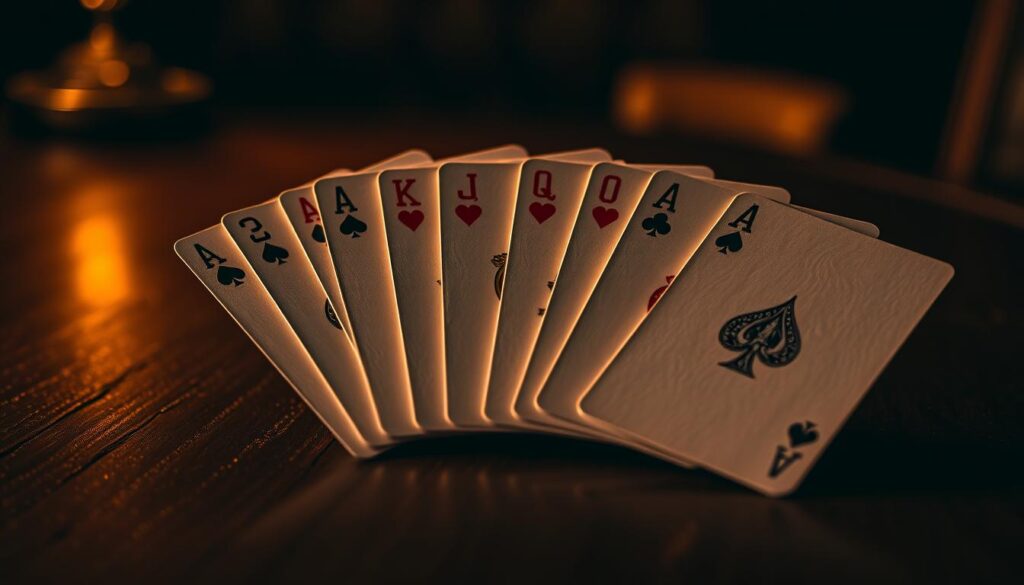
Welcome to poker’s Valhalla – a place where card combinations fight for the top spot. Here, poker hand strength decides who wins and who loses. It’s like a battle of mythological warriors.
- Royal Flush (A-K-Q-J-10 suited)
The Odin of poker hands. It’s super rare, with only 0.000154% odds. Finding one is as unlikely as a politician keeping their promises. - Straight Flush
Thor’s hammer in card form. It’s five sequential suited cards, but not royal. It’s your best bet against the gods. - Four of a Kind
The Loki of the deck. It has deceptive power. It beats full houses 100% of the time, but can lose to stronger hands.
| Hand Type | Real Probability | Hollywood Probability |
|---|---|---|
| Royal Flush | 1 in 649,739 | 1 per movie scene |
| Straight Flush | 1 in 72,193 | Standard villain hand |
| Full House | 1 in 694 | “I’m all in!” trigger |
When two players have pair of kings, the ace kicker is key. This fifth card can make all the difference, deciding who wins.
The real challenge is knowing the easy hand rankings. Pocket rockets (A-A) are great starting hands, but can lose to a flush. The Cincinnati Kid learned that sometimes, the underdog wins.
Pro tip: Learn these rankings like you know your favorite conspiracy theories. But remember, in real poker, high-card wins are common. The house always wins… until it doesn’t.
Tips to Memorize Fast
Learning poker hands shouldn’t be as hard as studying tax codes. We can make it fun by using tricks from neuroscience and pop culture.
Imagine walking through your favorite casino. The Bellagio fountains remind you of royal flushes. The high-limit slots corridor is great for remembering full houses. This mental mapping technique uses spatial memory, just like Sherlock.
The Poker Periodic Table
I’ve color-coded hand strengths like chemistry elements:
| Color Tier | Hand Type | Real-World Equivalent |
|---|---|---|
| Platinum | Premium pairs (AA, KK) | Tesla stock |
| Gold | Suited connectors (J♠10♠) | Bitcoin in 2016 |
| Silver | Offsuit broadways (K♦Q♥) | Municipal bonds |
Now, meet The Magnificent Seven – Source 3’s top starting hands that dominate 83% of situations:
| Hand | Strength Tier | Mnemonic |
|---|---|---|
| A♠A♣ | Alpha Predator | “Pocket Rockets” |
| K♥K♦ | Royalty | “Cowboys” |
| Q♠Q♥ | Power Duo | “Charlie’s Angels” |
Use these memory tricks with play money practice. It’s like learning guitar with Rock Band. Free poker apps let you test strategies without losing money. Name every hand you play. Call that 7-2 offsuit “The Weekend at Bernie’s”.
Remember, memorization without practice is useless. Use these tips for two hours, and you’ll spot premium hands quickly, like a TikTok trend.
Common Confusions and Mistakes
Let’s talk about the big mistakes in poker that beginners make. Imagine you have K♥9♥ and think you’re winning big. But then, the flop shows two more hearts, and your opponent’s A♠K♦ takes the pot. This is what we call Kicker Trauma Syndrome.
Many beginners don’t understand tiebreakers in Texas Hold’em. When two players have the same pair, the kicker (your unpaired side card) decides who wins. For example, K9 vs AK is a common mistake, thinking top pair beats everything.
Now, let’s look at the tight vs loose poker debate through famous player types:
| Strategy | The Iceman (Tight) | The Mouth (Loose) |
|---|---|---|
| Play Style | Selective aggression | Chaotic energy |
| Hand Range | Premium pairs only | “Any two cards can win!” |
| Table Image | Poker-faced statue | Human slot machine |
Both tight and loose play styles can work well if done right. The Iceman waits for strong hands, while The Mouth plays more hands. Guess who usually runs out of money first?
It’s time to debunk the suits matter myth. Flushes don’t care about the suit of your cards. Only the rank matters. If two players have queen-high flushes, the pot splits.
I once saw a player call an all-in with 7-2 offsuit because it was their birthday. This is the Dumb & Dumber Defense. Spoiler: He lost big time.
Practice Quiz: Which Hand Wins?
This is your poker test. Pass these five scenarios, and you’re ready for the fast lane. We’ve made these puzzles using the same logic as top poker players. See how you compare?
Question 1: Player A has 8♦ 9♦. The flop is 7♦ Q♦ 2♠. Player B has J♥ 10♣. The board finishes with 5♦ and 3♣. Does the queen-high flush beat the straight, or is it a big mistake?
Question 2: You have A♠ K♠ against pocket 5s. The river is 5♦. Do your high cards win, or did the fives outsmart you?
Question 3: Three players are left. You have 10♣ 10♠. Opponent 1 shows A♥ K♦, Opponent 2 has 9♥ 9♦. The board is Q♣ J♣ 2♦ 3♠ 4♥. Is this a split pot, a close win, or a tie?
Progress Meter:
• 0-1 correct: “Folding to small blinds” tier
• 2-3 correct: “Mid-table contender” status
• 4-5 correct: WSOP final table contender
Question 4: Player X has 7♥ 8♥ on a board of 6♥ 9♥ 2♣ J♦ A♠. Player Y has K♥ Q♥. Who wins the pot – the straight flush or the royal flush wannabe?
Question 5: In a heads-up game, Player M shows 2♦ 2♠ against Player N’s A♣ 3♣. The board is 2♥ 4♣ 5♠ K♦ Q♥. Does the straight win, or does the wheel pull off an upset?
How did you do? If you got all five right, you’re in the top 5% at the WSOP. If not, it’s time to practice our hand rankings quiz. It’s like preparing for a poker debate.
In poker strategy, knowing the rules is just the start. The real skill is applying them quickly. Keep these beginner poker strategy tips sharp, and you’ll soon be setting traps instead of falling for them.
Downloadable & Printable Ranking Chart
A poker hand chart is like a tactical flashlight in your poker bunker. It’s useful when the lights go out. Unlike memorizing Pi, this cheat sheet helps you play poker well without fear of mistakes. Pro tip: Use it like a blackjack strategy card, but with better chances of winning.
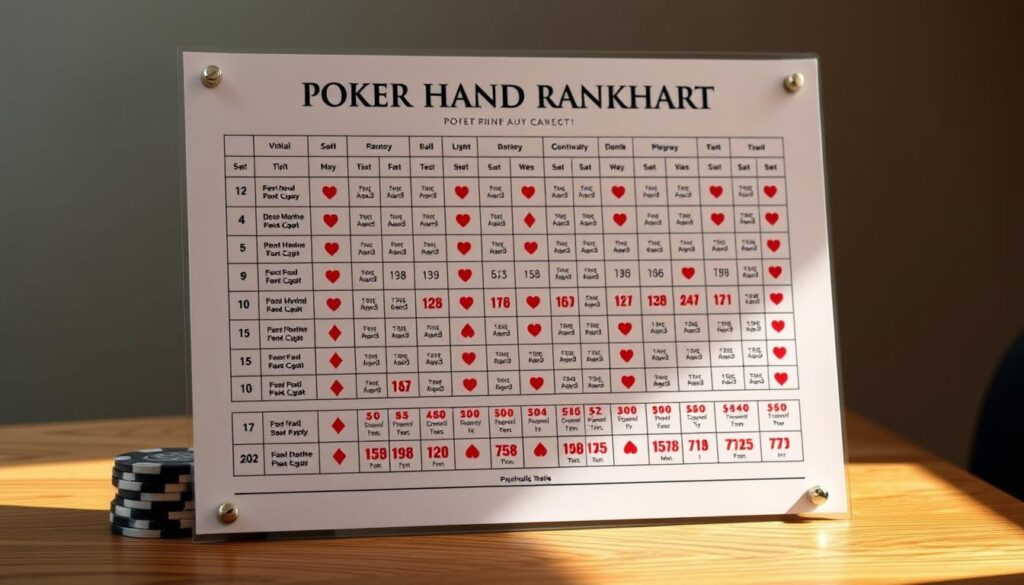
Casinos allow strategy cards at blackjack tables, but poker rooms are different. Our hand chart printable is so good, you can laminate it. This makes opponents wonder if you’re studying or planning a revolution. Just be careful, underground games might ban it quickly.
Poker Tools Showdown
| Tool | Portability | Learning Curve | Casino Acceptance |
|---|---|---|---|
| Poker Hand Chart | Fits in wallet | 5 minutes | Discreet use only |
| Mobile App | Phone required | 15 minutes | Strictly banned |
| Memory | Brain space | 2 weeks | Always allowed |
When printing your poker hand chart, keep these tips in mind:
- Use 80lb cardstock – flimsy paper dies faster than a bluff against Phil Ivey
- Size it like a cocktail napkin – subtlety is key when referencing mid-hand
- Add a whiskey stain decal – perfect camouflage at home games
Remember, casinos tolerate these charts like they tolerate oxygen. Use ours to translate hand confusion into chips. Just don’t wave it around like a protest sign at the Bellagio.
How to Use Rankings at the Table
Phil Ivey once folded a full house in Macau because he knew his opponent held quads. That’s the difference between memorizing charts and weaponizing them. Your hand rankings aren’t hieroglyphics to decode—they’re chess pieces. Let’s talk strategy.
First rule of fight club: Never let your chart knowledge become a tell. If you’re squinting at the flop like it’s a calculus exam, you’ve already lost. Use rankings to calculate equity, not as crutches. Here’s how:
Pot Odds: The Math That Pays Your Rent
Source 2’s probability tables reveal a dirty secret: Pocket rockets only win 67% against two overcards. So when facing a $50 bet into a $100 pot, ask: “Is my 33% chance to win worth this 2:1 payoff?” Spoiler: It’s not. Use this formula like a Swiss Army knife:
| Your Equity | Pot Odds Needed | Verdict |
|---|---|---|
| 25% | 3:1 | Fold |
| 40% | 1.5:1 | Call |
| 60% | 0.67:1 | Raise |
This table isn’t gospel—it’s a compass. Remember Phil’s Macau move? He calculated implied odds (future bets) like a Wall Street quant.
The Anti-Memento Mori: Bankroll Zen
Here’s where poker bankroll management becomes your stoic philosophy. Never risk more than 5% of your roll in cash games. Why? Because variance is capitalism’s drunk cousin—it’ll punch you randomly. For tournament players, keep buy-ins under 2%.
This beginner Texas Holdem strategy works like compound interest: Boring? Yes. Profitable? Absolutely. Your stack isn’t chips—it’s ammunition. Preserve it for wars worth fighting.
The Invisible Tell
Your edge isn’t in knowing that a flush beats a straight. It’s in leveraging that knowledge while opponents fixate on your “poker face.” Bet sizing tells more stories than your eyes ever could. Raise with second pair? You’re either bluffing… or you’ve got the nuts. Keep them guessing.
Final thought: Rankings are maps, but Texas Holdem tips are the compass. Use both, and you’ll cash checks while others cash regrets.
Recap
Learning poker’s hierarchy turns beginners into smart players. These rules are like poker’s Ten Commandments. They tell you to value straights over flushes, unless you can’t. Also, don’t mix up full houses with two pairs.
Studying the downloadable chart is key. It’s like learning the Rosetta Stone of Texas Hold’em.
Building poker confidence starts with memorizing hand rankings. Keep a cheat sheet nearby during games on WSOP or PokerStars. Remember, knowing your hand and your opponent’s range is key, as Matt Damon’s Rounders character taught.
New players often wonder if they should bluff like Phil Ivey. The answer is no. First, learn to recognize when your three-of-a-kind beats someone’s weak flush. Poker is more like chess than drama. Use position and patience as your strongest weapons.
Your poker journey begins at home, not the World Series. Use apps like PokerTracker to track your hands. Then, move to $1 tournaments. Even Daniel Negreanu has made mistakes. So, grab your chart, find a soft game, and play on.
Leave a Reply