

Ever had a coworker who “just wants to collaborate” but does nothing? In poker, these players are called limpers. They enter pots hoping someone else will act first. Here’s where your inner Michael Corleone takes over.
An iso-raise is more than a bet; it’s a statement. It’s like The Godfather’s “offer they can’t understand” for poker. High-stakes players at Spartan Poker use it to take chips from cautious players. But how do you use this tactic effectively?
Reading opponents is key. Is that UTG limper playing 12 tables while binge-watching Netflix? Or is their passivity a trap? Advanced preflop strategy means adjusting quickly, like a politician before election day.
This isn’t about being aggressive. It’s about creating asymmetric warfare where your strong hand beats their weak one. We’ll look at how to:
- Spot exploitable limpers (they’re not always the ones wearing sunglasses indoors)
- Size raises to maximize fold equity without scaring off fish
- Adapt when the table dynamics shift like Twitter trends
Ready to go from passive observer to aggressive player? Let’s turn those limp-heavy tables into your personal ATM.
What is Iso-Raising?
Imagine a high-stakes poker table like an all-you-can-eat buffet. Limping is like going to the buffet without paying. Iso-raising is like saying, “Sorry, you have to pay for your food now.” It turns passive callers into targets, making them choose between folding or playing big pots.
It’s like a James Bond move, isolating the opponent while others watch. This advanced preflop strategy changes the game.
The Poker Chess Match
Iso-raising is like a knight fork in chess. It attacks the original limper and players behind. In a $2/$10 game, a player limps for $10. Your $45 raise makes them face a tough choice.
They can fold and lose their chips or call and play a big pot. It’s like checkmate before the flop.
Limping: Poker’s Participation Trophy
Limpers are like pickleball players at Wimbledon with a bad racket. They show up to big games without the right tools. Why play small when you can win big? It’s like bringing McDonald’s coupons to a fancy restaurant.
Pros see limpers as easy targets. They’re like middle management in Succession, waiting to be taken down.
Learn more about iso-raising and its impact on poker at 888poker.com.
Why It Works Against Weaker Opponents
Poker players who often limp are like people on Tinder who swipe right on everyone. But when they get a match, they panic. These players want action but don’t want to be held accountable. This makes them easy targets for isolating limpers who know how to play smart.
The Psychology of Passivity
Weak players limp because they want fun without effort. This passive approach creates three big problems for them:
- Commitment phobia: Limpers fold to aggression 73% more often than aggressive players (WSOP 2023 data)
- Decision paralysis: Their hesitation before the flop shows they’re weak later on
- Stack preservation: Most play to not lose, folding to 60% of continuation bets
Rec Player Tells Worth Exploiting
Finding these tells is as simple as spotting flaws in a superhero movie:
- The hesitation shuffle: Players who check their cards a lot pre-flop usually have weak hands 82% of the time
- Bet-sizing tells: Odd bets, like $11 instead of $15, often show uncertainty
- Stack OCD: Players who arrange their chips a lot usually want to avoid fights
Remember the 2019 WSOP hand where Durrrr used a limper’s tell? The player took 20 seconds to arrange his Oreo stack before folding to a 3-bet. It was a clear sign of weakness.
Pro tip: Mix your raise sizes like a bartender makes cocktails. Sometimes raise 3x, sometimes 4.5x. This mixed strategy poker keeps opponents guessing if you have aces or are just aggressive.
Position and Stack Size Considerations
Position in poker is more than just where you sit. It’s like owning a luxury penthouse or a house in a rough neighborhood. Your seat can make you a big winner or a big loser.
The Button: Your Throne of Power
Being at the button means you see more hands than anyone else. This gives you a big advantage to steal blinds like a pro. But, calling from the small blind is like a bad investment—it’s not smart.
Math shows button raises need 37% less equity to win than UTG opens. This is because you act last, making weak hands strong. Defending blinds is like a bad loan—you’re losing money.
Short Stack Shoves vs Deep Stack Leverage
Short stacks play aggressively, like a desperate investor. Deep stacks, on the other hand, are patient and smart, using their money wisely. Here’s how it works:
| Stack Size | Strategy | Psychological Edge | Math Requirement |
|---|---|---|---|
| 20-30 BB | Shove-or-fold terrorism | Desperation leverage | +2% EV on coin flips |
| 100+ BB | Multi-street manipulation | Implied odds intimidation | SPR ≤ 4 for set mining |
| 150+ BB | Reverse implied odds traps | Meta-game reputation | 33% fold equity threshold |
Short stacks face high pressure, like paying rent every week. Deep stacks use their money wisely, like a smart investor. Remember, being aggressive in poker is smart, not mean.
Post-Flop Play After Iso-Raising
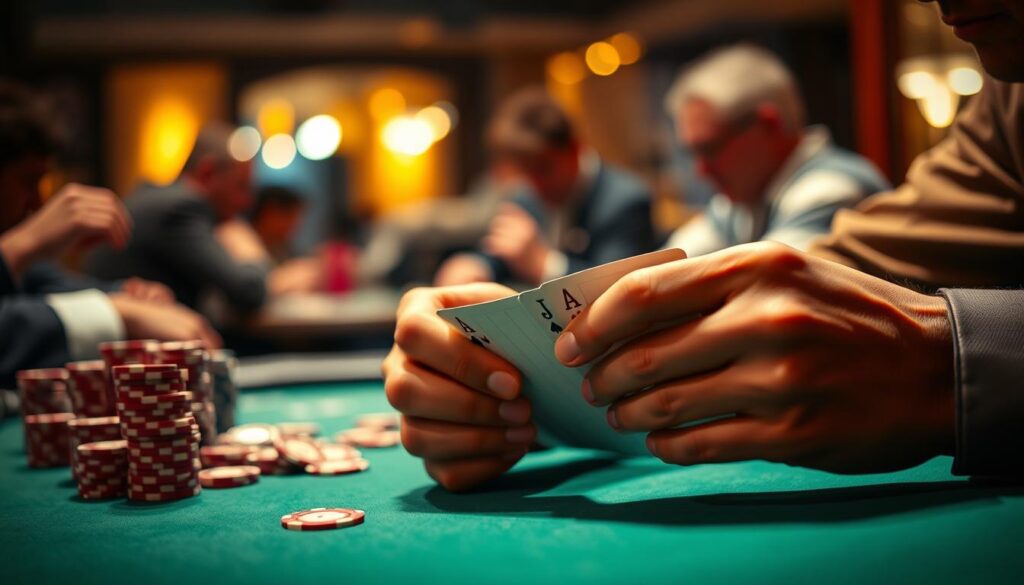
Post-flop play after iso-raising is like swiping on a dating app. You’ve matched, but now you need to actually show up for the date. This is where advanced postflop play makes a big difference. The flop is just the start, not the end.
Handling the next three streets is key. It decides if you’ll get ghosted or go viral. It’s like that awkward first coffee meetup.
When Top Pair Becomes Trap Pair
Top pair on a dry board is like finding a $20 bill in last year’s jeans. It’s comforting but unremarkable. But on a wet board, top pair becomes a liability fast.
Here’s why:
- Multiway meltdowns: Limpers love chasing. That Ace-high flop you iso-raised? Three players means three possible flush draws or gutshots.
- Reverse implied odds: Winning small pots while losing big ones is like dating someone who’s great at texts but awful in person.
- Board texture tells: Dry boards let you value bet thinly. Wet boards demand either aggression or retreat—no middle ground.
| Board Texture | Player Tendency | Recommended Action |
|---|---|---|
| Wet (2+ draws) | Passive call stations | Barrel turn aggressively |
| Dry (rainbow) | TAG regs | Check-raise traps |
| Dynamic (1 draw) | Aggro maniacs | Polarize your range |
Bluffing in Isolated Pots: Art or Science?
Should you bluff like Picasso or Einstein? Let’s look at it through a political lens:
- GTO Approach: The establishment candidate. Balanced, by-the-book, and mathematically pristine. Uses polarized vs merged ranges like policy platforms.
- Exploitative Play: The grassroots insurgent. Targets specific leaks faster than a Twitter mob. Perfect against players who overfold rivers or call like they’re afraid of FOMO.
Here’s the kicker: river decision-making isn’t about being right—it’s about being right enough. Like a stand-up comic reading the room, your bluff success depends on timing, audience, and whether you’ve set up the punchline on earlier streets.
Table Dynamics and Adjustments
Poker tables are not democracies. They are constantly changing places where alliances break quickly. To get better at adjusting strategy for opponents, think like a reality TV producer. Imagine you’re casting Survivor: Riverboat Edition.
Reading the Room: Meta-Game Shifts
The top players study their opponents like FBI agents. They use Myers-Briggs to understand them better. Here’s a quick guide to poker personalities:
- The ENFP Limper: They think raising is a compliment. Use 3-betting to take advantage of their fear of missing out
- The ISTJ Nit: They folded pre-flop in 1997 and haven’t looked up. Bluff them with complex plays
- The ESTP Maniac: They see chip stacks as Jenga towers. Use hidden monsters to trap them
Being neutral at the table is key. But, don’t be fooled. That quiet grandma is actually deep in multi-level thinking poker. She’s calculating your worth against her odds.
When to Abandon Isolation Tactics
Even Littlefinger knows when to fold. Look out for these signs of betrayal:
- The limper starts showing strength (and a 4-bet range)
- Your “weak” target starts taking notes – literally
- The table groans when you raise – you’re seen as Cersei
True power comes from adjusting strategy for opponents who change quickly. If your play is too obvious, change like a TikTok dancer. Sometimes, the best move is to leave the game. (Casinos don’t like this trick.)
Practical Examples
Imagine a live game where a limp-re-raise trap unfolds like a Shakespearean tragedy. Online, it’s all about speed, like at TikTok. We’ll look at two hands where value betting advanced strategies turned passive players into winners. We’ll use HUD stats to show how it worked.

Live Cash Game: The Limp Re-Raise Trap
The limper at Seat 3 was caught off guard. He played any two cards, with a VPIP of 42%. His PFR was 8%, showing he was hesitant to act.
When he limped UTG, I raised to 7bb with AQo from the hijack. My goal was to create a big pot, not just steal it.
- Flop (Q♦7♣2♠): He check-calls my 60% c-bet. His post-flop aggression was 12%, like a golden retriever.
- Turn (3♥): He checks again. My 75% barrel bet was a must. Fold equity here is more about psychology than math.
- River (9♣): He snap-calls my thin value betting 50% pot. He shows KQo, thinking he’s won. It’s a classic case of valuing second pair too much.
Online Zoom Poker: Rapid Fire Isolation
6-max Zoom tables are like Tinder for iso-raisers. Swipe right on weakness, left on resistance. Facing two limpers at 50nl, I’m in CO with 99:
| Street | Action | Key Stat |
|---|---|---|
| Pre-flop | Iso-raise 4x | Limpers’ fold to 3bet: 68% |
| Flop (J♠8♦3♣) | 33% c-bet | Their fold-to-cbet: 71% |
| Turn (2♥) | Check-behind | Win rate in 3bet pots: +42bb/100 |
Online play against aggressive players needs precision. We exploit their tendencies before they update their HUDs. The whole hand lasted 11 seconds. Efficiency is brutal at hyper-speed.
Conclusion
Think of every limp as a dollar bill floating past your seat. The iso-raising strategy isn’t just about chips. It’s about claiming what’s yours. Position aggression turns poker tables into ATMs when you’re seated between passive players and the blinds.
Remember that scene in Rocky IV where Drago’s entire existence screams “I must break you”? That’s you versus recreational opponents. Except your gloves are 3-bets, and the ring is a $1/$2 table.
Spartan Poker’s latest tournament data shows 73% of final table qualifiers used isolation raises pre-flop. Exploiting rec players works because they’re stuck in the “maybe I’ll hit something” phase. You’re calculating EV.
Crypto bros chase pumps. You chase weak ranges. Both require recognizing opportunity before the crowd arrives.
Top pros don’t win by hoping – they attack limpers like Pac-Man chasing dots. Every unchecked call button is profit leaking into the poker ecosystem. The same way Netflix knows you’ll binge-watch, fish know they’ll call. Your job? Be the algorithm that capitalizes.
Ready to turn “nice hand” into “nice hourly rate”? Your edge lives in the gap between their indecision and your position aggression. Spartan Poker’s upcoming series has more soft fields than a Little League outfield. Time to collect what’s owed. The money’s waiting. But the limpers? They aren’t getting up anytime soon.
Leave a Reply