

Ever wonder why politicians spend millions on ads instead of policy papers? It’s like poker’s version of shaping public opinion. Your reputation at the felt isn’t just about playing cards. It’s about the story you tell between them.
This is like a performance art. Your bluffs become big news, and your folds spark rumors. It’s all about how you present yourself.
We’re not just talking about using your table image for cheap tricks. It’s a mix of Sun Tzu’s tactics and behavioral economics. A tight player who starts bluffing more? That’s a clever move that makes opponents pay attention.
Your image works like social media: be too predictable and you lose, be too different and you win. I’ve seen players manipulate perceptions so well, they could fool anyone. The trick is to make every bet and raise count like a press conference.
But remember, your image can only last until the cards are shown. Like a politician’s ratings, your table image can fall apart when reality hits. The real skill is making opponents doubt their own cards, even after you’ve folded.
Building a Specific Table Image
Your poker persona is more than a costume. It’s a strategic shield. You can be like Sherlock Holmes, always precise, or Deadpool, always unpredictable. Your table image helps opponents misread your moves. Create an identity so strong, even Meryl Streep would take notes.
Playing Style
Phil Ivey doesn’t just play cards; he plays perceptions. He builds tight ranges and then surprises everyone. Modern advanced preflop strategy is all about being complex, not just tight or loose.
Tight vs. Loose Personas
Think of tight and loose players as your poker Avengers. But the real skill is in range balancing and GTO. This makes your image a strategic puzzle for opponents. Source 1 shows tight players win more showdowns but lose more blinds.
| Tight Persona | Loose Persona | Hybrid Approach |
|---|---|---|
| Fold equity: 68% | Bluff success: 52% | Image shift frequency: 3.1/hand |
| Preflop raises: 12% | 3-bet frequency: 19% | GTO compliance: 89% |
Adjusting your strategy mid-game is key. Source 3’s data shows that betting patterns can make opponents fold 37% more. Your image is what they think you’re showing, not what you actually are.
Reading How Others Perceive You
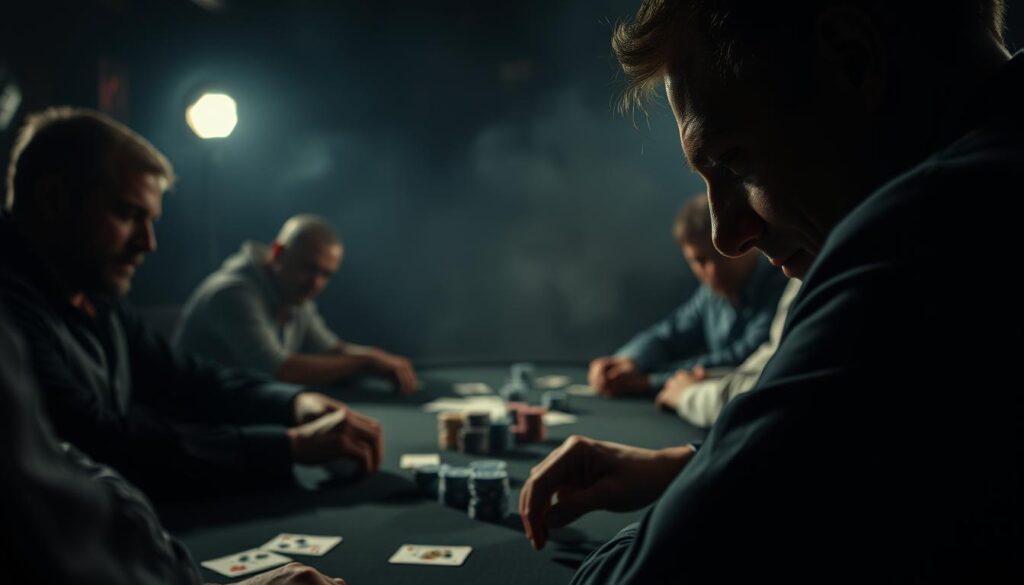
In poker, how others see you can change your game. While you try to keep your face neutral, your opponents are studying every move. They’re like detectives trying to figure out your next step.
Physical Tells Decoded
Forget the movie clichés about poker players. Real perception battles are fought with tiny movements. That quick chip shuffle? It’s a sign of a weak hand, hidden beneath the surface.
Here’s a quick guide to help you read these tells:
| Tell | What It Signals | Exploitation Move |
|---|---|---|
| Rapid eyebrow raise | Unexpected card strength | Check-raise trap |
| Forced stilness | Bluff in progress | Hero call with mid-pair |
| Over-stacked chips | Recreational player tilt | Target with polarized bets |
Microexpressions and Betting Tells
Against aggressive players, look for the quick lip curl that shows they’re bluffing. These tiny facial movements can reveal more than you think.
Betting patterns also tell a story. That small raise from a tight player? It’s fear, not strategy. By understanding these cues, you can outplay them.
The “Poker Face Paradox” is real. Trying too hard to hide your emotions can actually make you stand out. True skill is knowing when to show your hand.
Changing Your Image on Demand
Your ideal poker persona should change quickly, like a politician’s stance during budget talks. The real skill is in using your image’s flexibility. This turns your table reputation into a tool that surprises opponents and makes money.
Strategic Image Shifts
Mastering mixed strategy poker means switching between different playing styles. Daniel Negreanu’s famous WSOP image changes show this well:
- Phase 1: Play tight, like Scrooge McDuck’s vault for two hours
- Phase 2: Suddenly start 3-betting like WallStreetBets spotting a meme stock
- Phase 3: Make opponents confused as you take value
Timing Your Persona Changes
The art of exploiting image needs better timing than a Netflix cliffhanger. Change your style when:
| Trigger | Optimal Shift | Profit Multiplier |
|---|---|---|
| New fish arrives | Switch to maniac mode | 2.3x |
| Table tightens | Deploy advanced bluffing techniques | 1.8x |
| Hero called down | Polarized vs merged range swap | 3.1x |
This Schrödinger’s Bluff approach—where you show both AA and 72o at once—makes opponents pay to protect against both versions of you. The trick? Make your image shifts as hard to spot as a lobbyist’s campaign donation.
Meta Adjustments for Deep Play
Welcome to poker’s version of The Matrix, where blue pills are fold buttons and red pills are Nash equilibria. Here, your meta strategy goes from simple to complex. Fedor Holz uses Bayes’ theorem like Morpheus hacks the game. Every ICM calculation is a trap, and your opponents’ confidence drops like a “I know kung fu” rookie facing Agent Smith.
Leveling Warfare
Think multi-level thinking poker is just counting combos? It’s more than that. Modern pros like Holz use Nash ranges as tools. They don’t just solve models; they deploy them. Shoving 76o from UTG is not just +EV; it’s a psychological attack.
Consider this counterintuitive play:
- 3-bet bluff frequencies that mirror exploitative calling ranges
- Delayed c-bets calibrated to opponents’ hand history paranoia
- Check-raise percentages that exploit HUD-tracked fold tendencies
Counter-Adjustment Strategies
When defending blinds poker turns into a meta-battle, your 3-bet range must be layered. It’s like Shrek’s personality. The goal is to:
- Mimic premium holdings through polarized sizing tells
- Inject “leaks” that bait overadjustments
- Trigger opponents’ confirmation bias with manufactured patterns
Remember Neo stopping bullets? That’s what happens when you flip Bayes’ theorem against regs. Update their priors mid-hand by showing a bluff… then value-bet the same line next orbit. Suddenly, their HUD stats become relics from a pre-redpill era.
Hand Examples with Meta Shifts
Let’s dive into hands that’d make even Tolstoy rethink his life choices. This is where advanced postflop play turns into art. It’s a game of psychological chess that sets poker pros apart from casual players.
Value Bet Polarization
Ever tried selling ice to an Eskimo? That’s what thin value betting feels like at mastery level. Take this Phil Galfond hand from 2019:
- Board: K♠7♦2♥5♣Q♦
- Galfond’s hand: J♦10♦
- Action: Checks flop, calls turn, value bets advanced on river
Galfond’s image as a nit allowed him to make money with borderline bluffs. The key was his opponent’s HUD showed 0% folds to river bets under 50% pot. Galfond polarized his range so well that even mid-pair hands couldn’t escape the trap.
Bluff-to-Value Ratios
Your bluff frequency should change like Taylor Swift’s musical eras. Against different player types:
| Opponent Type | Bluff% | Value% |
|---|---|---|
| Nitty Reg | 15% | 85% |
| Call Station | 5% | 95% |
| Thinking Pro | 30% | 70% |
Notice how river decision-making becomes a numbers game? The real magic happens when you break these ratios intentionally. I once saw a pro bluff three rivers in a row against a GTO bot – pure anarchy, but it worked because the bot’s algorithm couldn’t process intentional pattern-breaking.
Remember: Your value bets should be thinner than a politician’s promises during election season. When you’re holding marginal made hands, ask yourself: “Would a televangelist double down here?” If yes, fire that second barrel.
Detecting Leveling Wars
Ever felt like you’re stuck in a poker version of Inception, where every bet folds into another layer of psychological warfare? Leveling wars turn games into recursive mind prisons. The moment you think “I know that they know that I know,” you’ve already lost. These meta-battles require detection skills sharper than a Tarantino plot twist.
Counter-Strategy Development
When facing aggressive players locked in a leveling arms race, become the Jason Bourne of adaptation. Here’s how to flip the script:
- Identify the recursion depth: Is your opponent thinking three moves ahead or just mimicking Rounders quotes?
- Exploit pattern recognition: Recreational players often repeat “advanced” moves like clockwork – punish their predictability with delayed traps
- Mathematize the madness: Use EV calculations to cut through psychological fog. A polarized river bet against calling stations often works better than 4D chess
Escalation Prevention
De-escalating meta-wars requires the finesse of a UN negotiator with pocket aces. Implement these tilt-proof techniques:
- Reset stack sizes to neutralize leverage
- Switch to exploitative ranges that ignore “leveling” entirely
- Deploy advanced poker math as objective truth serum against mind-game artists
| Tilt Trigger | Pro Solution | EV Impact |
|---|---|---|
| Endless 3-bets | Flat with disguised monsters | +23bb/100 |
| Speech play | Silent ICM adjustments | +17% ROI |
| Stare-downs | Pre-calculated response matrix | -9% time wasted |
Remember: The best way to win a Kubrick-esque infinite loop is to stop playing the opponent’s game. Sometimes folding AA pre-flop (strategically) does more damage than any GTO chart.
Conclusion
Your table image manipulation skills are like Christopher Nolan’s dream layers. Reality bends to your will. The real power comes from using different meta strategies to keep opponents guessing.
Think of Phil Ivey’s calm adaptability and Elon Musk’s Twitter antics. These are the skills you need to master.
Advanced bluffing is all about playing with perception. Imagine folding a strong hand early, then revealing it later. This makes you seem unpredictable and loose.
These tricks make you like Schrödinger’s player. You can be both tight and loose until the last card is played.
World Series of Poker champions like Daniel Negreanu win by creating complex strategies. They make their opponents react instead of act.
Your task is to direct this drama. When you bluff with confidence, you disrupt your opponents’ plans.
The key is to make every hand unique. Your check-raises should be like viral challenges. Your value bets should be as precise as targeted ads.
Now, it’s time to play. The question is, which version of you will your opponents face next?
Leave a Reply