
Starting your first poker night is like running for city council. You need charm, a good strategy, and to know when you’re being played. The bright lights of casinos fade when you’re at your friend’s table with mismatched chips.
But, that’s where the magic happens. Legends and big bluffs are born in those moments.
You don’t need a fancy casino to start. Just grab a deck, some fake chips, and three friends who owe you. The game is like chess, with every hand a risk and a bit of psychological battle.
Nixon played poker during his presidency, not just for the whiskey. It was a strategic move.
We’ll clear up the mystery. You’ll learn about Texas Hold’em and Seven-Card Stud. You’ll see why folding is hard, but it’s about managing risks.
This isn’t just about knowing hand rankings. It’s about understanding the game’s hidden language. By the end, you might be hosting poker nights or understanding your uncle’s poker quotes.
Introduction to Poker
Imagine a game where Wild West outlaws bet their boots, now it trains hedge fund managers. Poker turns saloon fun into a boardroom challenge. It’s a story of how a 19th-century game became a test of strategy.
History and Growth
Poker started on Mississippi riverboats, like Mark Twain’s dreams. It grew into Vegas casinos by 1970, with rhinestones. Today, World Series of Poker winners get bracelets worth more than Twain’s steamboat.
Wall Street traders study Texas Hold’em like the NASDAQ. It teaches more about people than an MBA. Sun Tzu would say: “Know thy opponent’s tell, know thy own bluff, and in 100 hands no bet will surprise you.”
Why Play Poker?
Poker is more than just winning chips. It’s like cognitive CrossFit. Malcolm Gladwell’s Blink theories come to life when you decide fast.
- Pattern recognition: Spotting when someone’s sweating more than a mint julep in July
- Risk calculus: Measuring odds faster than a blackjack dealer counts cards
- Emotional control: Keeping your “poker face” when you’re holding garbage
Modern poker rules might seem complex, but they’re just structured chaos. Learning the basics lets you see into human motivation. And isn’t that the ultimate life hack?
Poker Basics
Poker is not just one game; it’s a collection of games with changing rules. Choosing a game is like picking a political system. You might prefer Texas Hold’em’s openness or Omaha’s complexity. Let’s explore the options.
Types of Poker Games
Texas Hold’em is like a two-party system at poker tables. Everyone gets five community cards and keeps two hole cards secret. Omaha, on the other hand, is like building coalitions with four hole cards and using exactly two.
Draw poker games, like Five-Card, are like libertarians. They focus on negotiation with the deck, without community cards. Here’s a comparison of these systems:
| Feature | Texas Hold’em | Omaha | Five-Card Draw |
|---|---|---|---|
| Hole Cards | 2 | 4 | 5 |
| Community Cards | 5 | 5 | 0 |
| Betting Rounds | 4 | 4 | 2 |
| Key Strategy | Positional awareness | Hand selection | Bluff mastery |
Basic Rules Overview
Poker hands are like NFL drives, with betting rounds and strategic checks. The basics of poker include four phases:
- Pre-flop: Your initial strategy after getting hole cards
- Flop: Three community cards are dealt, time to adjust
- Turn: Fourth community card, changing odds like a Hail Mary
- River: Final community card, revealing the endgame
Position is key, not your poker face. Acting last gives you an advantage, like a CIA operative. Beginners often miss this, but experts know it can turn weak hands into strong ones.
Setting Up for Your First Game
Getting ready for poker is like putting together IKEA furniture. If you skip the instructions, you’ll end up with a mess. We’ll focus on two key areas: logistical precision (setting up the table) and hierarchical awareness (understanding hand rankings). It’s like your first day at a new job, but with poker.
Table Setup, Chips, and Blinds
Your poker table is more than just furniture. It’s like a small economy. You need to manage chips wisely. Too many, and betting gets wild. Too few, and the game gets dull.
- Blinds: These are like taxes. Players left of the dealer must contribute. The small blind is like basic needs. The big blind is like a mortgage.
- Chip Values: Chips have different values. White chips are worth $1, like an intern. Red chips are $5, like a manager. Green chips are $25, like an executive.
- Seating: Shuffle the seating to avoid any Game of Thrones drama. No one wants a schemer in Seat 3.
Poker Hand Rankings
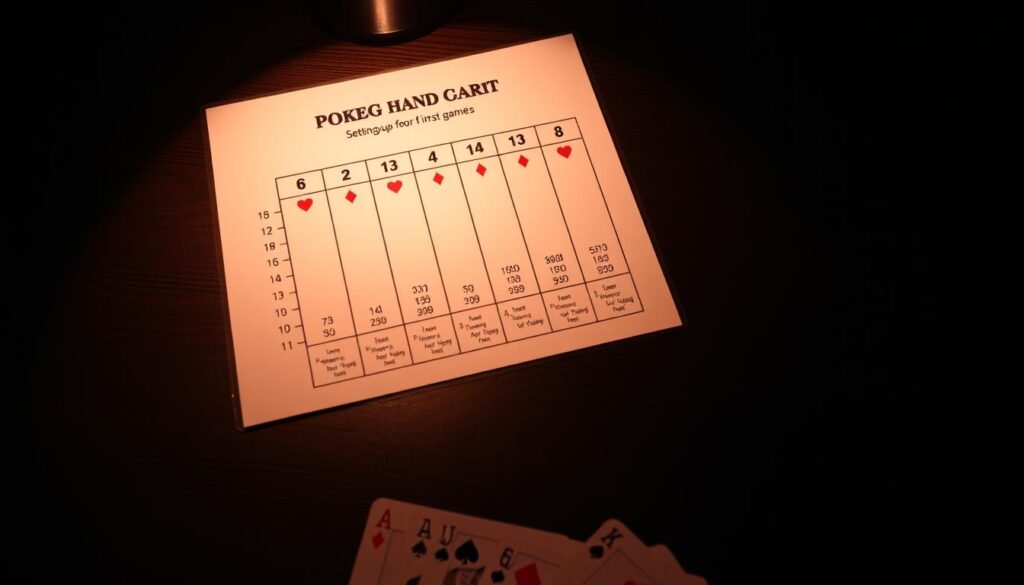
Learning hand strengths is like climbing the corporate ladder. Let’s compare poker to office politics:
- High Card (Intern): “I just need something on my resume”
- Pair (Assistant Manager): Competent but replaceable
- Three-of-a-Kind (Department Head): Actually knows the budget
- Straight (VP): Connects ideas others miss
- Flush (C-Suite): Perfectly color-coordinated power
- Full House (Board Member): Three kids, two divorces, one yacht
- Royal Flush (CEO): Unicorn status – seen once per career
The best starting hands in poker are like top startups. Premium pairs (AA/KK) are like FAANG stocks. Suited connectors (7♠8♠) are like risky crypto investments. Use your poker hand chart like a stock ticker. But even Jeff Bezos folds sometimes.
Step-By-Step Through a Hand
Imagine your first poker hand like a West Wing episode. It’s full of tense moments, power struggles, and that exciting moment when someone slams their cards down. It’s like President Bartlet dropping truth bombs. Let’s break down a full hand with the drama of a Brexit referendum (spoiler: bluffing can backfire).
The Deal
You get dealt Ace-Queen offsuit. It’s like having charisma and good polling data. The small blind posts $1, big blind $2. The action starts with the player to the left of the big blind. Do you fold, call, or raise? This is your chance to set your strategy.
Betting Rounds
The flop is 10♠️-J♦️-Q♥️. You have middle pair with a straight draw. It’s like playing chess – checking here is risky. When someone bets $5, you check-raise to $15. It’s a move so smooth, it makes Aaron Sorkin dialogue look simple.
| Round | Political Analogy | Strategic Insight |
|---|---|---|
| Flop | Prime Minister’s Questions | Control the narrative early |
| Turn | Midterm Elections | Reassess your position |
| River | Brexit Vote | Bluff at your peril |
Showdown and Winner
The river is a meaningless 2♣️. Your opponent goes all-in. Do you call? This is where many beginners make big mistakes. You have second pair – fold. It turns out they had kings. Remember, even the best tips can’t save you from overconfidence.
Simple Strategies to Start Strong
Think of your first poker game like a big meeting. Cards are your diplomats, chips are your power, and your seat is your place at the table. Let’s look at two key strategies to help you stay strong.
The Tight-Loose Spectrum: Political Parties of Poker
Playing tight poker is like running a conservative campaign. You only show strength with top hands (like AA or KK). On the other hand, loose play is like being a libertarian. You play more hands, hoping to win.
Folding is your secret weapon. Studies show winners fold 60-70% of their starting hands. Here’s a quick guide:
| Tight Strategy (Blue Chip) | Loose Strategy (Wild Card) |
|---|---|
| Pairs 88+ | Suited Aces (A5s+) |
| AK/AQ suited | Connected cards (67s+) |
| KQ suited | One-gap connectors (J9s) |
Remember, like in Goodfellas: “Never rat on your friends, and always fold 7-2 offsuit.” Being disciplined is what makes you a winner.
Positional Power: Your Veto at the Table
Late position in poker is like having UN veto power. The later you act, the more information you have. It’s like gathering intel with chips.
- Early Position: Needs strong alliances (only play top hands)
- Middle Position: Offers some flexibility (play a bit more)
- Button: Has the most power (control the pot, steal blinds)
Pro tip: Adjust your starting hands like you would in foreign policy. Play tighter in early position and looser on the button. Don’t let early position traps catch you off guard.
Poker Etiquette for Beginners
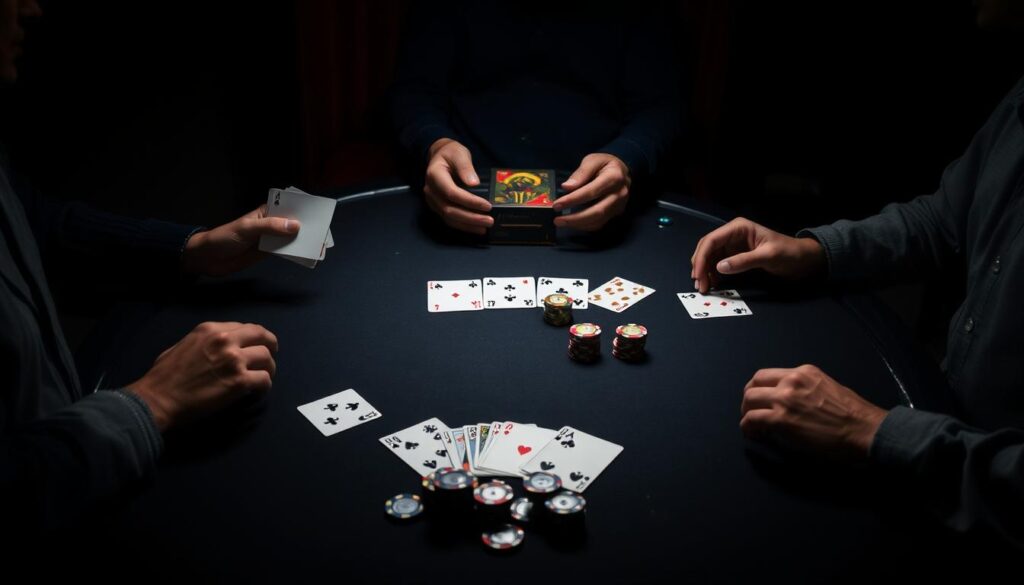
Poker tables are like social labs. A wrong laugh or fidget can give away your hand. It’s like playing kazoo during Beethoven’s Fifth. New players often make these common beginner mistakes in poker without realizing it.
Let’s look at physical tells. Chip-shuffling is not just annoying; it shows you’re nervous. Casino Royale showed us that watching eyelids is key, not foam mustaches.
Here are three key etiquette rules to avoid poker table mistakes:
- Act in turn: Reveal cards on time, not early. It’s like spoiling a Netflix finale.
- Keep emotions muted: Your “poker face” should be calm, not like a TikTok video.
- Respect the flow: Don’t slowroll winning hands. It’s like leaving someone on “read” for too long.
Seasoned players move their hands like sushi chefs. Quick, smooth chip handling is key. It keeps opponents guessing. How you fold is often more important than what you fold.
Dealing with bad beats is a test of etiquette. Don’t throw cards like confetti. Treat losses like deleted tweets – acknowledge them quietly and move on.
Avoiding Early Mistakes
Think of your poker money like a 401k. Put in a little each time, never take it out for risky bets, and watch it grow. I learned this the hard way after losing three buy-ins chasing losses. Poker bankroll management is key, just like saving for retirement.
New players often get too confident too fast. They win a few hands and think they’re pros. This isn’t a story of Greek tragedy; it’s tilt. It’s like a Wall Street trader panicking during a crash.
Spotting tilt is important. Here are some signs:
- Doubling bets after bad beats (hubris in action)
- Chasing straights like they’re last-call tequila shots
- Muttering “I’m due for a win” like a roulette addict
Remember the 2008 housing crash? Building poker confidence means recognizing patterns like Michael Burry. Spot these bubbles before they burst:
| Poker Mistake | Pop Culture Parallel | Smart Adjustment |
|---|---|---|
| Overbetting bluffs | Lehman Brothers’ subprime bets | Size wagers like measured stock options |
| Ignoring position | DJ Khaled forgetting his microphone | Play late position like a home-field advantage |
| Hero calls with 7-2 | Homer Simpson nuclear plant decisions | Fold like you’re avoiding radioactive donuts |
The secret is mixing Warren Buffett’s patience with Loki’s cunning. Keep your stack safe during slow times. Strike when weak players show their tells. This way, you’ll go from being like Blockbuster to Netflix – adaptable and profitable.
Resources and Tools for New Players
Think of your poker toolkit as a political war room – where data nerds and gut-instinct generals collaborate to conquer tables. You wouldn’t storm Omaha Beach with a slingshot, so why approach Texas Hold’em without these game-changers?
Hand charts are your laminated battle plans. Sites like Upswing Poker offer cheat sheets sharper than LBJ’s legislative strategies. These visual guides help you:
- Identify which starting hands to play (spoiler: fold that 7-2 offsuit)
- Navigate pre-flop decisions like a congressional whip counting votes
- Avoid tilt-inducing blunders that turn your stack into political capital for opponents
Modern odds calculators make Nate Silver’s election models look like kindergarten math. Tools like Equilab analyze millions of hand scenarios faster than MSNBC’s election night coverage. They’re the Moneyball of poker – revealing undervalued strategies like:
- When to call that suspicious river bet (hint: check the pot odds first)
- How often your flush draw actually hits by showdown
- Why position matters more than your aunt’s Facebook political takes
Want to level up? Training sites like Run It Once offer video libraries that make C-SPAN look entertaining. Study hand histories like Watergate tapes – every fold and raise tells a story. Pro tip: Combine these tools like a policy wonk crafting legislation. Use hand charts to build fundamentals, then let calculators handle the heavy statistical lifting.
Remember: Tools don’t replace skill any more than polling predicts elections. But used wisely? They’ll help you outmaneuver opponents faster than a filibuster ending at 2 AM.
Conclusion
Poker is a lot like life. You need patience, just like Warren Buffett with compound interest. And you must be bold, like Jordan Belfort finding new markets. Forget the Rounders dreams – real poker is more like D-Day planning with a bit of Jon Stewart’s doubt.
For beginners, poker is all about balance. You need to know your opponents and keep your own secrets. Playing tight early helps build trust. It’s like using your chips as psychological tools. Watch how Phil Ivey’s calmness speaks volumes, even when he’s all-in.
Every World Series of Poker winner has made a big mistake. But they don’t let it get them down. Treat losses like Warren Buffett views stock drops – as temporary. Use tools like PokerTracker to guide you, but listen to your gut too.
Stay alert, like a Daily Show critic. If the game feels like a Scorsese film, you might be the target. Set limits on your losses, just like a tight pre-flop raise. Poker is all about discipline, in betting and knowing when to walk away.
The best strategy for beginners? Keep learning. Watch Daniel Negreanu’s MasterClass. Study hands on Reddit’s r/poker. Play small stakes online to test your skills. Poker’s beauty is in outsmarting your opponents, one move at a time. Now, let’s play – your chance to build an empire is here.
Leave a Reply