
Think you’ve mastered Texas Hold’em? Try playing four-card chess. Omaha is like its cousin but with a twist. You get twice as many hole cards, making every hand a puzzle.
This game isn’t just checkers with chips. You have four personal cards and five community cards. The poker hand rankings you know now have more combinations than you can count.
That flush draw might be a trap. And that full house? Others might have better ones. The poker betting structures are familiar, but the stakes are high. Every decision is critical.
Why does this matter? It’s like playing Jenga while solving quantum physics. More cards mean more strategic possibilities. But, it also means more ways to make mistakes. It’s a game for those who love complexity.
Introduction to Omaha
Welcome to Omaha poker, where every pot can split into different realities. Your unbeatable quad Aces might lose to a low hand, making you question reality. This game mixes math and madness.
Omaha gives players four hole cards instead of two in Texas Hold’em. This creates a big difference in how you play. You must use exactly two of these cards with three community cards. It’s like solving a puzzle with only half the pieces.
Omaha Hi-Lo’s Split Personality
The game’s twist is in the omaha hi lo rules. Pots split between the highest and lowest hands. It’s like choosing between two pills, each leading to a different reality.
| Pill Color | Poker Outcome | Reality Shift |
|---|---|---|
| Red | High Hand (e.g., A♥ K♣ Q♦ J♠) | Traditional poker dominance |
| Blue | Low Hand (e.g., 2♦ 3♣ 4♥ 5♠) | Underdog victory through backdoor straights |
This setup makes poker pots explained like quantum physics. A single hand can win the high, split the low, or get divided. The math is complex, with 16,432 possible starting hand combinations.
Why Your Texas Hold’em Instincts Will Fail
Omaha’s complexity comes from hand interactions:
- Flush draws multiply like Agent Smith clones
- Straight possibilities bloom like the Matrix’s code rain
- Full house-over-full house collisions become common
Remember, even pocket rockets (A-A) can lose. Your four-card hand needs constant review. What seems like a win might be a trap.
Differences Between Omaha and Texas Hold’em
If Texas Hold’em is like speed dating, Omaha is like a royal wedding. You must pair up two hole cards. The four-card “buffet” seems generous, but you’ll struggle if you don’t follow the mandatory two-card commitment rule.
Let’s explore why Omaha makes you think strategically:
- Four-card monte: You get four hole cards but must use exactly two. Unlike Texas, where you can ignore one card.
- Hand construction limits: Your final hand must mix three community cards with precisely two hole cards. Omaha doesn’t accept “close enough.”
- Positional warfare: Knowing your position is key in Omaha. Early positions are riskier than a Red Wedding RSVP.
| Aspect | Texas Hold’em | Omaha |
|---|---|---|
| Hole Cards | 2 (use 0-2) | 4 (must use 2) |
| Average Hand Strength | Pair often wins | Straight minimum |
| Strategic Focus | Bluffing | Nut-chasing |
| Commitment Level | Tinder swipe | Prenup negotiation |
Omaha players who think like Hold’em players get eliminated fast. The four hole cards are a puzzle, not a chance to gamble. Positional awareness is key to success.
Pro tip: View your starting hands as political alliances. Two cards are your base, the other two are swing states. But remember, you need exactly two to win.
Number of Cards and Dealing Process
Think of Omaha’s card distribution like a drum solo. Every beat is important, but you need to count all four limbs to keep the rhythm. Unlike Texas Hold’em, Omaha gives players four hole cards. This makes every hand a complex combination of cards.
- Blinds post their mandatory “tolls” (small then big)
- Dealer distributes four cards face-down to each player
- First betting round begins with the player left of the big blind
The poker blinds and antes structure is key in Omaha. The blinds change positions after each hand. This ensures everyone contributes to the game.
| Position | Blind Type | Responsibility |
|---|---|---|
| Dealer Button | None | Last betting action post-flop |
| Small Blind | Half minimum bet | Starts pre-flop action |
| Big Blind | Full minimum bet | Anchor for opening bets |
New players often make the mistake of using all four cards. But, the basic poker rules say you can only use two hole cards and three community cards. This rule makes Omaha a game of careful selection.
The dealer button is more than just a decoration. It guides who pays what and when. Learning its rhythm helps you navigate betting rounds with purpose.
Building a Hand in Omaha
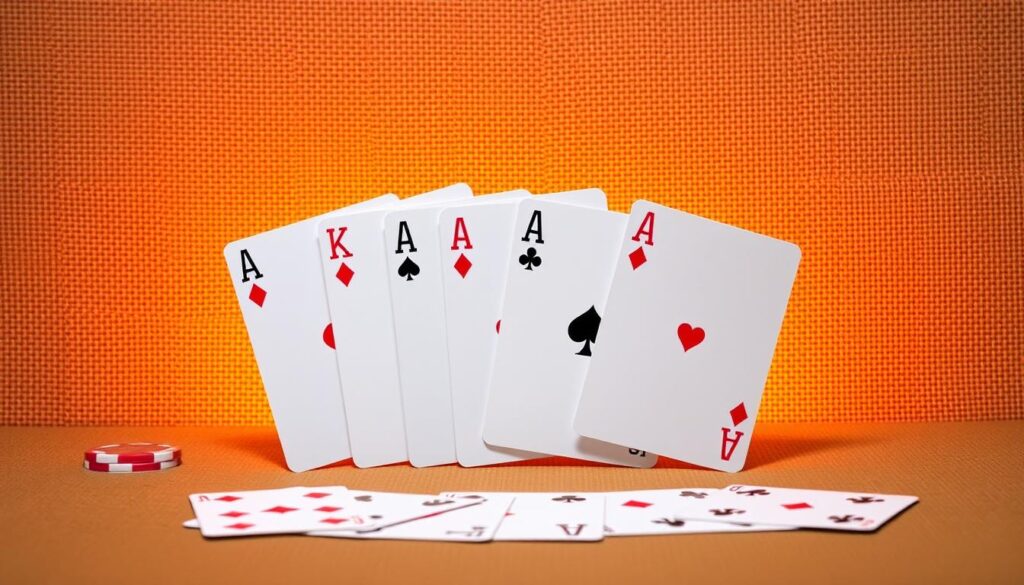
Imagine trying to build a championship poker hand while handcuffed to a rulebook – that’s Omaha’s two-card requirement in a nutshell. You’ve got four hole cards whispering sweet possibilities, but the game forces you to pick exactly two like a Sophie’s Choice for card sharks. Forget this rule, and your “monster hand” becomes a Frankenstein’s monster of dead money.
Let’s dissect two common autopsy reports from the Omaha morgue:
The Flush That Wasn’t
Player holds A♥ 7♥ 3♦ J♣. Flop comes K♥ 9♥ 2♠. Cue the celebration? Not so fast. Our victim used three hearts from their hand, violating the two-card mandate. Their royal flush dreams got flushed faster than a Vegas bachelor party.
The Phantom Straight
Hole cards: 10♠ 8♦ 5♣ 6♥. Board shows 7♦ 9♣ J♥. Looks like an easy 5-6-7-8-9 straight? Only if you ignore the rule requiring two precise ingredients from your hand. Mix three community cards with two hole cards? That’s not poker – that’s wishful thinking.
Omaha’s construction rules turn every hand into a logic puzzle. Your four cards aren’t possibilities – they’re pairings. Pro tip: Highlight possible two-card combos before the flop like you’re swiping through poker Tinder matches. That 7♥ 3♦ might look ugly now, but paired with the right community cards? Suddenly you’re the Leonardo DiCaprio of low-stakes games.
Remember: The two-card rule isn’t a suggestion – it’s the law. Break it, and you’ll join the endless parade of players muttering “But I thought…” while their chips disappear. Master it? You’ll start seeing hand-building opportunities hidden in plain sight, like spotting Waldo in a poker-themed Where’s Wally? book.
Hand Rankings in Omaha
Omaha hand rankings are like Hollywood reboots – they look familiar but play by entirely different rules. While Texas Hold’em players might think they’ve got this figured out, Omaha turns poker hierarchy into a mathematical meat grinder. Here, “good hands” go to die. Let’s break down why your full house now ranks somewhere between “meh” and “maybe”.
The key difference? You must use exactly two hole cards. This creates what I call counterfeit protection. Your seemingly strong hand could get demoted faster than a Twitter CEO when community cards duplicate your values. Aces full of kings might as well bring a resume to the table.
| Hand Type | Omaha Reality | Hold’em Perception |
|---|---|---|
| Flush | Common as reality TV stars | Stil impressive |
| Straight | Frequent flyer | Respectable achievement |
| Full House | Middle management | Executive suite material |
| Quads | Actual rarity | Mythical creature |
Here’s your Forbes Top 5 of Omaha hands that actually matter:
- 💎 Royal Flush: The CEO, but now requires two hole cards – good luck with that
- 🔥 Straight Flush: The Elon Musk of hands – rare but world-changing
- 🦄 Four of a Kind: Actually means something here
- 🌪️ Nut Flush: Requires ace-high AND two suited cards
- 🎢 Wrap Straight Draw: Not even a made hand, but the poker odds basics favorite
Why does this matter? Omaha’s poker hand rankings create inverted value structures. That flush you’re so proud of? It’s basically participation trophy material. The real power lies in redraw and blocker effects – concepts that would make Schrödinger’s cat fold pre-flop.
Pro tip: If you’re not calculating poker odds basics for at least three possible hand upgrades per street, you’re just gambling. Omaha turns poker into 4D chess where your full house is merely a pawn in someone else’s endgame.
Betting Structures: Pot Limit, Fixed Limit
Pot-Limit Omaha is like a financial thriller, mixing Margin Call with Deal or No Deal. Unlike Texas Hold’em, PLO’s pot limit mechanics make players think like Wall Street experts. This is why these betting structures are key to winning.
In Pot-Limit games, your bet can’t be more than the current pot. This means a small pot can quickly grow. For example, a $10 pot can become $210 in just three raises. Here’s how it works:
| Action | Player 1 | Player 2 | New Pot |
|---|---|---|---|
| Initial Bet | $10 | – | $20 |
| Raise | – | $30 | $60 |
| Re-Raise | $90 | – | $210 |
Fixed Limit games are more predictable, with bets going up in set amounts. This keeps bankrolls safe but limits bluffing. You’ll see Fixed Limit in mixed poker events where survival is key.
Which style fits you best? Pot-Limit is for those who love solving math puzzles. Fixed Limit is for players who like to build up their bets slowly. Remember, in PLO, always keep track of the pot size. A small mistake can cost you big.
Example Hands and Play-Throughs
Let’s dive into an Omaha hand that will make you wonder about your choices. It’s like a true crime story on Netflix. We have two players in our case study:
Player A: 4♠5♠J♦Q♣ (late position)
Player B: 7♠8♠ (early position)
Board: A♠2♠9♦
Player A seems to have a good hand at first. But then, a twist hits like a plot twist. They have the suicide king of spades. Let’s look at how this hand goes wrong:
| Street | Player A’s Action | Player B’s Action | Key Insight |
|---|---|---|---|
| Flop | Bets 75% pot | Calls | Both players smell blood (and spades) |
| Turn (3♥) | Checks | Bets full pot | Position becomes critical |
| River (K♠) | Shoves remaining stack | Insta-calls | The brutal truth emerges |
When the river completes the flush, Player A thinks they’ve won. But then Player B shows their 8♠. This turns the game into a ”That’s not how any of this works!” moment. The lesson? Your position at the table is key to survival.
Here are three important lessons from this hand:
- Low spades = high danger in multi-way pots
- Position dictates aggression – Player B’s early check-raise trapped their opponent
- Always ask: “What flush could beat mine?” before going all-in
This hand shows why Omaha is a game for thinkers, not dreamers. Remember, in a game full of monsters, you don’t want to be holding the pitchfork when Godzilla shows up.
Strategy Tips for Beginners
Omaha isn’t a free-for-all. It’s a high-stakes butcher shop where weak hands get crushed. Think of your starting cards as Ron Swanson’s dinner order: only premium cuts are good. Let’s build your “starter home” strategy with the meat-and-potatoes fundamentals that separate the strong from the weak.
Your starting hand selection needs careful thought. Follow this hierarchy:
- AA23 (double-suited): The wagyu beef of Omaha – rare, powerful, and worth going all-in for
- KKQJ with flush poteential: Like a perfectly marbled ribeye – needs careful cooking
- Connected middling cards: The sirloin of your range – decent but don’t overvalue
🚩 Red flag territory: Single-suited junk hands (looking at you, 7♥5♦3♣2♠) – these are the gas station sushi of Omaha poker.
Real Estate Rules Apply: Position, Position, Position
Your poker position strategy should be tight. In early positions:
- Play fewer hands than a monk plays slot machines
- Raise aggressively with premium holdings
When late position freedom arrives:
- Steal blinds like Batman takes down villains
- Extract maximum value from made hands
Poker Odds Basics: Your Inner GPS
Understanding poker odds basics is like having Waze for Omaha’s winding roads. Remember:
- Flush draws have better odds here than in Texas Hold’em
- Straight possibilities multiply faster than conspiracy theories
- Always check your outs like you’d verify a political fact-check
Pro tip: If your hand needs three specific cards to win, you’re not drawing – you’re buying lottery tickets.
The Three Commandments for Omaha Newbies
- Thou shalt not fall in love with pre-flop aces
- Thou shalt respect the power of position
- Thou shalt fold more than a laundromat
Remember: Omaha isn’t about making hands – it’s about making better hands than three opponents simultaneously. Now go forth and pot-limit responsibly.
Top Mistakes to Avoid in Omaha
Omaha isn’t just Hold’em on steroids—it’s a game where even quad Aces can leave you crying. Let’s look at the seven deadly sins that turn promising players into cautionary tales. (Cue the sad trombone.)
1. Icarus Syndrome: Chasing straight or flush draws like they’re the last chopper out of ‘Nam? You’ll crash faster than a crypto bro’s portfolio. Omaha’s four-card mechanics create false hope—that gutshot has 32% fewer outs than you think.
2. Hold’em Hangover: Treating Omaha like its Texas cousin is like using a chainsaw for bonsai trimming. Those pocket Aces? They’re now 1/4 of your hand. Position strategy here isn’t optional—it’s survival math. Fold pre-flop aggression from early positions like you’re dodging spoilers for Succession season finales.
3. Quad Fever: Yes, four-of-a-kind looks sexy. But in Omaha, it’s about as rare as a bipartisan Senate bill. Overvaluing these hands against possible straights/flushes? That’s how you fund someone else’s vacation home.
- Nut Pedestal Fallacy: The nuts change faster than TikTok trends. What’s golden on the flop could be worthless by the river.
- Pot Limit Paralysis: Betting small “to control the pot” is like bringing a Nerf gun to Ukraine. You either commit or fold—no half-measures.
- Tiltosaurus Rex: Losing with AA72? Welcome to Omaha. Emotional stability here isn’t zen—it’s table stakes.
Remember: Omaha rewards patience over heroics. Master poker position strategy, respect the math, and avoid becoming the David Blaine of bad beats. Your wallet (and dignity) will thank you.
Glossary of Key Omaha Terms
Think Omaha terminology is just poker slang? Think again – it’s more like a secret society handshake with better odds. Let’s crack the code on phrases that sound like bad movie titles but could make or break your game.
Nut Low: No, this isn’t keto diet advice. In omaha hi lo rules, it’s the lowest possible qualifying hand that can split the pot. Imagine bringing celery sticks to a steak dinner – that’s your nut low at a high-hand table.
Counterfeit Protection: Forget Treasury Department vibes. This refers to holding duplicate low cards that prevent opponents from making better low hands. It’s like having two birth certificates – completely legal, but suspiciously advantageous.
Wrap: The ultimate anti-gift scenario. A straight draw with up to 20 outs (yes, twenty). Picture a Christmas present so big it needs three people to carry it – except here, you’re the only one getting the goods.
When poker pots explained in Omaha Hi-Lo, remember: the pot splits like a divorced couple’s assets. The high hand gets half, the qualifying low hand gets half, and everyone else gets existential dread. Pro tip: If your “low” hand contains a queen, you’ve basically brought a spoon to a knife fight.
Ever heard of a Quartered Pot? It’s when two players split half the pot, leaving them with 25% each – the poker equivalent of finding out your inheritance is just Grandma’s porcelain doll collection.
Remember: Omaha’s vocabulary turns novices into Mark Twains of the felt. Master these terms, and you’ll be trash-talking in iambic pentameter before the river card drops.
Getting Started Online/Live
Choosing your Pot Limit Omaha battleground is like swiping through dating apps. You want lots of action without the weirdos. Here’s a simple guide to help you navigate the digital world.
Our undercover team looked at platforms with three key criteria. Even Gordon Ramsay would approve:
| Platform | Traffic Density | Software Smoothness | Fish Index* |
|---|---|---|---|
| Bovada | Marathon Rush Hour | Tesla Autopilot | 🐟🐟🐟🐟 |
| PokerStars | Times Square NYE | Swiss Watch | 🐟🐟 |
| PartyPoker | Suburban Mall | 1998 Dial-Up | 🐟🐟🐟🐟🐟 |
*Fish Index measures players who think “nut flush” involves bathroom plumbing. Bovada’s beginner tables are full of them. It’s perfect for practicing your poker table position skills.
Live game pro tip: Your seat isn’t just furniture. Early position means playing tight. Late position is your chance to shine – use it like a Wall Street short seller.
- Online tells: Players taking 30 seconds to call $2 bets? Human ATMs in disguise
- Live etiquette: Stack chips Neat & Organized (NO) – messy piles scream “rookie”
- Bankroll rule: Buy in for 5% of your total roll. Unless you enjoy ramen dinners
Remember: In Pot Limit Omaha, online and live games are different. Online games let you hide behind avatars. Live games require real social skills. Choose your arena wisely.
Conclusion: Elevating Your Omaha Game
Learning Omaha poker rules can turn you into a card game master. It’s like moving from simple games to complex ones. Every card dealt is a chance to recalculate your chances, like a poker expert.
Knowing poker odds is key. It lets you spot overvalued hands easily. This skill is like having a superpower at the table.
Improving in Omaha is not straightforward. You need to study hand histories deeply. Watch how opponents play, like a detective. WSOP winners don’t just remember starting hands; they analyze every move.
Tools like Equilab help you make smart decisions. They turn guesses into solid numbers. This makes you a better player.
Omaha is all about being bold and strategic. Don’t be afraid to bet big on strong hands. Use platforms like PokerStars to practice without risking too much.
The ultimate skill is knowing when to fold. Spotting the right time to give up is as important as winning. Omaha teaches you to value each decision.
Leave a Reply