
Imagine trying to solve a Rubik’s Cube blindfolded while someone shouts “all in!” That’s card math for you—chaotic yet calculable. There are 2,598,960 possible hand combinations, as Chen’s Mathematics of Poker shows. Even the loudest table bully can’t outshout a binomial distribution.
Poker hand rankings are like Darwinism in action: survival of the statistically fittest. A flush beats a straight because it’s more powerful, just like hurricanes are stronger than confetti. It’s not just about luck; it’s a strategic game with chips.
Your seat at the table is more than just a place to sit—it’s a strategic spot. Early position is like storming Normandy, while late position is like Oppenheimer watching a chain reaction. Every decision is a move in a game of probability.
Forget about luck. Real power comes from knowing that three hearts on the flop give you a 34.97% chance of winning. To outplay the room, treat the green felt like a chessboard dipped in game theory.
Introduction: Why Odds Matter
Think of poker odds as your secret decoder ring. It’s the difference between guessing and knowing if that river card will save or sink your stack. While others might be acting like Maverick from Top Gun, 73% of winners are quietly doing math like blackjack pros. It’s not luck, but probability in disguise.
Here’s the truth: Playing without calculating your chance of winning is like playing slots with cards. That 4.62% gutshot probability is more than a number. It’s the moment you see poker is about math, not just reading players.
| Behavior | Pros | Amateurs |
|---|---|---|
| Using Probability | 73% of decisions | 22% of decisions |
| Calculating Outs | Pre-flop to river | “Feeling lucky” |
| Bluff Success Rate | 48% (calculated) | 16% (random) |
Probability in poker is like Clippy from old Microsoft Word, but smarter. It says: “Looks like you’re trying to bluff against a 70% favorite. Need help?” The math doesn’t care about your lucky socks or past wins. It’s what separates grinders from gamblers.
Think odds are only for MIT grads? Think again. Knowing if you’re a 2:1 underdog or 3:1 favorite makes poker like chess, not magic. And unlike your ex’s mixed signals, these numbers never lie.
The Basics of Poker Odds
Poker math is like Blackjack card counting, but with more caffeine and fewer pit bosses. Beginners learn poker hand rankings like the MCU power scale. Pros treat probabilities like a sports almanac from Back to the Future. Let’s dive into this numbers casino.
Poker Hand Probability Foundations
That heart-flopping moment when you chase a flush? You’re facing a 1-in-4 shot. It’s better odds than surviving a Game of Thrones wedding. Here’s the breakdown:
- The 9/47 Rule: Need a spade? With 9 outs post-flop, you’ve got 19% odds. It’s slightly worse than Drax understanding metaphors
- Paired Board Paradox: When the flop shows duplicates, full house chances jump like Tesla stock during a Musk tweetstorm
- Marvel Math: Pocket aces have Hulk-level strength (85% vs. 7-2 offsuit). But they become Ant-Man when facing multiple opponents
| Hand Type | Pre-Flop Win % | Post-Flop Improvement |
|---|---|---|
| Suited Connectors | 4.8% | +22% with flush draw |
| Pocket Pairs | 5.9% | +12% per set chance |
Here’s the kicker: poker hand rankings aren’t static. That “weak” pair of eights becomes Oppenheimer-level powerful when the board pairs. Probability isn’t destiny – it’s chess with a 52-card board and bourbon.
Remember: Odds calculations should be faster than a TikTok trend. If you’re counting on your fingers when the turn comes? You’re the guy bringing a lightsaber to a gunfight.
Common Probability Scenarios: When Math Becomes Your Lightsaber
Ever stared at a flush draw like it’s a Baby Yoda-sized mystery? Let’s cut through the fog with probability’s Beskar blade. These recurring situations separate weekend warriors from players who actually know where their outs are hiding.
The Flush Draw Dilemma
Nine outs. Thirty-five percent. Sounds simple until you’re facing a 4:1 pot odds decision faster than Grogu steals cookies. Here’s how to armor up:
- Outs ≠ Guarantees: Your 9 flush cards feel like destiny, but 35% means you’ll miss twice as often as you hit
- Position Is Your Dark Saber: Late position? Milk that 65% failure chance for free cards. Early? Prepare to pay Beskar prices for intel
- The Mandalorian Math: 47 unseen cards? That’s 9/47 (19%) on the turn, 9/46 (20%) if you whiff. But combined odds? “This is the way” to 35%
Straight Odds Calculation
Open-ended vs. gutshot straights – the difference between wielding a blaster and throwing rocks:
| Straight Type | Outs | Turn % | River % |
|---|---|---|---|
| Open-Ended | 8 | 17% | 32% |
| Gutshot | 4 | 8.5% | 16.5% |
See that 32% chance of winning? That’s worse odds than Disney+ renewing your favorite show. But pair it with implied odds? Suddenly you’re playing chess while opponents mash checkers.
Calculating Pot Odds and Expected Value
Every bet in poker is like a mini Wall Street trade. You’re playing risk analyst with a whiskey sour in hand. Pot odds guide you through the game, where bluffs and probabilities meet.
The Risk/Reward Ratio
Imagine a $14 pot and a $4 bet from your opponent. Do you call? Pot odds turn poker into algebra. Your $4 call must win 1 out of every 4.5 times to break even.
If your hand’s equity beats those odds, you’ve found positive expected value (EV). It’s like winning big.
Let’s simplify it:
- Pot Total: $14 existing + $4 bet = $18
- Your Call: $4
- Odds: 18:4 → 4.5:1 simplified
If your flush draw has 9 outs (≈35% chance), you’re getting better odds. It’s like buying Bitcoin at $18k when it might hit $60k. The math says “all-in,” but your gut says “wait.”
Pro tip: If you’re overthinking, you’re overdoing it. Modern poker apps do the hard work. Your job is to recognize patterns. Remember, profitable decisions are more important than perfect calculations. Why solve hard math when you have the Rule of 4 and 2?
Using Outs and Odds in Play
Ever counted your outs like Elon counts Twitter bots – obsessively, yet with questionable accuracy? Let’s turn that chaotic energy into cold, hard math. Whether you’re chasing a flush or praying for a gutshot, calculating outs is your GPS through poker’s wilderness. Just don’t mistake it for Google Maps – no recalculations allowed when the river card arrives.
The Outs Equation
Here’s the cheat code: Your outs are the remaining cards that can turn your “meh” hand into a masterpiece. Got 9 spades left in the deck? That’s 9/47 odds – about 19% – of hitting your flush on the turn. Simple, right? Until you realize there are more variables here than in a crypto bro’s investment portfolio.
Memorize this survival math:
- Pre-flop: 2 cards = 2.1% per out
- Flop to Turn: Multiply outs by 2 (roughly 2.1% per out)
- Turn to River: Multiply outs by 2.2% (because math hates round numbers)
Omaha players, lean in. With four hole cards instead of two, your outs multiply faster than conspiracy theories on Reddit. That open-ended straight draw? Suddenly you’re juggling 16 possible outs across two different suits. It’s like solving a Rubik’s Cube while riding a mechanical bull – thrilling until you faceplant.
| Scenario | Texas Hold’em Outs | Omaha Outs |
|---|---|---|
| Flush Draw | 9 | 15-20 |
| Straight Draw | 8 | 12-16 |
| Two-Pair Upgrade | 4 | 8-12 |
Pro tip: Subtract “tainted outs” like cards that might give opponents better hands. It’s not paranoia if the deck really is out to get you. Remember – knowing your outs is power, but using them wisely? That’s how you turn probability into profit.
Odds for Common Hands
Ever wonder why pocket pairs feel like Schrödinger’s hole cards—simultaneously invincible and fragile? Let’s dive into the stats. Analyzing starting hand equity is like art, using probability. It’s your James Bond moment at the poker table, with a twist of cold, hard numbers.
Pocket Pair Probabilities: The Fine Print
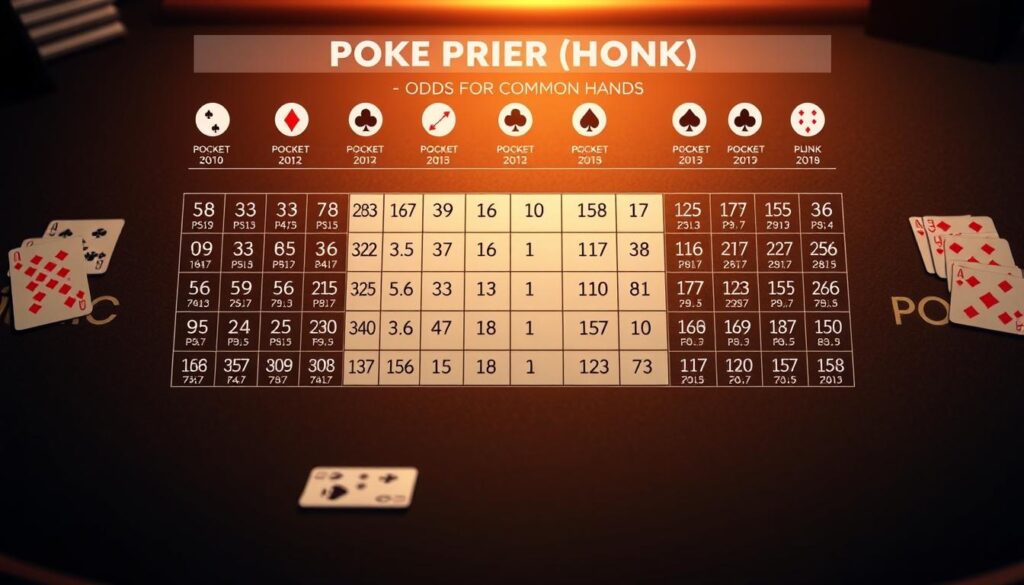
That pair of rockets in your hand? They have a 42.3% chance of making it past the flop. That’s better than most Netflix rom-coms. But not all pairs are equal. Let’s look at them like a sommelier:
- Premium pairs (AA-JJ): The Dom Pérignon of starting hands. Holds up 65%+ against single opponents
- Mid-tier pairs (TT-77): Your craft beer options. Needs favorable flop texture to avoid becoming folding stock
- Small pairs (66-22): The boxed wine special. Either flops a set or becomes tomorrow’s recycling
| Hand | Heads-Up Win % | 6-Max Survival Rate |
|---|---|---|
| AA | 85% | 72% |
| 88 | 52% | 41% |
| 33 | 35% | 29% |
Pocket deuces have less equity than a crypto bro’s Twitter thread? That’s why 7-card stud data shows a harsh truth. Low pairs lose chips fast, like a Game of Thrones finale. Treat small pairs like Tinder dates—cheap to see the flop, but bail fast if there’s no connection.
Here’s the kicker: even premium pairs get dethroned 1 in 3 times. That’s why understanding poker hand rankings is key, not just memorizing odds. It’s not about what you’re holding—it’s about what the board could hold. Next time you’re dealt ducks, ask yourself: “Would I stream this hand on Spotify?” If it’s not chart-topping material, fold like a lawn chair.
Quick Math Tools and Shortcuts
Did you know you don’t need a calculator for Vegas math? Blackjack players worry about dealer cards, while poker pros use mental tricks. These tricks make complex math simple.
The Rule of 4 and 2
MIT grads love this trick: multiply your outs by 4 after the flop or 2 after the turn. For example, nine outs for a flush? That’s 9×4 = 36% chance. It’s as easy as counting drinks at a free bar.
But why is this better than blackjack’s basic strategy? Let’s look at it:
| Situation | Poker Calculation | Blackjack Calculation |
|---|---|---|
| Flop to River | Outs x 4 = ~% chance | Dealer’s 6 upcard = 42% bust chance |
| Turn to River | Outs x 2 = ~% chance | 12 vs dealer 2 = 31% hit/bust risk |
| Key Difference | Controlled variables (known cards) | Unknown deck composition |
Poker lets you count visible variables. Blackjack’s deck changes, making math harder. Our Rule of 4/2 works because we use known math.
Pro tip: Keep this secret like your favorite dive bar’s menu. Use it wisely, but remember – even with 36% odds, you’ll miss 64% of the time. Math can be both generous and cruel.
Real-Life Examples and Practice Problems
Let’s dive into poker history like it’s a mystery to solve. Here, the river card is like a clue, and knowing pot odds is key. We’ll look at hands where math met bravado, showing if players made smart choices or just hoped for luck.
Tournament Hand Breakdown
In the 2021 WSOP Main Event, a player faced a big decision. They had 8♠7♠ on a 5♠2♥9♠ flop, with a $14,000 pot at stake. Their opponent bet $6,200. Was calling +EV or a huge blunder? Let’s examine it closely:
- Outs: 9 spades left (flush) + 3 non-spade 6s (straight) = 12 outs
- Equity: With 12 outs, 48% chance to win
- Pot Odds: $14,000 pot vs. $6,200 call → 2.26:1 (30.6% breakeven point)
The math clearly says “Call!” louder than a roulette fan winning 15 times in a row. With 48% equity, this is a classic pot odds case. But the player folded. It shows even pros can ignore math when their gut tells them to.
| Scenario | Pot Size | Call Amount | Required Equity | Correct Play |
|---|---|---|---|---|
| Flush Draw | $14k | $6.2k | 30.6% | Call |
| Open-Ended Straight | $8k | $3k | 27.3% | Raise |
| Overpair vs Shove | $25k | $11k | 30.5% | Fold |
Now it’s your turn: In a $10,000 pot with $3,500 to call and 15 outs, what do you do? (Hint: Do the equity math before your amygdala starts yelling “All in!”) The answer’s clearer than a clean poker table – but I’ll let you figure it out.
Avoiding Odds Misconceptions
Let’s talk about something big in poker: 57% of new players think probability works like Netflix. They think things are “due” to happen next. But, cards don’t care about how you feel. They’re as changeable as a TV show getting canceled.
The Gambler’s Fallacy Exposed

Think seven missed flush draws mean the eighth must hit? That’s not math—it’s wishful thinking. Each hand starts fresh. Your chance of winning with a flush draw on the turn is always 19.1%, no matter how many times you’ve missed.
Why do people believe this myth? Our brains love patterns, like avocado toast. But poker doesn’t care about patterns. It’s all about short-term luck, not karma. Knowing when to play is key. Use late position to control the game when luck is against you.
- Track patterns over 100+ hands, not single sessions
- Stick to pre-flop ranges that math approves, not gut feelings
- Treat every hand as its own universe—no cosmic debts exist
Remember: The chance of winning isn’t a slot machine. It’s a simple math problem. Learn it, and you’ll stop chasing “due” cards faster than Hollywood reboots Narnia.
Advanced Reading
You’ve learned the basics of math, now it’s time for poker’s advanced physics. Imagine doing complex math while enjoying kombucha. We’re moving beyond simple counting to complex decision-making.
GTO and Beyond
Game Theory Optimal (GTO) is more than a buzzword. It’s the holy grail of unexploitable play. It’s like a high-stakes version of rock-paper-scissors. Achieving Nash equilibrium means your strategy can’t be beaten, even if opponents know it.
Let’s explore two key concepts:
| Concept | What It Solves | Key Insight | Real-World Use |
|---|---|---|---|
| Sklansky Dollars | Expected value in perfect scenarios | “What if opponents always made optimal decisions?” | Post-hand analysis |
| Chen’s G-Bucks | Equity vs. opponent ranges | “My hand’s value depends on what you might have” | Preflop adjustments |
| Reverse Implied Odds | Future betting consequences | “Winning this pot could cost me three bigger ones later” | River bluff sizing |
Modern poker isn’t just about charts. It’s about dynamic balancing. Your 3-bet frequency is a mix of math and strategy. Top players make “illogical” calls to keep balance, not chase bad hands.
Using these concepts together is the real magic. Chen’s G-Bucks helps you choose which hands to play. Reverse implied odds guide how deep to bet. It’s like using GPS and weather radar together, avoiding bad situations.
Pro tip: Start with one advanced concept at a time. Trying to learn everything at once is like doing calculus without fractions. Even Einstein started with basic algebra.
Conclusion: Taking Your Math to the Table
Learning poker odds is like mastering a craft. First, you learn the basics, then you add your own flair. Remembering hand probabilities is like playing a simple riff. But once you get the hang of it, calculating expected value becomes your own solo.
When you hit 82% accuracy, you’re like Jimi Hendrix with cards. Poker’s math is complex, unlike blackjack’s straightforward stats. Blackjack is like a machine, but poker is like jazz, where every card changes the game.
Think of the flush draw breakdown as your secret chord. The Rule of 4 and 2 is your cheat code. These tools help you make smart bets, turning guesses into sure things.
Next time you see a straight draw, don’t just look at the 31.5% chance. See the whole story. The pot odds and implied value are like whispers and winks. That’s when math turns into money. Now, let’s play and see the numbers come alive.
Leave a Reply