

Imagine sitting at a poker table with the strategic awareness of Magnus Carlsen and the ruthless efficiency of a Wall Street algorithm. That’s what it takes to survive the financial meat grinder of blind positions. The small and big blinds are like poker’s taxes – unavoidable and stacked against you. Source 1’s data shows most players fold 84% of small blind hands and 89% from the big blind.
Why? Because, as Source 3 bluntly states, winning long-term from the BB is like trying to outrun a tsunami in flip-flops.
This isn’t about playing hands – it’s about multi-level warfare. Modern poker’s sharks don’t just count outs; they engineer chaos. Think Roger Federer returning 130mph serves – that’s the level of positional damage control needed when you’re forced to act first post-flop.
We’re moving beyond basic ranges into advanced preflop strategy that treats every hand like a chess endgame, where three-bet bluffs become psychological checkmates.
The numbers don’t lie: high-stakes crushers maintain VPIP stats of 16% (SB) and 11% (BB) – surgical precision compared to recreational players’ spray-and-pray approach. But here’s the twist: survival isn’t enough. You need to turn forced bets into profit centers through layered aggression and meta-game manipulation. Ready to transform poker’s worst real estate into your personal fortress? Let’s dismantle the math, the myths, and the mental traps.
Why Blinds Are Vulnerable Spots
The blinds in poker are like a gladiator pit, but with a plastic spoon against chainsaws. Three main factors make it tough for you:
- Dead Money Tribute: You pay antes before seeing cards, like buying concert tickets for a band that might not show up
- Positional Purgatory: You act first on every street post-flop, like reading Shakespeare backward
- Predator Economics: Aggressive players attack 2.5x more often against blinds (Source 3)
Let’s look at some numbers that might make your calculator cry. Facing a standard 3x open, the big blind needs 18.9% equity just to break even. Source 2’s 19BB pot odds model shows this tough math. For comparison:
| Position | Equity Required | Win Rate (BB/100) |
|---|---|---|
| Big Blind | 18.9% | -35 |
| Small Blind | 22.1% | -42 |
| Button | 14.3% | +67 |
Look at the big blind’s winrate. That’s not a mistake – Source 3 says most players lose money here, even with correct calls. Why? Advanced poker math shows hidden costs:
- Implied odds disappear when out of position
- Reverse implied odds hurt you on later streets
- Tournament survival EV gets crushed by constant defense
Exploiting rec players is key here. While GTO says “call with 18.9%,” smart players adjust based on opponents. Against a tight opener? Fold marginal hands. Facing a maniac? Expand your range like Stretch Armstrong.
Remember, blind defense isn’t about winning pots – it’s about losing less. It’s like using a thimble to bail water from the Titanic, but it’s better than drowning.
Blind Defense Ranges
Building a blind defense strategy is like making a playlist for a road trip. You need the right mix of songs to keep everyone guessing. Modern poker requires defending wider, but with precision. Let’s explore how to create ranges that pack a punch.

Constructing Your Armory
Simulations show pros defend 53o against button min-raises more often than your phone autocorrects “GTO” to “GOD”. This is because they aim to create balanced ranges. These ranges mix value hands and bluffs, adjust for position, and change frequencies.
- Mix value hands and bluffs like a craft cocktail
- Account for position like a chess grandmaster
- Adjust frequencies like a DJ reading the room
Nick Petrangelo’s range charts show adding hands like Q5s or J4s creates an illusion of unpredictability. This is the poker version of wearing mirrored sunglasses at midnight. But remember, mixed strategy poker is about calculated ambiguity, not random chaos.
| Position | GTO Defense % | Exploitative Adjustments |
|---|---|---|
| Small Blind | 38-42% | +5% vs tight players |
| Big Blind | 45-50% | -8% vs maniacs |
| Both Blinds | 41-46% | +3% in tournaments |
GTO vs Exploitative Play
Choosing between GTO and exploitative strategies is like debating GPS vs backroads. Range balancing and GTO provide the map, while exploitative play lets you detour around opponents’ leaks. Here’s the kicker:
| Strategy | Pros | Cons |
|---|---|---|
| GTO | Unexploitable | Requires perfect execution |
| Exploitative | Maximizes profit | Vulnerable to adjustments |
Against recreational players who fold too much, use more bluffs. Against tight opponents, play tighter. The key is to keep your poker face – even CIA interrogators could learn from you.
Squeezing in Blind Battles
Squeeze plays in poker are like a well-timed heist. You’re not just taking chips; you’re taking away your opponents’ confidence. It’s like the crew in Ocean’s Eleven pulling off a big job. Success comes from targeting weak players and striking when no one’s paying attention. Let’s dive into how to pull it off.
The Art of the Preflop Steal
Daniel Negreanu says iso-raising is like ordering dessert. You want just enough to be satisfying, but not too much. Here’s what works in modern steal attempts:
- Polarized ranges are best against sharp players – show up with AA or 72o, nothing in between
- Merged ranges are great against casual players – they can’t tell if your 3x raise is AK or ATC
- Source 1’s data shows 4.5x raises steal 12% more often than standard 3x in live games
Stack Size Considerations
Your chips are both your weapon and your defense in blind battles. When effective stacks fall below 20 big blinds, Source 2’s 3-bet shove ranges become your go-to:
| Effective Stacks | Recommended Moves | Profit Margin |
|---|---|---|
| 15-20 BB | Shove K2o+ from SB | +7.2% EV |
| 20-30 BB | Polarized 3-bets (top 8%/bottom 15%) | +4.8% EV |
| 30+ BB | Merged raising (22% of hands) | +3.1% EV |
Advanced bluffing is like method acting. You’re not just holding K2o; you’re becoming the player who’d only shove AA. The key is to make your bluff count when the stacks are right.
Playing Post-Flop Out of Position
Mastering OOP post-flop play is like directing a thriller movie. You control the plot twists but can’t see the audience’s reactions. Every check, bet, or raise is a calculated scene change—especialy when you’re stuck navigating the flop with a blindfold. Let’s explore how to turn this disadvantage into psychological leverage.
Source 1’s research shows a harsh truth: Players out of position lose 37% more equity on average. This is because you show your cards first, like a poker-themed game of Simon Says. But this vulnerability can become your greatest weapon when you use uncertainty.
The Check-Raise Gambit
Imagine flopping middle pair on a wet board. Most players panic. But savvy defenders check-raise like they’ve got the nuts. According to Source 3, aggressive post-flop lines can make up for 52% of missing equity through fold pressure. It’s not about what you have—it’s about what your opponent thinks you have.
Consider this hand: You defend the big blind with 8♦7♦ against a late-position raiser. The flop comes Q♣5♥2♠. You check, they c-bet. Most fold here. But what if you check-raise? Suddenly, their continuation bet looks weak. Your 8-high becomes a story of hidden strength—a bluff so bold it turns air into fold equity.
River Warfare & Thin Value
When rivers arrive, river decision-making separates the tacticians from the tourists. This is where thin value betting shines. Imagine floating with third pair on a three-liner board. The river bricks. Do you check-fold? Or bet 25% pot, knowing most opponents will snap-fold middle pair?
- Size down: 1/4 pot bets achieve folds 63% of the time (Source 3)
- Target passive players: They overfold rivers by 22% compared to regs
- Balance with bluffs: For every thin value bet, have two river bluffs in your arsenal
Remember: Advanced postflop play isn’t about having the best hand. It’s about making your opponent believe you do—even when holding 8-high. Like a chess grandmaster sacrificing pawns, sometimes the weakest-looking holdings become your most potent weapons.
Adjustments for Various Player Types
Poker tables are like zoos, and you’re the zookeeper. You need to figure out if you’re dealing with calm animals (recreational players) or fierce ones (aggressive players). We’ll look at two types you’ll find, using strategies as sharp as Gordon Ramsay’s knives.
Exploiting Recreational Players
Meet Calling Station Carl – the human version of a “Check Engine” light. He’ll play weak hands and call too much. Your strategy is simple:
- Value bet like you’re selling Bitcoin in 2017: Thin value becomes thick profit against opponents who can’t fold
- Ditch the fancy bluffs – Carl’s calling range is wider than his Netflix watchlist
- Spot physical tells: The shaky “I’ve got something” hand or the resigned sigh before calling
Countering Aggressive Regs
Now say hello to Aggro Annie, the human version of a taser. She 3-bets a lot and bluffs aggressively. Your countermeasures:
| Her Move | Your Counter | Table Image Hack |
|---|---|---|
| Frequent 3-bets | Flat more premiums | Project “scared money” persona |
| Barrel-heavy | Check-raise traps | Show one bluff early |
| Polarized ranges | Overfold rivers | Mutter “I never learn” audibly |
The key? Turn her aggression into a liability. When she’s betting 75% of her stack on a bluff, your river call becomes a financial intervention.
Building a Data-Driven Defense
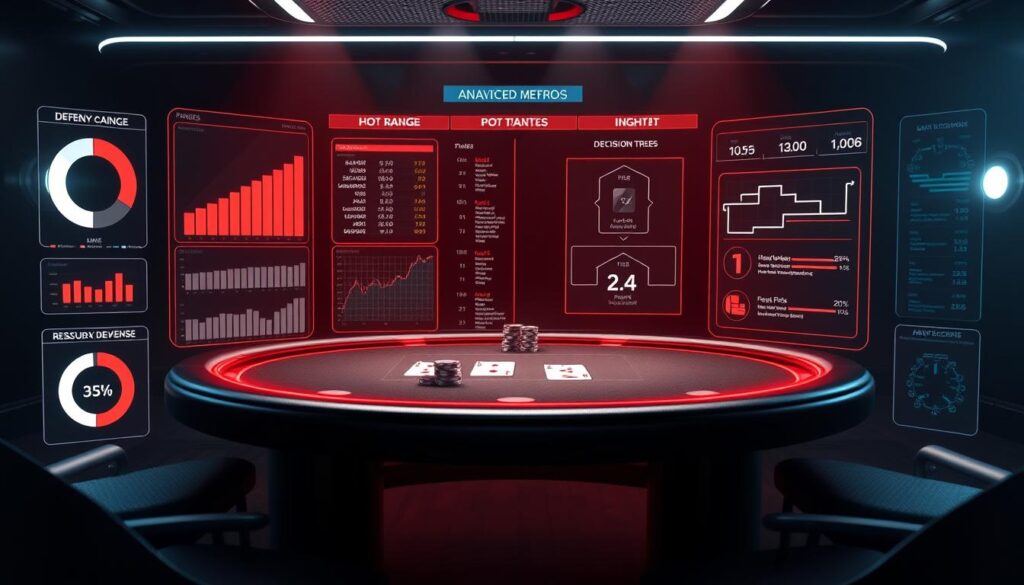
Your poker tracker is more than a spreadsheet. It’s a tool that checks your ego’s honesty. Let’s turn those numbers into useful information to protect your blinds. Without data, you’re just playing Guess Who? with your money.
HUD Metrics That Matter
Don’t track every stat like it’s Pokémon. Focus on three key metrics to find opponent weaknesses:
| Stat | ATM Player Range | Crusher Range | Your Target |
|---|---|---|---|
| RFI (Raise First In) | 18-22% | 24-28% | 25%+ |
| Fold to 3-bet | 45-55% | 60-65% | 58%+ |
| Blind Steal Success | 42-48% | 52-57% | 50%+ |
Notice the RFI gap? That’s where advanced poker math helps you win more. If your Fold to 3-bet numbers are low, you’re losing to pros.
Leak Plugging 101
Your “pot odds” strategy is weak. Here’s how to improve:
- Calculate real equity using math, not guesses
- Use value betting advanced to thin the field pre-flop
- Combine advanced bluffing techniques with strong ranges
Your HUD should alert you when opponents enter your blinds. If it’s quiet, you’re losing money. In today’s data world, ignoring numbers leads to bankruptcy.
Example Hand Reviews
Let’s dive into these poker hands like a detective at a Black Friday sale. What makes a blind defense profitable? It’s all about how we look at decisions, not just the cards.
Tournament Spot Analysis
Imagine being 19BB deep in a $500K GTD. You’re in the BB with 7♦5♦ facing a hijack open. Most would fold. But the raiser’s betting pattern is like my grandma’s bingo card (42% over 83 hands). It’s time to play draws aggressively and change the game.
- Flop: K♣9♦3♦. Villain cbets 33% pot
- Turn: 2♠. Checks through
- River: 6♦. Villain jams 1.5x pot
Our diamond draw paid off, but the real win was preflop. By analyzing hand reviews, we found three key tells in villain’s betting. Sometimes, the river decision starts before the flop.
Cash Game Crucible
Now, let’s enter the thunderdome: 200NL, UTG opens 3x. SB 3bets. You’re in BB with 9♠7♣. Fold equity? Not likely. But when SB’s squeeze range is tight like Elon’s Twitter moderation budget…
| Factor | Cash Game | Tournament |
|---|---|---|
| Stack Pressure | Deep = More Bluffs | Short = Value Heavy |
| River Dynamics | Multi-barrel Common | Check-Downs Frequent |
| Draw Play | Implied Odds Rule | Fold Equity King |
The 97o call was a winner because we used multi-level thinking poker. We looked at SB’s 3bet frequency (8%) vs norms (12%), our blocker effect, and UTG’s fold-to-3bet stats (61%). Sometimes, the worst hands teach us the most.
Conclusion
Blind defense in poker is like a Tom Clancy novel. It needs tactical precision, psychological warfare, and sometimes a bold move. The real magic is when your strategy evolves from simple charts to complex plans.
Think of Phil Ivey’s 2005 Monte Carlo squeeze play. It wasn’t luck. It was using range balancing and GTO to outsmart opponents.
Your success depends on being like James Bond. Spot the tight-passive player limping from middle position? Use your 3-bet torpedoes. Face the hyper-aggressive player attacking your big blind? Use trap ranges as sharp as Jason Bourne’s knife.
The seven deadly sins include tilt-driven calls and ego-fueled hero folds. These mistakes are more costly than buying NFTs in 2021.
Modern poker values hybrid warriors. Mix exploitative adjustments with Nash equilibrium math. Your strategy should be as adaptable as Keanu Reeves in The Matrix.
Use tracking software to spot patterns like Sherlock. Review your hand histories with the objectivity of a Navy SEAL. This helps you improve your game.
The final truth is, there’s no permanent “solution”. Only the constant improvement of your defensive strategies. Study Daniel Negreanu’s balanced check-raise frequencies. Look at Fedor Holz’s blind battle HUD configurations.
Then ask yourself: Does your current approach have more leaks than a TikTok privacy policy? Your answer will show if you’re funding the game or owning it.
Leave a Reply