

Welcome to your ultimate guide on one of the most fundamental ideas in the card game. This mathematical concept is the cornerstone of a winning strategy.
Our content will break down this critical term in a clear, beginner-friendly way. We’ll move from basic definitions to practical applications you can use right away.
Mastering this principle transforms your play. It shifts decision-making from guesswork to a calculated and logical process. This skill is essential for long-term success and profitability.
This article provides a complete framework. We’ll explore a famous sports analogy, a universal formula, and real-table examples. You’ll learn to evaluate every move—bet, call, raise, or fold.
Remember, short-term results involve luck. However, consistent success is built on solid strategic foundations. Understanding this core idea offers a significant advantage over opponents.
Think of it as a learnable skill. Once internalized, it becomes a powerful tool in your mental arsenal. Let’s begin building that foundation now.
Introduction: What is Expected Value?
This mathematical framework isn’t exclusive to gambling; it’s a cornerstone of finance, insurance, and strategic planning. In its broadest sense, expected value (EV) is a statistical measure. It represents the average outcome of a decision when repeated over many trials.
Think of it as the long-term result you can anticipate from a choice. This powerful idea helps us navigate uncertainty in a logical way.
Defining EV Beyond Poker
The concept applies to countless everyday situations. Insurance companies use it to calculate premiums based on risk probabilities.
Investors rely on it to assess the potential average return of an asset. Even a simple coin toss has a calculable expected value.
This universal relevance shows EV is a tool for rational analysis. It moves decisions from guesswork to calculated probability.
Why EV is the Foundation of Profitable Poker
In the card game, this principle quantifies the long-term profitability of any action. Calling a bet or raising can be evaluated through this lens.
Consistently making +EV decisions leads to winning results over time. This holds true despite short-term luck or variance.
A single loss doesn’t invalidate a good, +EV play. Conversely, a lucky win doesn’t justify a poor, -EV one.
This is why mastering this skill transforms the activity. Players learn to identify and execute profitable moves.
Understanding EV shifts your approach from intuition to an analytical, evidence-based method. For a more detailed EV analysis, explore this resource.
It provides the strategic foundation for all long-term success. Embracing this concept is the first step toward a significant advantage.
The Steph Curry Bet: A Simple EV Analogy
To truly grasp this core principle, consider a straightforward wager on a basketball superstar. This example strips away complexity and shows the math in action.
We’ll use a hypothetical bet on Steph Curry shooting a free throw. His career accuracy is an incredible 90.1%.
This simple scenario teaches everything about long-term averages. It shows how the same action can be good or bad based on the terms.
Setting Up the Wager
Here is the situation. You put $5 on the line. You are betting that Curry will make his next free throw.
A friend offers you even money. If Curry makes it, you win $5. If he misses, you lose your $5.
The probability he makes the shot is 90.1%, or 0.901. The chance he misses is 9.9%, or 0.099. This is the foundation for our calculation.
Calculating the Negative EV Scenario
Let’s find the average result. Multiply each outcome’s value by its probability.
For a loss: 0.901 probability * (-$5) = -$4.505. For a win: 0.099 probability * (+$5) = +$0.495.
Add them together: -$4.505 + $0.495 = -$4.01. This is the expected value.
A negative number means this is a poor bet. If you repeated it many times, you’d lose about $4.01 per event on average.
The high chance of a small loss overwhelms the small chance of a small win.
| Scenario | Your Bet (Risk) | Potential Win | Win Probability | Loss Probability | Expected Value (EV) |
|---|---|---|---|---|---|
| Even Money | $5 | $5 | 9.9% (0.099) | 90.1% (0.901) | -$4.01 |
| 20-to-1 Odds | $5 | $100 | 9.9% (0.099) | 90.1% (0.901) | +$5.39 |
How Changing the Odds Creates +EV
Now, change the offer. Your friend gives you 20-to-1 odds. You still risk $5.
But if Curry makes it, you win $100. The probabilities stay the same.
Recalculate: Loss: 0.901 * (-$5) = -$4.505. Win: 0.099 * (+$100) = +$9.90.
The new sum: -$4.505 + $9.90 = +$5.39. The EV is now positive.
This example reveals a key insight. The profitability of an action depends on the risk-reward ratio.
The same bet on Curry flips from bad to good when the potential reward is large enough.
In the card game, this mirrors pot odds. A call can be correct or incorrect based on the amount in the pot versus the cost.
Remember, even a +EV bet can lose. Curry will likely make the shot, and you’d lose your $5 that time.
But over the long course, making such +EV decisions guarantees profit. This separates skill from short-term win lose results.
The Universal Expected Value Formula
The engine behind all strategic analysis is a universal formula that quantifies choice. This equation turns abstract ideas about averages into a concrete number you can use.
It provides a clear way to evaluate any decision with uncertain outcomes. Let’s look at this powerful tool.
Breaking Down the EV Equation
The standard form of the expected value formula is:
EV = (Probability of Winning × Amount Won) – (Probability of Losing × Amount Lost).
Each part has a specific meaning:
- Probability of Winning: Your estimated chance of success, written as a decimal (e.g., 40% = 0.40).
- Amount Won: Your net gain. In a game context, this is the total pot you would win, minus any cost you’ve already put in.
- Probability of Losing: Simply 1 minus your win probability. If you have a 40% chance to win, you have a 60% chance to lose.
- Amount Lost: This is typically the chips you must risk now to stay in the hand.
Remember to convert any percentage to a decimal before calculating. A 35% chance becomes 0.35.
The amount you can win includes money already in the middle. The amount you might lose is usually your next bet or call.
Understanding Probability and Outcome Value
Consider a fair coin flip. You win $10 on heads, but lose $5 on tails.
The probability for each outcome is 50%, or 0.5. Plugging into the formula:
EV = (0.5 × $10) – (0.5 × $5) = $5 – $2.50 = +$2.50.
This positive number means the wager is profitable in the long run. You expect to gain $2.50 per flip on average.
The formula itself is straightforward. The real skill lies in estimating the probabilities accurately.
You must assess the likelihood of different result scenarios. Good inputs lead to a useful value for your decision.
Poor estimates, however, will make the final calculation misleading. Precise inputs are crucial for a correct analysis.
What is Poker Expected Value (EV)?
This concept, when applied to the felt, defines the average chip outcome of any single move you make. It is the specific mathematical principle that guides profitable strategy in the card game.
Here, we move from the universal formula to its direct application. Understanding this idea is the key to turning random events into a reliable process.
EV as Your Long-Term Average Result
In this activity, expected value (EV) is the average chip result of a specific action in a hand. This average is calculated if the same decision were repeated over thousands of trials.
It represents your long-term average result. This smooths out the short-term luck, or variance, that is part of every session.
Consider a classic example. Getting all your chips in preflop with pocket aces is massively +EV.
Sometimes a weaker hand will suck out and win. Over a large sample size, however, your aces will generate a significant profit. The positive EV captures this guaranteed long-run edge.
The Difference Between a Single Outcome and EV
A critical distinction exists between a single outcome and EV. Winning a particular pot does not mean your choice was correct.
Conversely, losing a hand does not mean your play was wrong. The real question is: was your decision profitable over the long term?
Good players focus solely on making +EV decisions. They trust that volume will realize the expected value, regardless of immediate results.
This applies to every action. Calling can be +EV if the pot odds justify it. Betting and raising can be +EV for value or as a bluff.
Even folding can be a +EV play. This is true if calling would lose more chips on average.
Adopting this view requires a major mental shift. You move from being results-oriented to being process-oriented.
The goal is no longer just to win the pot in front of you. The goal is to make the play with the highest average return.
In practice, these calculations involve complex estimations. You must judge opponent hand ranges and predict future actions on later streets.
Mastering this skill transforms how you approach the game. It builds a foundation for consistent success.
Key Components of Poker EV: Equity and Ranges
Accurate strategic analysis relies on understanding two interconnected components: your hand’s equity and your opponent’s possible holdings. These ideas transform vague guesses into precise calculations.
Mastering them is essential for making profitable decisions. They provide the raw data needed for any expected value formula.
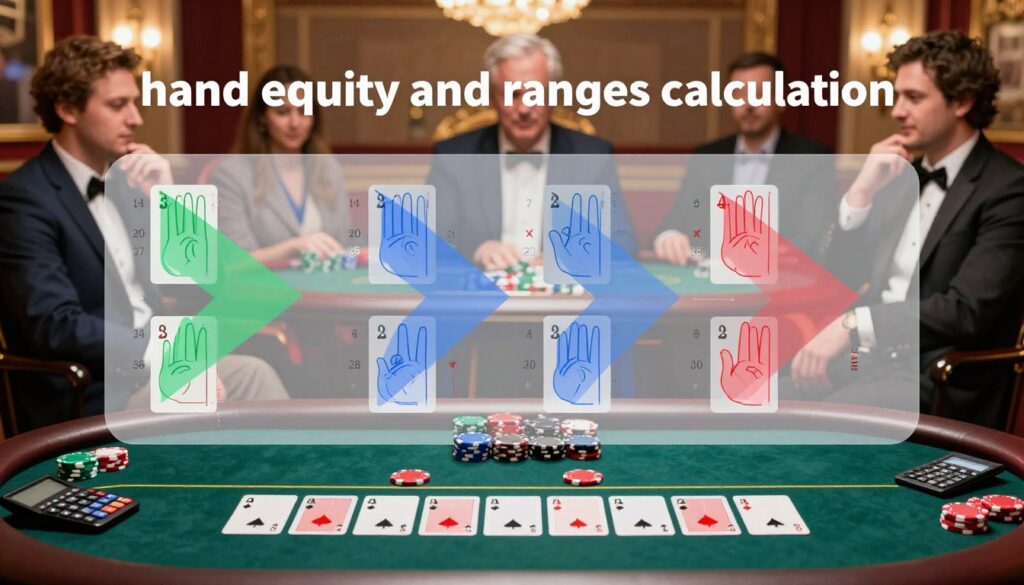
What is Hand Equity and How is it Calculated?
Hand equity is your percentage chance of winning a hand at showdown. It assumes all remaining community cards are dealt out.
This number represents your share of the pot based on pure card strength. For example, a combo draw might have 34.09% equity against a single pair like top pair.
You calculate this figure in two primary ways. Advanced players use software known as an equity calculator.
You input your cards, your opponent’s assumed range, and the board. The software runs thousands of simulations to find an exact percentage.
For a quick at-the-table estimate, use the rule of 2 and 4. After the flop, multiply your number of outs by 4 to get an approximate equity percentage.
After the turn, multiply your outs by 2. This method gives a solid ballpark figure for decision-making.
The Concept of Opponent Hand Ranges
Thinking in terms of a single hand is a common mistake. Skilled players consider a range, which is the set of all hands an opponent could logically hold.
This range is built from their actions throughout the hand. A pre-flop raise and a flop bet might indicate a range of “top pair or better” and “strong draws.”
Assigning a range is far more accurate. It accounts for the uncertainty inherent in the game.
Your rival could have several different holdings that fit their actions. Your strategy must work against all of them, not just one.
Estimating Equity Against a Range
You don’t have equity against one hand, but against an entire spectrum of possibilities. The process involves averaging your equity across every hand in their assigned range.
Specialized software does this instantly. For a mental approximation, consider how your hand fares against the strongest and weakest parts of their range.
Let’s examine a concrete situation. You hold Q♥J♥ on a flop of A♥K♦7♥.
You face a bet from a tight player. You assign them a c-betting range of strong hands like top pair, sets, and maybe A-K.
Against that specific range, your flush draw and gutshot straight draw have about 42% equity. This is a crucial piece of information for deciding whether to call, raise, or fold.
Accurate EV calculations depend entirely on correctly estimating equity. That estimation, in turn, depends on accurately assigning ranges.
Remember, equity is not static. It changes on every street as new cards are revealed and your opponent’s range narrows.
A draw that misses on the turn sees its equity drop significantly. A made hand that improves can see its equity soar.
| Calculation Method | Best Used For | Process | Example (9 outs after flop) | Estimated Equity |
|---|---|---|---|---|
| Rule of 4 | Quick flop decisions | Multiply outs by 4 | 9 outs × 4 | ~36% |
| Rule of 2 | Turn decisions | Multiply outs by 2 | 9 outs × 2 | ~18% |
| Equity Calculator | Detailed analysis & study | Input cards, board, and full opponent range | Q♥J♥ vs. tight range on A♥K♦7♥ | ~42% (exact) |
This table shows the primary ways to find your equity percentage. Choosing the right tool for the situation is a key skill.
Understanding these components provides a clear way to evaluate any spot. You move from feeling to a number you can use in a formula.
Step-by-Step: How to Calculate EV in a Poker Hand
The real power of this mathematical framework is unlocked when you learn to apply it to specific situations. A clear, four-step method turns complex choices into a logical process.
This approach works for any decision: calling, betting, raising, or folding. You break the situation down into parts.
Mastering these steps builds the skill to evaluate moves quickly. Let’s examine each part of the process.
1. Identify All Possible Outcomes
First, map out every way the hand could end after your action. Don’t just think about winning or losing the pot right now.
For a bet or raise, common outcomes include your opponent folding, calling, or re-raising. If they call, you must consider both winning and losing at showdown.
For a call, the main outcomes are usually just two: you win the pot, or you lose the chips you just put in. Listing these possibilities creates a complete picture.
2. Assign Probabilities to Each Outcome
This step requires your best judgment. You estimate the likelihood, or probability, of each outcome you identified.
Use your analysis of opponent tendencies and hand ranges. How often will they fold to your bet? This is fold equity.
If they call, what is your hand’s equity against their calling range? This is your showdown percentage.
These estimates are rarely perfect. The goal is a reasonable, educated guess based on the available information.
| Outcome | Basis for Probability Estimate | Example Estimate |
|---|---|---|
| Opponent Folds | Their observed fold frequency to similar bets. | 40% (0.40) |
| Opponent Calls & You Win | Your hand equity vs. their calling range. | 35% of the 60% call chance = 21% total |
| Opponent Calls & You Lose | Your loss equity vs. their calling range. | 65% of the 60% call chance = 39% total |
3. Determine the Financial Result of Each
Now, find the chip result for every scenario. How much do you gain or lose?
For an outcome where you win, the amount is the total pot you will collect. Remember to subtract any chips you have already invested.
For an outcome where you lose, the amount is typically the chips you are risking with your current decision. Be precise with these numbers.
4. Plug the Numbers into the Formula
The final step is the calculation. Multiply each outcome’s probability (as a decimal) by its financial result.
Then, sum all these products together. The total is the expected value of your decision.
You can use the standard formula: EV = (%Win * $Won) – (%Lose * $Lost). This gives you a clear average result.
Let’s walk through a simple example. You face a $50 bet on the turn. The pot is $100, and you have a flush draw with 9 outs.
Step 1: Outcomes. You call and win, or you call and lose.
Step 2: Probabilities. With 9 outs, your equity is about 18% (using the rule of 2). Win probability: 0.18. Lose probability: 0.82.
Step 3: Financial Results. If you win, you gain the $150 total pot ($100 + opponent’s $50) minus your $50 call. Net win = +$100. If you lose, you lose your $50 call.
Step 4: Calculation. EV = (0.18 * $100) – (0.82 * $50) = $18 – $41 = -$23.
This negative number shows a call is unprofitable given these pot odds. You would need better odds or implied odds to justify it.
Steps 2 and 3 are where strategic skill shines. Estimating probabilities and pot amounts accurately separates good players from great ones.
Full calculations at the table are complex. Practicing them away from the game builds intuition for faster, in-game decisions.
Many players use decision trees to visualize this process. They map each branch of possible action and its corresponding outcomes.
This structured way of thinking ensures you consider every important factor. Over times, it becomes second nature.
Poker EV in Action: The Combo Draw All-In Decision
Applying the EV framework to a semi-bluff shove reveals the engine of long-term profit. This example puts theory into practice with a common but complex scenario.
You face a large bet on the turn while holding a powerful draw. The decision to move all-in combines precise math with psychological reads.
Hand Setup and Opponent Read
Imagine a $2/$4 cash game. You are on the button with J♦9♦. The flop comes 5♦10♦2♣, giving you a flush draw and a gutshot straight draw.
The turn is the 7♠. Your opponent, in middle position, bets $50 into a pot of $148. This player has an aggressive style.
They are capable of betting with marginal made hands for protection. Your read suggests they might fold 66% of the time to a large all-in raise.
Building the Decision Tree
You decide to shove your remaining $154. Three primary results are possible.
The villain folds immediately. You win the current $148 pot. They could call your shove.
If they call, you then either win the larger pot or lose your entire stack. This creates a clear decision tree.
| Possible Outcome | Probability | Financial Result | Partial EV Contribution |
|---|---|---|---|
| Opponent Folds | 66% (0.66) | + $148 | 0.66 × $148 = +$97.68 |
| Opponent Calls & You Win | 11.59% (0.1159) | + $252 | 0.1159 × $252 = +$29.21 |
| Opponent Calls & You Lose | 22.41% (0.2241) | – $154 | 0.2241 × -$154 = -$34.51 |
The probabilities for the call scenarios come from your equity estimate. Against a likely calling range including top pair, your hand has about 34.09% equity.
Crunching the Numbers: Fold Equity vs. Showdown Equity
The calculation separates into two parts. First, find the EV for when you are called.
Your showdown equity is 34.09%. The net win amount is $252. The loss is your $154 shove.
EVWhen Called = (0.3409 × $252) – (0.6591 × $154). This equals approximately -$16.50.
Being a slight underdog when called creates a negative value in that branch. This is offset by your fold equity.
Fold equity is the money you gain when the villain folds. Its EV is 0.66 × $148 = +$97.68.
The total EV of the shove is the sum: $97.68 + (-$16.50) = +$92.23. This large positive number confirms the shove is highly profitable.
Why This Shove is +EV
The play is +EV because the high fold chance (66%) generates enough profit to cover the loss when called. Your bluff has a strong mathematical purpose.
This example highlights two key components. Fold equity is the value derived from making your opponent surrender.
Showdown equity is the value from your card equity when all chips go in. Here, the former massively outweighs the latter.
It is crucial to note this decision is player-specific. Against a tight player who calls often, the same shove on this flop and turn could be -EV.
Your accurate read on their folding frequency transforms a marginal hand into a profitable weapon. This is strategic adjustment in action.
Positive EV (+EV) vs. Negative EV (-EV)
Every move you make at the table can be classified as either adding to or subtracting from your long-term chip stack. This binary framework is the essence of strategic mastery.
A positive expected value (+EV) action is one that, on average, adds chips to your stack when repeated over many trials. Conversely, a negative expected value (-EV) decision loses chips on average.
The goal of winning play is simple: maximize +EV choices and minimize -EV ones. Your long-term profit is the direct sum of these actions.
Identifying +EV Plays for Long-Term Profit
Spotting profitable situations requires a mix of math and observation. You use the EV formula, equity estimates, and reads on your opponent.
Common +EV plays include calling when pot odds justify it. Value betting with strong hands is another clear example.
Bluffing in good spots, where fold equity is high, also qualifies. Each of these actions has a positive theoretical chip balance.
To identify them, ask: does the potential reward outweigh the risk? Use your calculated equity against the villain’s assumed range.
Then, check if the pot offers enough to call. Consistent profit comes from repeating these correct decisions.
Recognizing and Avoiding -EV Decisions
Losing plays often feel tempting in the moment. They are calls made with insufficient odds or bluffs into players who never fold.
Overplaying weak hands for multiple streets is a classic -EV way to lose chips. These choices have a negative average result.
The key to avoidance is discipline. Stick to your calculations even when you want to “gamble.”
Be wary of “fancy play syndrome.” This is where you make a complex, -EV play trying to outthink an opponent unnecessarily.
Simple, solid decisions based on math are usually best. They build your stack over time.
When to Deviate from Pure EV (Tournament Considerations)
In cash games, chip EV equals monetary value. A +EV decision always means more money.
Tournament poker adds layers. The Independent Chip Model (ICM) changes chip value near pay jumps.
Sometimes, avoiding a slightly +EV situation is correct. This preserves your tournament life for a bigger payday later.
Survival can outweigh small edges in certain tournament stages. This is a strategic deviation from pure chip EV.
Always consider the stage and payout structure. Your strategy must adapt to the specific situation.
| Aspect | +EV (Positive Expected Value) | -EV (Negative Expected Value) |
|---|---|---|
| Long-Term Result | Adds chips to your stack on average. | Loses chips from your stack on average. |
| Strategic Goal | Maximize these actions. | Minimize and avoid these actions. |
| Common Examples | Calling with correct pot odds, value betting strong hands, well-timed bluffs. | Calling with poor odds, bluffing calling stations, overplaying marginal hands. |
| Financial Impact (Cash Games) | Directly translates to monetary profit. | Directly translates to monetary loss. |
| Tournament Adjustment | Sometimes avoided for survival/ICM reasons. | Always harmful, but may be less catastrophic early. |
| Player Mindset | Process-oriented, focused on correct decisions. | Results-oriented, focused on short-term outcomes. |
The Power of Fold Equity in EV Calculations
The true art of pressure involves calculating not just your hand’s strength, but your opponent’s willingness to surrender. This hidden layer of profit is called fold equity.
It represents the additional value gained from the chance your rival will fold to your aggressive action. Mastering this concept transforms bluffs from guesses into calculated investments.
How Your Opponent’s Fold Chance Adds Value
Fold equity is the extra expected value earned because your adversary might muck their cards. It is factored into calculations as a separate outcome with its own probability and reward.
In the combo draw example from earlier, the high fold chance contributed massively to the +EV shove. The math separated the profit from folds and the result when called.
Estimating an opponent’s fold frequency is crucial. Tight players often fold less to aggression. Loose, aggressive opponents might fold more often to large bets.
Your read on their tendencies provides the probability input for the EV formula. An accurate estimate turns a speculative bet into a profitable play.
Bluffing with a Mathematical Purpose
Successful bluffing isn’t about trickery; it’s about capitalizing on fold equity when the risk-reward ratio is favorable. A pure bluff with zero showdown equity can still be +EV.
This happens if the opponent folds often enough to make the bet profitable. The math justifies the move.
Combining fold equity with showdown equity—semi-bluffing—creates powerful +EV opportunities. Your hand has two ways to win: by forcing a fold or by improving.
However, accurate reads are essential. Misjudging fold frequency turns a +EV bluff into a costly -EV one. You must adjust based on the specific situation.
Also, fold equity decreases as pots grow larger or opponents become more committed. A player with a big investment is less likely to surrender.
| Bluff Scenario | Opponent Fold Frequency | Bet Size | Pot Size Before Bet | EV of Bluff (Pure, Zero Showdown Equity) | Key Insight |
|---|---|---|---|---|---|
| Tight Player on Dry Board | 40% | $50 | $80 | (0.4 * $80) – (0.6 * $50) = +$2 | Small +EV due to moderate fold chance. |
| Loose Aggressive on Scary Board | 70% | $75 | $100 | (0.7 * $100) – (0.3 * $75) = +$47.5 | High fold chance creates large +EV. |
| Committed Opponent (Large Pot) | 15% | $100 | $200 | (0.15 * $200) – (0.85 * $100) = -$55 | Low fold chance makes bluff highly -EV. |
This table shows how the same bluff changes based on your read. The mathematical purpose is clear: target high fold frequencies for profit.
Always consider the pot size and your opponent’s likely commitment level. This disciplined way of thinking ensures your aggression has a solid foundation.
Adjusting EV Calculations for Implied Odds
The concept of implied odds bridges the gap between immediate pot odds and long-term profitability on drawing hands. It moves your analysis beyond the chips already in the middle.
This advanced idea considers future bets you might win. It can turn a mathematically shaky call into a profitable long-term investment.
What Are Implied Odds?
Implied odds represent the ratio of the total amount you expect to win if you complete your draw to the amount you must risk now. They account for extra money you can extract on later streets.
This contrasts sharply with basic pot odds. Pot odds only consider the current size of the pot versus the cost of your call.
Implied odds add an estimate of future bets to that equation. They answer a bigger question: “If I hit my hand, how much more can I win?”
| Concept | What It Measures | Time Frame | Key Question |
|---|---|---|---|
| Pot Odds | The ratio of the current pot size to the call amount. | Present decision only. | “Is the pot big enough to call now?” |
| Implied Odds | The ratio of total expected future winnings to the call amount. | Present decision + future streets. | “If I hit, can I win enough later to justify this call?” |
Factoring Future Betting into Present EV
This idea directly adjusts your expected value calculation. The “Amount Won” part of the formula expands to include estimated future bets.
Let’s examine a common flop scenario. You have a small flush draw. The pot is $80, and your opponent bets $60.
Your pot odds are poor. You must call $60 to win $140, needing about 30% equity. Your flush draw has only about 19%.
Based on pot odds alone, this is a -EV fold. But consider implied odds. If you hit your flush on the turn or river, you might win a large additional bet.
If you estimate you can win an extra $200 on later streets, your total potential win becomes $340. This new ratio can justify the call.
Several factors increase your implied odds:
- Deep stacks: You and your opponent have plenty of chips left to bet.
- Opponent tendencies: They are loose and passive, likely to pay you off with a strong but second-best hand.
- Hidden draws: Your draw is to the nuts (the best possible hand) and is hard for them to detect.
However, these odds are speculative. Overestimating them is a major error. You must realistically assess your ability to get paid.
Use this concept primarily with strong draws to the best possible hand. Weaker draws often won’t get action when they hit.
Implied odds are most powerful in loose, passive games. In these games, players frequently call down with mediocre holdings, paying off your big hands.
Mastering this layer of calculation separates intermediate players from advanced ones. It allows you to see profit where others see only a missed opportunity.
How Your Opponent’s Tendencies Impact EV
A play that prints money against one type of competitor can be a sure loss against another. Your strategic calculations are not static. They must adapt to the specific person sitting across the table.
Opponent tendencies dramatically alter the inputs for your mathematical analysis. This changes fold probabilities and the assumed hand ranges you face. Accurate reads transform guesswork into precise, profitable decisions.
EV Against a Tight Player vs. a Loose Player
Contrasting these two common profiles reveals a core strategic principle. Against a tight player, fold equity decreases. They surrender less often, making bluffs less profitable.
Their hand ranges are also stronger and narrower. Your equity against them is often lower. Value betting becomes your primary weapon, but you must bet thinner for value.
Against a loose player, the dynamics flip. They call too frequently with weak holdings. This makes value betting highly profitable with a wider range of strong hands.
They may also fold too much on later streets. This can increase the success rate of well-timed bluffs. Your fold equity against them is often higher.
| Tendency | Impact on Fold Equity | Impact on Hand Ranges | Optimal Strategic Adjustment |
|---|---|---|---|
| Tight Player | Lower. They call down more. | Stronger, narrower range. | Bluff less. Value bet thinner, stronger hands. |
| Loose Player | Higher post-flop. They fold more. | Weaker, wider range. | Bluff more selectively. Value bet wider for maximum profit. |
Dynamic Hand Ranges and Adjusting Your Strategy
The key to long-term success is dynamic adjustment. You must update your opponent’s assumed range based on every action they take. This refines your equity estimates for each situation.
Consider the combo draw all-in example from earlier. That shove was highly +EV against a loose, aggressive player. Against a tight, passive one, the same move is likely -EV.
Their folding frequency and calling range would be completely different. This changes the expected outcome calculation entirely.
Observe rivals for clear patterns. Note how often they continuation bet, call raises, or attempt to bluff catch. These observations let you tailor your decisions.
Here is a practical way to gather data:
- Track fold frequencies: How often do they fold to a flop bet or a turn raise?
- Assess calling stations: Do they call down with weak hands?
- Identify aggression triggers: When do they become most likely to bluff?
Against an unknown opponent, default to a balanced strategy. Make standard, mathematically sound plays until you gather information. Then, shift your approach based on the profile you identify.
This dynamic process is what separates good players from great ones. It turns the game from a math puzzle into a human one, where your calculations are always person-specific.
Expected Value in Cash Games vs. Poker Tournaments
The strategic landscape shifts dramatically when you move from cash tables to tournament arenas. Your core mathematical framework remains, but its application must adapt.
In one format, chips are direct cash. In the other, they are tickets to a prize pool. Understanding this distinction is crucial for long-term success in both environments.
Mastering this concept means knowing when to push every edge and when to hold back. The correct decision depends entirely on the format you are playing.
Pure Chip EV in Cash Games
In a cash game, every chip has a fixed, direct monetary value. A $1 chip is worth exactly one dollar. This creates a beautifully simple objective.
Your goal is always to make the play with the highest expected chip count. Maximizing chip EV directly maximizes your profit.
This leads to a principle known as pure chip EV. You should always take a +EV edge, regardless of stack sizes or opponent dynamics.
Folding a profitable situation to avoid variance is a long-term mistake. The math is clean and absolute in this format.
Tournament EV: The Impact of ICM and Survival
Tournament structures change everything. Here, chips represent tournament equity, not direct cash. Their value fluctuates based on stack sizes and the payout structure.
A chip won is not always equal to a chip lost. This is where the Independent Chip Model (ICM) becomes essential.
ICM is a mathematical model. It converts chip stacks into precise monetary equity based on the prize pool distribution.
This model dramatically alters EV calculations. Preserving your survival can be more valuable than gaining chips in certain spots.
| Aspect | Cash Game EV | Tournament EV (ICM-Aware) |
|---|---|---|
| Chip Value | Direct, fixed monetary value (e.g., $1 = $1). | Variable. Depends on stack sizes, pay jumps, and remaining players. |
| Primary Goal | Maximize chip EV on every decision. | Maximize monetary tournament equity, which may require passing on chip EV. |
| Key Strategic Principle | Pure chip EV. Always take +EV edges. | Survival & equity preservation near bubbles and pay jumps. |
| Example Scenario | Call a marginal all-in for a small +EV edge. | Fold the same marginal +EV all-in on the bubble to secure a pay jump. |
| Late-Stage Adjustment | Not applicable. | As the field shrinks to few players, chip EV and ICM converge. |
Consider a common tournament event. You are on the bubble, close to the money. A short-stacked player shoves, and you have a marginal calling hand.
Pure chip EV might say call. However, ICM analysis often dictates a fold. Securing the min-cash adds more to your equity than the risky chips.
Early in a tournament, you might also avoid “coin flip” situations. Doubling up early is less crucial than surviving to deeper stages where skill edges are larger.
This does not mean playing scared. It means playing smart with the payout structure in mind.
As the field shrinks, especially at the final table, chip EV becomes king again. The ICM pressure lessens, and accumulating chips is the direct path to the top prizes.
Serious tournament players should study ICM principles. Using an ICM calculator during study sessions trains your intuition for these complex in-game decisions.
It transforms your game from simply playing cards to managing a dynamic equity portfolio. This is the advanced layer that separates winners in the long run.
Variance: The Bridge Between EV and Real-World Results
Variance is the powerful force that explains why good decisions sometimes lead to bad outcomes. It is the statistical measure of how far short-term results can swing from the expected long-term average.
This concept connects your solid strategy to the chaotic reality of any session. Mastering it is essential for maintaining confidence and a proper mindset.
Why +EV Plays Don’t Always Win Immediately
Even a clearly profitable play can lose in a single event. This happens because the card game involves incomplete information and random card distribution.
Your calculated edge is an average over thousands of repetitions. In the short term, luck dominates.
Recall the Steph Curry bet example. Even at +EV, you still lose the wager about 90% of the time. The positive expectation only manifests over many trials.
The same principle applies on the felt. You can lose with pocket aces multiple times in a row. A single result does not define the quality of your choice.
Variance is the reason. It causes actual wins and losses to deviate from the theoretical value. This is a normal part of the game.
Managing Downswings and Trusting the Process
A downswing is an extended period where actual results are worse than your expected value due to negative variance. Every player will experience this.
Managing these stretches is a critical skill. The first step is maintaining a proper bankroll.
You need enough chips to withstand the natural swings without going broke. This allows you to continue making +EV decisions without fear.
The second step is avoiding tilt. Do not let short-term bad luck change your solid strategy. Emotional reactions lead to poor, -EV play.
Instead, focus on decision quality rather than outcomes. This is called “trusting the process.”
Know that your edge will manifest over sufficient volume. This long-term view is the way to sustainable success.
It’s important to note that variance is higher in formats with more all-in confrontations. Tournaments often see bigger swings.
Cash games with smaller edges typically have lower variance. Your approach to risk should adjust for the situation.
A great way to gauge variance is using tracking software. These tools compare your all-in EV (expected win) with your actual results.
This shows you the number of chips “luck” has taken or given you. It provides objective proof that you are on the right path, even during a tough time.
Seeing a positive “all-in EV” line during a downswing is powerful. It confirms you are making the right moves. A lot of frustration melts away with this data.
Remember, variance affects every hand and every event. By understanding and planning for it, you build mental resilience. This turns a potential weakness into a strategic advantage.
Practical Tools to Master EV Calculations
Modern strategic study is powered by software that turns complex calculations into clear data. These applications move you from theory to precise, actionable insight.
They help you verify your decisions and build powerful intuition. Let’s explore the essential tools for mastering your mathematical edge.
Poker Solvers and Equity Calculators
For deep analysis, specialized software is indispensable. Poker solvers like PioSolver and MonkerSolver compute game theory optimal (GTO) strategies.
They show the precise equity and profitability of every action in a specific spot. You input board textures, stack sizes, and hand ranges to get exact answers.
For quicker equity checks, use programs like Equilab or PokerStove. These calculators determine your hand’s win percentage against an opponent’s assumed range.
This gives you the crucial number needed for any EV formula. Both solvers and calculators are for study, not real-time use during a play session.
The Rule of 2 and 4 for Quick Estimates
At the table, you need a fast method. The Rule of 2 and 4 is the perfect shortcut for estimating equity.
On the flop, multiply your number of outs by 4. On the turn, multiply your outs by 2. The result is your approximate win percentage.
Consider a flush draw with 9 outs. On the flop, your equity is about 36% (9 x 4). After the turn, it drops to roughly 18% (9 x 2).
This rule helps you compare your odds to the pot odds instantly. It’s a foundational skill for live decision-making.
| Tool Type | Primary Use | Speed | Example Output |
|---|---|---|---|
| Rule of 2 & 4 | Instant at-table equity estimate | Very Fast | 9 outs = ~36% equity on flop |
| Equity Calculator | Accurate range vs. range analysis | Fast (Study) | Your hand has 42.7% equity vs. opponent’s defined range |
| Poker Solver | Optimal strategy & EV for complex spots | Slow (Study) | EV of betting $75 = +$12.40; EV of checking = +$8.10 |
Using Tracking Software for Post-Game Analysis
Programs like Holdem Manager and Poker Tracker record every hand you play. They build a database of your decisions for review.
You can filter for specific spots to analyze your EV mistakes. These tools highlight leaks in your strategy that cost you money.
Integrate them into a regular study routine. Run confusing hands through a solver. Review your database for patterns.
This feedback loop is how you improve. While tools give precise answers, developing your own intuition is key for in-game speed.
Use technology to understand the “why” behind every move. This is the best way to prepare for any situation.
Common EV Mistakes Beginners Make
Even with a solid grasp of theory, many newcomers fall into predictable traps that drain their chip stack. These errors distort your strategic calculations and turn potential profit into consistent loss.
Recognizing and fixing these leaks is a fast track to improvement. Let’s examine the three most costly missteps.
Overvaluing Made Hands Against Strong Draws
A common error is overestimating the strength of a hand like top pair on a coordinated flop. You might feel great with your pair of kings.
However, the board has two hearts and connected cards. An aggressive opponent is betting and raising. Their play often indicates a strong draw or a better made hand.
Failing to respect this leads to a -EV disaster. You commit too many chips, only to lose a huge pot when their draw completes.
The correct way is to control the pot size or even fold in the face of extreme aggression. This preserves your stack for more profitable spots.
Ignoring Pot Size in Decision-Making
This mistake has two parts. First, players call without checking pot odds. They chase a draw when the pot is too small to justify the risk.
Second, they use incorrect bet sizing. A bet that’s too small fails to extract value from weaker hands. One that’s too large scares off those same customers.
Both errors directly hurt your expected outcome. Proper sizing maximizes your average gain from each situation.

| Mistake Type | Example Scenario | EV Impact | Correct Adjustment |
|---|---|---|---|
| Calling with Poor Pot Odds | Facing a $50 bet into a $60 pot with a flush draw (~19% equity). | Highly -EV. You lose chips on average. | Fold unless implied odds are exceptionally high. |
| Betting Too Small for Value | Having the nuts on the river and betting 20% of the pot. | +EV but suboptimal. Leaves significant value on the table. | Bet 50-75% of the pot to maximize earnings from calls. |
| Betting Too Large as a Bluff | Shoving 200% of the pot on a scare card against a nit. | Often -EV. They call with their strong range; you lose your stack. | Use a smaller, more believable sizing (55-80% pot) to increase fold frequency. |
Misjudging Opponent Fold Frequencies
The final major leak is misreading how often your rival will surrender. Assuming a tight player will fold to aggression is a classic error.
In reality, they call down with strong holdings. Bluffing them becomes a -EV play.
The reverse is also true. Failing to bluff a predictable “nit” when the board is scary is a missed +EV opportunity.
Against a known calling station, any bluff is usually -EV. Your bet has almost no fold equity.
Accurate reads are everything. As noted in a guide on maximizing your edge, revealing unnecessary information about your game or letting others dictate your decisions gives away EV. You must adjust based on the specific person.
To correct these errors, consciously review your hand histories. Ask if you overvalued a hand, misjudged the pot, or guessed wrong about an opponent.
Use a pot odds chart for quick reference. Take notes on player tendencies to lock in accurate fold frequency estimates.
Eliminating these three mistakes will solidify your foundation. Your strategic calculations will become far more reliable and profitable.
Conclusion: Making EV Your Strategic Advantage
Turning poker into a game of skill starts with one commitment. Evaluate every action through the lens of long-term average gain.
This mathematical concept is your ultimate edge. The expected value formula shows the average result of any decision.
Consistently making +EV choices leads to profit. This holds true despite short-term luck. Key components like equity and ranges refine your estimates.
Mastery requires practice. Study with tools and develop quick mental approximations. Shift your mindset from outcomes to process quality.
Remember, value applies differently in cash games versus tournaments. Adjust for survival when needed.
Start applying these principles now. Review one hand using the EV formula. Commit to continuous learning for a lasting advantage.
Leave a Reply