

Mastering any complex skill requires more than just raw talent. It demands structured, deliberate practice. Think of Michael Jordan perfecting his free throws or Michael Jackson rehearsing dance routines for countless hours.
This principle applies directly to the card tables. Consistent, focused effort is what separates winning players from the rest. Malcolm Gladwell’s popular 10,000-hour rule highlights the importance of dedicated time.
For card players, this means adopting a methodical approach to learning. Prioritizing core fundamentals over advanced theory is crucial. As Upswing coach Ryan Fee says, these basics are the “low-hanging fruit” that offer the most profit.
This guide provides a step-by-step framework for your development. It will help you assess your current skills and set clear goals. You’ll learn to integrate essential math and modern software into your process.
We’ll cover how to create a sustainable schedule that balances theory with actual play. A proper structured study plan transforms random effort into consistent progress.
Whether you’re new to the game or a seasoned veteran, commitment to continuous improvement is key. Let’s build a foundation for long-term success.
Why a Structured Poker Study Routine is Your Key to Success
A common trap for card enthusiasts is consuming content aimlessly. This “random studying” approach involves watching videos, browsing forums, and glancing at hand histories without a clear plan.
The result is often frustration and minimal progress. Hours feel wasted, and real improvement stays elusive.
Contrast this with a structured study routine. It provides focus, direction, and measurable progress. Your dedicated time transforms into a genuine competitive edge.
Think of professional athletes. They follow precise training regimens to maximize efficiency. A systematic approach to learning works the same way.
You absorb and retain information far more effectively. Key concepts stick through repetition and practical application.
This method directly sharpens your decision-making at the tables. You reinforce correct strategies until they become instinct.
A solid plan also maintains motivation and discipline. It prevents burnout by ensuring consistent, manageable effort over the long term.
Well-designed sessions adapt to your individual needs. They target specific weaknesses instead of covering too many topics superficially.
Leading training content emphasizes this systematic approach. Experts agree that focused work on core areas yields the fastest results.
Investing time in creating and following a structured plan is a high-return activity. It turns your effort into sustained skill growth and better results.
Step 1: Honestly Assess Your Current Poker Skills
Every journey toward mastery begins with a clear-eyed look at your starting point. You cannot fix leaks you do not see. An honest evaluation of your abilities is the essential first move.
This step transforms vague feelings into concrete facts. It replaces guesswork with a targeted roadmap for growth. Diagnosing your weaknesses is the prerequisite for meaningful improvement.
Leveraging Tracking Software for Data-Driven Insights
Modern tools provide an objective mirror for your game. Applications like PokerTracker, Hold’em Manager, or GGPoker’s Smart HUD collect vast amounts of data. This quantitative analysis reveals your true tendencies.
Key statistics offer immediate insights. Your Voluntarily Put Money In Pot (VPIP) and Preflop Raise (PFR) numbers show hand selection discipline. A high VPIP with a low PFR often indicates passive, loose play.
Post-flop metrics are equally revealing. Your continuation bet percentage shows aggression on favorable boards. Your showdown win rate highlights how well you convert bets into pots.
Interpreting these stats uncovers specific leaks. You might call too frequently on the river. Perhaps you fold too easily to aggression on the turn. The software highlights these patterns without bias.
| Key Statistic | What It Measures | Common Leak Indicator |
|---|---|---|
| VPIP | Percentage of hands you voluntarily put money in the pot preflop. | Above 25% in 6-max games often means playing too many weak hands. |
| PFR | Percentage of hands you raise preflop. | A large gap between VPIP and PFR suggests passive calling instead of aggressive raising. |
| C-bet % | How often you bet on the flop after raising preflop. | A very low percentage ( |
| WSD (Went to Showdown) | How often you see the final card. | A high WSD percentage may show you are calling down too lightly with marginal hands. |
| W$SD (Won Money at Showdown) | Percentage of showdowns you win. | A low rate suggests poor hand selection or incorrect value betting. |
Conducting a Deep Dive into Your Hand Histories
Numbers tell part of the story. Your saved hand histories provide the full narrative. Reviewing these records is where real understanding develops.
Focus on spots where you felt lost or lost a significant pot. Ask critical questions about each decision. Did you misjudge an opponent’s likely range? Did you miss a key bet for value?
Look for recurring errors. You might consistently misplay suited connectors from early position. Perhaps you struggle with bluff-catching on dynamic boards. These patterns define your specific weak areas.
Create a written list of your biggest strengths and weaknesses. For example, “Strength: solid preflop ranges from late position. Weakness: poor turn barrel strategy in multi-way pots.” This list becomes your personal curriculum.
Seeking external feedback accelerates this process. A more experienced player or a qualified coach can spot blind spots you miss. They provide perspective on strategic concepts you may misunderstand.
Remember, this assessment is not a one-time event. Your skill level evolves as you learn and practice. Schedule regular reviews, perhaps monthly, to track your progress and adjust your focus.
This thorough self-assessment sets a rock-solid foundation. It ensures your subsequent goals and study efforts target what matters most for your development. You move forward with clarity and purpose.
Step 2: Set Clear, Measurable Goals for Your Poker Study
Without a clear destination, even the most diligent effort can lead you in circles. This is why defining your objectives is a non-negotiable part of a successful training regimen.
Specific targets provide direction and fuel motivation. They prevent drift and ensure every minute of your dedicated time moves you forward.
A well-constructed plan turns vague wishes into a roadmap for improvement. It transforms “I want to get better” into actionable steps you can execute daily.
Differentiating Between Outcome Goals and Process Goals
First, understand the two main types of objectives. Outcome goals focus on results you desire. Examples include increasing your win rate or moving up in stakes.
These are long-term and less controllable. Your results depend on variance, opponent skill, and other external factors.
Process goals, however, focus on actions you fully control. They are the specific tasks you complete to improve. Reviewing ten hands on turn decisions is a perfect example.
Your primary focus should be on process goals. They are the engine that drives you toward your desired outcomes.
To formulate powerful process goals, use the SMART framework. This means making them Specific, Measurable, Attainable, Relevant, and Time-bound.
A weak goal is “get better at hand reading.” A SMART goal is: “Accurately predict opponents’ likely hands in 60% of reviewed games within three months.”
Effective process goals target core skills. Here are concrete examples:
- Mastering pot odds and equity calculations for common bet sizes.
- Improving hand reading accuracy for river bluff-catching decisions.
- Studying optimal turn barreling ranges for specific board textures.
Break large, intimidating topics into weekly sprints. Dedicate one week to preflop 3-bet strategies. The next week, focus on flop continuation bet concepts.
This method makes continuous learning manageable and less overwhelming.
Before each study session, write down your goal. This simple act sharpens your focus. For instance: “Watch a 30-minute video on 4-bet pots and analyze five relevant hand histories.”
This clarity prevents you from mindlessly clicking through videos or articles.
Your goals must also address the mental side of the game. Soft skills are crucial for success at the table.
Set objectives for managing tilt or improving patience during long sessions. These are as valuable as any technical strategy topic.
Finally, schedule regular reviews of your progress. Your needs will evolve as your skill grows.
Adjust your goals every month. This ensures your study plan remains aligned with your current development areas.
This cycle of setting, executing, and reviewing creates a powerful feedback loop for any serious poker player.
Step 3: Master the Poker Fundamentals (The Low-Hanging Fruit)
Your development accelerates when you target the ‘low-hanging fruit’—the core principles that offer the highest return on your study time. Coined by Upswing Poker’s Ryan Fee, this term describes fundamental concepts that are easy to learn, occur constantly, and are immensely profitable.
These bedrock ideas possess B.A.S.E. properties: they are Bedrock (elementary), Ample (high frequency), Simple (easy to describe), and Efficient (profitable when applied). Mastering them provides a stronger foundation than prematurely chasing advanced theory.
Understanding the Preflop Trifecta: Initiative, Position, and Range
One of the most powerful fundamental concepts is the Preflop Trifecta. Controlling these three elements—Initiative, Position, and Range Advantage—grants you a mathematical edge before the flop is even dealt.
Initiative means you were the last aggressor. If you raise and everyone calls, you keep the initiative. Position is acting last after the flop, giving you more information. Range Advantage means your starting hands are stronger, on average, than your opponent’s.
You can evaluate any preflop scenario using a simple point system. Award yourself one point for each element you control. Isolating a limper from the button? You likely have all three points. Opening from early position? You may only have initiative.
This assessment guides your decisions. With two or three points, your strategy should be aggressive. With zero or one point, proceed with caution or fold. This framework turns complex preflop choices into clear, logical actions.

The Critical Role of Aggression in a Winning Strategy
Aggression is a necessary condition for success. Winning players prioritize betting and raising over passive calling. This doesn’t mean reckless play, but rather seizing control of the pot when you have a reason to be involved.
Adopt a “go big or go home” mindset. Fight aggressively for pots where you have an edge, and fold quickly when you don’t. This approach maximizes your wins and minimizes costly, marginal calls.
Focus on offensive strategies first in your training. Learn to 3-bet properly before studying how to defend against 3-bets. Master continuation bet concepts before worrying about defending against them.
This offensive focus builds confidence and applies pressure. It forces opponents into difficult decisions instead of the other way around. Your work on these fundamentals creates sustainable improvement, leading to better results at the table.
Step 4: Integrate Essential Poker Math into Your Decision-Making
The difference between a break-even enthusiast and a consistent winner is often a clear understanding of pot odds, equity, and expected value. These concepts remove emotion and guesswork from your plays.
They provide a logical framework for every choice you make. Integrating this math into your process is a fundamental skill for any serious competitor.
Calculating Pot Odds and Equity
Pot odds tell you the price of a call. You calculate them by comparing the current size of the pot to the cost of your call.
For example, if the pot is $100 and your opponent bets $50, you must call $50 to win $150 ($100 pot + $50 bet). Your pot odds are 150:50, which simplifies to 3:1.
This ratio represents your risk versus reward. Equity is your chance of winning the hand at that moment. It’s expressed as a percentage.
You compare your equity to your pot odds to make a profitable decision. If your equity is greater than the risk implied by the odds, you should call.
Use the “rule of 2 and 4” for quick estimates. Multiply your outs by 2 for turn-to-river odds, or by 4 for flop-to-river odds.
Modern tools like equity calculators give you precise numbers during hand reviews. This practice builds fluency for real-time play.
Applying Expected Value (EV) to Your Plays
Expected Value (EV) is the average result of a decision over the long run. A +EV play makes money; a -EV play loses money.
Your goal is to find and execute +EV actions every time. This is the core of a winning strategy.
Consider a bluff on the river. You must ask: how often does my opponent fold? Multiply the pot size by that fold percentage. Then, subtract the cost of your bet multiplied by their call percentage.
If the result is positive, the bluff is +EV. The same logic applies to calling with a marginal hand. You weigh the chance of winning against the cost of the call.
Here are common scenarios where EV analysis is critical:
- Calling a bet on the river with a medium-strength hand.
- Deciding to shove all-in with a drawing hand.
- Choosing whether to play a speculative hand from early position.
Work on these calculations away from the table. Use simulation software or review your hand histories.
Dedicate minutes in each training session to pure math work. This builds the mental muscle memory you need.
Remember, math is your anchor, not your entire compass. Combine these calculations with reads on opponent tendencies and table dynamics.
Integrating these concepts into your routine transforms uncertainty into confidence. You will make more objective, profitable decisions and see more consistent results in your games.
Step 5: Assemble Your Poker Study Toolkit
Your dedicated hours yield the highest return when supported by a modern, purpose-built arsenal of learning aids. The right resources streamline analysis, provide deep insights, and turn theory into instinct.
Think of these tools as force multipliers for your intellect. They help you diagnose problems, explore optimal strategies, and absorb knowledge from experts.
An effective toolkit has three core components: software for review, applications for deep training, and curated educational content. Let’s explore each category.
Hand History Tracking and Analysis Software
Objective feedback is priceless. Hand history trackers like PokerTracker, Hold’em Manager, or GGPoker’s Smart HUD provide exactly that.
They automatically record every hand you play in online poker. This creates a vast database of your games for review.
The software calculates key statistics that reveal your true tendencies. You can spot leaks in your preflop ranges or post-flop aggression.
Reviewing these hand histories with the data visible transforms guesswork into clarity. You see patterns in your decisions that pure memory would miss.
This is the foundation for data-driven improvement. It tells you exactly which areas of your game need the most work.
GTO Solvers and Strategy Training Applications
For understanding optimal strategy, Game Theory Optimal (GTO) solvers are powerful. Tools like PioSolver or GTO+ calculate mathematically balanced plays.
They answer complex questions about pot odds, bet sizing, and hand ranges. This deep dive into concepts is invaluable for serious players.
A word of caution: these solvers can be complex. It’s easy to get lost in outputs without practical guidance.
Interactive training apps bridge this gap. Programs like DTO Poker Trainer or GTO Wizard present specific scenarios.
You make a decision, and the app gives immediate feedback. This practice helps cement theory for use at the table.
Curated Educational Content: Videos, Courses, and Books
Structured learning from proven winners accelerates your growth. Platforms like Run It Once or Upswing Poker offer extensive video libraries.
Top coaches break down advanced topics and common spots. Watching these videos provides new perspectives and strategies.
Don’t overlook classic books. “Modern Poker Theory” by Michael Acevedo is a seminal work on GTO fundamentals.
Reputable forums and articles offer additional ways to learn. The goal is to consume high-quality information that matches your current skill level.
Supplement this with a simple study journal. Log your insights, track progress, and note lingering questions. This creates a personalized resource for continuous learning.
Remember, tools are most powerful when used with purpose. Focus on mastering one application or topic at a time to avoid overwhelm.
Investing in a well-rounded toolkit will dramatically accelerate your poker study curve. It provides the diverse perspectives and deep analysis needed for long-term success.
Step 6: Create a Realistic and Consistent Study Schedule
The bridge between knowledge and skill is built with disciplined, scheduled practice. You can have the best tools and understand key concepts, but without a structured plan, progress stalls.
Effective time management transforms random effort into reliable improvement. A consistent routine ensures you make regular gains and avoid procrastination.
Treat your study sessions like important appointments. Carve out dedicated time each day or week. Whether it’s thirty minutes or two hours, consistency is the key.
Use a method called time-blocking. Allocate specific periods for different activities. This creates clarity and prevents wasted time deciding what to do next.
Blocking Time for Focused Theory Work
Dedicated theory blocks are for deep learning. This is when you review hand histories, watch instructional videos, or work with solver software.
A powerful technique is the Pomodoro Method. You focus intensely for twenty-five minutes, then take a five-minute break. This maintains concentration and prevents burnout during longer sessions.
Always prioritize high-value tasks. Target areas that directly address your weaknesses. Analyzing hands where you struggled offers more value than passively watching a random video.
Eliminate all distractions to maximize focus. Turn off notifications and close unrelated browser tabs. Create a quiet environment dedicated solely to your work.
Scheduling Dedicated Practice and Application Sessions
Your practice at the table is a critical part of your training. Schedule dedicated games with the specific intent of applying newly learned strategies.
Treat these sessions as live laboratories. Enter with a clear goal, like focusing on your preflop 3-bet decisions or practicing hand reading.
This active application cements theoretical knowledge into practical skill. It’s the difference between knowing a concept and instinctively using it during play.
Conclude each week with a brief review of your schedule. Assess what worked and what didn’t. Adjust your plan to improve efficiency and ensure you stick with it.
| Session Type | Primary Focus | Recommended Duration | Key Tools/Activities | Desired Outcome |
|---|---|---|---|---|
| Focused Theory | Deep learning & analysis | 25-90 minutes (using Pomodoro breaks) | Hand history review, solver work, video courses | Master specific topics and correct leaks |
| Applied Practice | Live implementation | 60-180 minutes | Targeted online poker play, decision trainer apps | Turn knowledge into instinct at the table |
| Weekly Review | Progress assessment & planning | 20-30 minutes | Journal, stat tracking software, study notes | Refine schedule and set next week’s goals |
This structured approach to your time ensures every poker study hour moves you forward. It builds the discipline necessary for a serious poker player to achieve long-term success.
Step 7: Balance Theoretical Learning with Practical Application
The most common roadblock to improvement isn’t a lack of information—it’s the failure to turn theory into actionable skill. Knowledge alone doesn’t win pots. It must be welded to instinct through deliberate application.
This step ensures your hard work translates directly to better results. A proper balance between absorbing concepts and using them is non-negotiable.
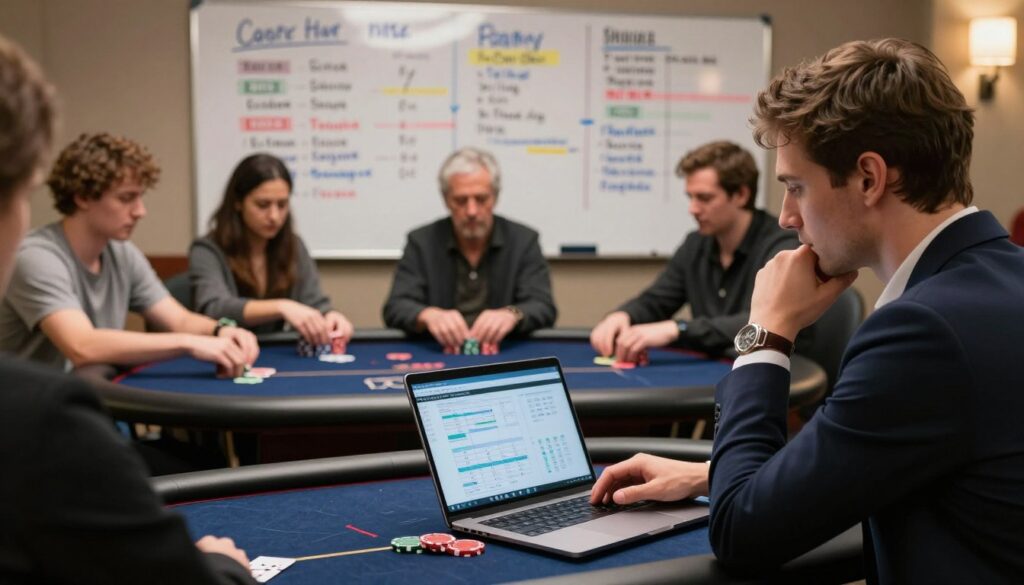
The 70/30 Rule: Prioritizing Practice Over Passive Consumption
A simple guideline can transform your approach. Allocate roughly 70% of your study time to active practice. Reserve the remaining 30% for consuming theory.
This ratio prioritizes doing over watching. It forces you to engage deeply with the material.
Theory involves consuming educational content. This includes instructional videos, strategy books, and forum articles.
These resources introduce new concepts and frameworks. They are essential for expanding your strategic vocabulary.
Practice is where the real learning happens. It encompasses activities like:
- Analyzing your own hand histories for mistakes.
- Running simulations with solver software.
- Playing focused sessions with specific implementation goals.
Active application internalizes knowledge. It builds the neural pathways needed for quick, accurate decisions at the table.
A major pitfall is learning without application. Many players watch hours of content but never test the ideas.
This leads to stagnation and frustration. The information remains theoretical, never becoming part of your toolkit.
To avoid this, schedule theory and practice back-to-back. Learn a new concept, then immediately apply it.
For example, watch a video on 3-bet bluffing ranges. Then, review hands where you faced a 3-bet. Identify spots where a bluff would have been profitable.
This creates a powerful feedback loop. Practice solidifies theory and reveals gaps in your understanding.
Use tools like GTO trainers to practice risk-free. Many sites offer play-money tables or simulation software.
These environments allow for experimentation. You can make mistakes without financial consequences.
This balanced approach accelerates skill development. It turns abstract knowledge into concrete, profitable habits.
Your growth becomes consistent and measurable. You’ll see faster progress in your actual games.
Step 8: Make Hand Review and Analysis a Core Habit
One activity consistently separates perpetual learners from genuine improvers: systematic hand review. Your recorded decisions are a goldmine for strategic growth.
Regular examination of your play is a cornerstone of improvement. It allows you to learn from both mistakes and successes in equal measure.
This habit transforms random experience into deliberate learning. It is one of the most effective ways to elevate your game.
Developing a Systematic Process for Reviewing Your Sessions
Consistency is vital. Develop a clear process you follow after each playing session.
Set aside dedicated time, even just twenty minutes. Review key hands while your memory is fresh.
Use hand history tracking software for easy access. Focus on spots where you felt uncertain, lost big pots, or made significant decisions.
| Review Step | Primary Action | Strategic Purpose |
|---|---|---|
| 1. Hand Selection | Filter for large pots, all-in decisions, and moments of confusion. | Prioritizes high-impact situations for maximum learning value. |
| 2. Context Reconstruction | Note your thought process, bet sizing, position, and opponent tendencies. | Recreates the in-game scenario to evaluate decision quality. |
| 3. Equity & Odds Check | Use software to calculate pot odds and your hand’s equity at key points. | Adds a mathematical layer to validate or challenge your instincts. |
| 4. Alternative Line Exploration | Ask “What if?” Consider different bet sizes, checks, or folds. | Expands your strategic options for future similar spots. |
| 5. Categorization & Filing | Tag hands by topic (e.g., bluff spots, value betting, fold decisions). | Identifies patterns and recurring weaknesses needing focused work. |
Honestly note your reasoning during the hand. Evaluate the quality of your choices regardless of the outcome.
Avoid results-oriented thinking. A good fold that got lucky is still a good fold.
Reviewing professional hands provides expert insight. See how top players approach similar situations.
Categorizing hands by topic helps identify your weak areas. You might discover a leak in certain preflop ranges.
This systematic approach turns review into targeted training. It builds your hand reading and decision-making skills.
Making this a habitual part of your routine ensures steady progress. Your overall strategy will become sharper and more robust.
Step 9: Strengthen Your Mental Game and Table Discipline
The final barrier separating competent competitors from elite performers is often psychological. Technical skills alone are insufficient for long-term success in cards.
Your mental game encompasses tilt control, emotional regulation, focus, and patience. These soft skills directly impact every decision you make under pressure.
Confidence and composure are just as critical as knowing your ranges. They determine whether you execute your strategy flawlessly or crumble after a setback.
Common mental leaks are costly. Going on tilt after a bad beat can erase hours of profit. Playing while distracted leads to poor decisions.
Lacking the discipline to stick to a proven plan is another major leak. Impulsive plays often follow emotional triggers.
Incorporate mental goals into your study routine. Dedicate time to this crucial area of your development.
Your objectives might include practicing mindfulness for five minutes daily. Developing a consistent pre-session routine is another powerful goal.
Studying resources on poker psychology is valuable work. This learning builds your emotional toolkit.
Effective tilt management requires specific techniques. Taking a short break after a tough loss is essential. Using a stop-loss limit protects your bankroll.
Reframe losses as paid training opportunities. This mindset shift reduces frustration and promotes growth.
Table discipline is a non-negotiable component. It means adhering to strict bankroll management rules. Avoid chasing losses or playing outside your designated stakes.
Maintain a professional attitude during all sessions. Treat every game with respect, regardless of short-term results.
Self-reflection after each play session is powerful. Assess your mental state and identify triggers for poor choices.
Keep a simple journal to track your progress. Note what caused frustration or loss of focus. This habit provides clarity for future games.
Strengthening your mental game and discipline leads to more consistent play. You will make better, more objective decisions at the table.
This resilience is your armor against variance. It transforms you from a skilled player into a formidable poker player capable of sustained success.
Step 10: Avoid Common Poker Study Pitfalls and Plateaus
Skill development often plateaus not from a lack of trying, but from repeating subtle mistakes. Recognizing these common traps is essential for maintaining momentum in your training.
Awareness allows you to steer clear of behaviors that waste time and stifle progress. This step outlines major pitfalls and provides actionable solutions.
Information Overload and Lack of Focus
Many enthusiasts consume too much material at once. They jump between advanced videos, forum articles, and solver outputs without a clear focus.
This leads to cognitive overwhelm and poor retention. Your brain cannot deeply process multiple complex topics simultaneously.
The solution is disciplined focus. Select one specific concept for each study cycle. For example, dedicate a week to mastering 3-bet ranges from the blinds.
Implement a “learn, apply, review” loop. First, learn the theory from a trusted resource. Then, apply it during dedicated practice sessions.
Finally, review your hand histories to assess performance. This cycle ensures mastery before moving to the next topic.
Failing to Apply Learned Concepts at the Tables
Theoretical knowledge alone does not improve your game. A major pitfall is understanding a strategy but never using it in actual play.
This gap between knowledge and execution halts real improvement. Your skills remain theoretical rather than instinctive.
Bridge this gap with intentional application goals. Before a session, set a specific goal like “apply a balanced c-bet strategy on dry flops.”
Focus your mental energy on executing this single concept. Afterward, analyze hands to see where you succeeded or deviated.
Use training applications for risk-free practice. Tools like decision simulators let you rehearse spots repeatedly. This builds the neural pathways needed for live decisions.
Neglecting Regular Review and Progress Tracking
Insights fade quickly if not documented. Another common error is studying hard but never reviewing what was learned or tracking progress.
Without reflection, the same leaks persist. You might forget key lessons from last month’s work.
Schedule a weekly reflection session. Use just twenty minutes to ask yourself key questions. What did I study this week? What went well in my games?
What specific areas still need work? Maintain a simple study journal to log these answers.
This habit creates a tangible record of your growth. It also highlights recurring weaknesses that need a changed approach.
Shift your mindset from short-term results to long-term process. Obsessing over daily wins or losses causes frustration and poor decisions.
Evaluate your play based on decision quality, not the pot outcome. A well-timed fold is correct, even if the opponent showed a bluff.
| Common Pitfall | Description | Proactive Solution |
|---|---|---|
| Information Overload | Trying to learn too many topics at once, leading to overwhelm and shallow understanding. | Focus on one concept per cycle. Use the “learn, apply, review” method to achieve mastery. |
| Failing to Apply Concepts | Theoretical knowledge doesn’t translate to improved skills at the table due to lack of intentional practice. | Set specific in-game application goals for each session. Use simulator tools for deliberate training. |
| Obsessing Over Short-Term Results | Frustration from variance causes deviation from sound strategy and emotional tilt. | Adopt a process-oriented mindset. Judge decisions on quality, not immediate wins or losses. |
| Neglecting Review & Tracking | Insights are forgotten, and progress becomes unmeasurable, allowing leaks to persist. | Schedule a weekly reflection. Keep a study journal to document insights and track improvement over time. |
Implementing these proactive strategies keeps your study routine effective. It prevents the stagnation that traps many players.
Continuous learning requires not just adding new knowledge, but also refining your approach. Avoid these pitfalls to ensure every hour of poker study moves you forward.
Conclusion: Committing to Continuous Improvement
Elevating your card game necessitates transforming sporadic effort into consistent, focused work. This guide outlined essential steps from self-assessment to mental discipline.
A structured study routine maximizes your return on invested time. It transforms random hours into productive learning. Consistency in deliberate practice matters more than intense but sporadic sessions.
Reflect on your current strategic approaches. Identify one specific area for immediate improvement. Craft your personalized plan and commit for at least one week.
You will notice increased clarity and confidence at the table. The journey of continuous improvement never concludes. Your plan should evolve as your strategic skill grows.
With dedicated commitment to this process, any player can achieve lasting success. Sharpening strategic decisions through regular review of hand histories is crucial for mastering advanced poker strategy.
Leave a Reply